




Obama team faces tough questions on Afghan strategy
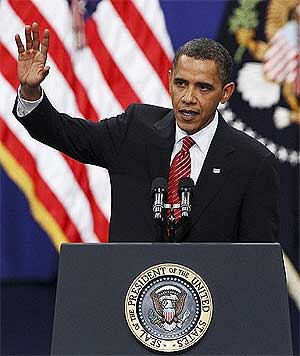
Top US officials renewed their defense of President Barack Obama's strategy in Afghanistan on Thursday as skeptical lawmakers questioned the costly mission and a July 2011 date to start an American withdrawal.
The president's plan to surge 30,000 troops to battle Afghan insurgents met with criticism from the both the right and the left, with Republicans opposed to a timeline for a pull-out and Obama's fellow Democrats anxious about sending yet more forces to fight for a corruption-plagued government in Kabul.
Top US officials renewed their defense of President Barack Obama's strategy in Afghanistan on Thursday as skeptical lawmakers questioned the costly mission and a July 2011 date to start an American withdrawal.
The president's plan to surge 30,000 troops to battle Afghan insurgents met with criticism from the both the right and the left, with Republicans opposed to a timeline for a pull-out and Obama's fellow Democrats anxious about sending yet more forces to fight for a corruption-plagued government in Kabul.
"I do not support the decision to prolong and expand a risky and unsustainable strategy in the region," Senator Russ Feingold, a Democrat from Wisconsin, told Obama's top deputies.
 "I do not believe more American lives should be risked for a war that no longer serves our most pressing national security interests," said Feingold, who warned that the war would drain resources needed to combat Al-Qaeda elsewhere.
In the second straight day of congressional hearings after Obama announced his plan, Defense Secretary Robert Gates, Secretary of State Hillary Clinton and top military officer Admiral Mike Mullen argued that the Taliban were colluding with Al-Qaeda and that the troop buildup was vital to breaking the insurgents' momentum.
Gates said the US surge could eventually rise to 33,000, as Obama had granted the defense chief authority to send up to 3,000 medics, intelligence analysts, bomb disposal specialists and other support troops to safeguard American combat forces.
With about 70,000 US troops already in Afghanistan, Obama's buildup will bring the number of American forces to more than 100,000 by the end of the summer.
Made a difference
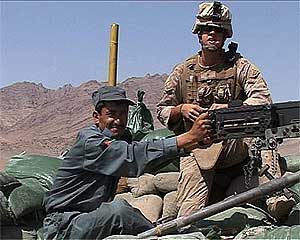
US Marines and Army troops sent in earlier this year by Obama had already made a difference but reinforcements were needed to protect towns and villages from the Taliban, Gates said.
"Fundamentally, where the troops have arrived, the situation has stabilized and in some cases gotten better," he said, citing Marines in the southern Helmand province.
In a tense exchange, Senator Robert Menendez demanded to know if the administration could promise that tens of thousands of troops would not still be in Afghanistan after July 2011.
Clinton would not answer the question directly and Menendez castigated the target date for the beginning of a handover to Afghan security forces.
"So when I hear these dates, I believe they are as solid as quicksand -- and are at best aspirational," the Democrat said.
 Republicans, however, worried that setting the 2011 date signaled a retreat to the enemy and to allies, particularly Pakistan.
"We really need to be clear on this," Senator James Risch said.
"Because the enemy is going to take their calendar out, they're going to circle July of 2011, and say, 'well, you know, just like America, we're going to reevaluate at that point whether we're going to step down until then and gear up at that point,'" he said.
Pakistan, Afghanistan's neighbor fighting its own battle against Islamist insurgents, has withheld backing for the US strategy with analysts warning that a premature exit of US troops could destabilize the nuclear-armed nation.
Pakistan media voiced dismay over talk of a withdrawal date, worrying it would embolden the Taliban.
Measure progress
An influential senior Democrat meanwhile expressed deep concern Wednesday about the surge and predicted Congress would seek to impose conditions to define the mission and measure progress.
"We'll definitely put benchmarks. We have got to be able to see what kind of progress will be made," Representative John Murtha, an ally of Democratic House Speaker Nancy Pelosi, told reporters.
The benchmarks would answer "how do we measure the goal? How is the Afghan army doing, what's the electricity production, if they changed the poppy field from poppy to agriculture?" said Murtha, who chairs the House Appropriations Committee that focuses on military spending.
"I get a fairly optimistic position from the people on the ground. They say we can do this. And maybe they can," he said.
"But I want to see -- before we start funding -- I want to convince myself and the subcommittee that we really have something we can achieve," he said.
-AFP


