




Russia ends freeze in ties with Ukraine after election
Russian President Dmitry Medvedev said on Tuesday his country would end a freeze in ties with Ukraine, a move that follows the election defeat of the ex-Soviet republic's pro-Western president.
The announcement that Russia would send an ambassador to the neighbouring country after a five-month freeze came after two candidates viewed as friendly to Moscow finished on top in Sunday's vote.
Russian President Dmitry Medvedev said on Tuesday his country would end a freeze in ties with Ukraine, a move that follows the election defeat of the ex-Soviet republic's pro-Western president.
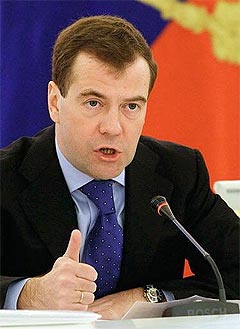 The announcement that Russia would send an ambassador to the neighbouring country after a five-month freeze came after two candidates viewed as friendly to Moscow finished on top in Sunday's vote.
The election marked a sharp turnaround for Ukraine, which had set out on a defiant course for European Union and NATO integration after the Orange Revolution of 2004.
"I think you should begin your duties as ambassador to Ukraine and try to do the utmost to strengthen the friendly character of our countries' relations," Medvedev was quoted as saying by Russian news agencies at a meeting with ambassador appointee Mikhail Zurabov.
Medvedev appointed Zurabov ambassador to the Ukraine last year but announced in August that he would not send him to Kiev in protest against the "anti-Russian" policies of Ukrainian President Viktor Yushchenko.
Yushchenko's re-election bid failed miserably in Sunday's presidential polls as voters gave him a humiliating fifth-place finish.
Final, official results released late Tuesday gave him just 5.45 percent of the votes.
'Pro-Russia' candidates on top
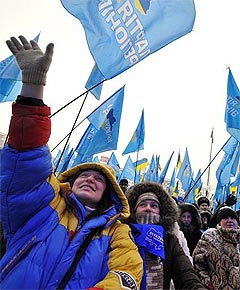
Two candidates viewed as friendly to Moscow, pro-Russia politician Viktor Yanukovich and Prime Minister Yulia Tymoshenko, took 35 percent and 25 percent respectively and are now set to compete in a February 7 run-off.
Third place went to businessman Sergiy Tigipko, with 13 percent, while former foreign minister Aresniy Yatseniuk took seven percent, Ukraine's Central Election Commission announced.
Medvedev said he hope the election would "lead to a capable, effective government, oriented towards the development of constructive, friendly and multidimensional relations with Russia."
Yushchenko came to power in the Orange Revolution pledging democratic reform and membership in the European Union.
He angered Moscow by seeking to bring Ukraine into the NATO military alliance, supporting Russia's foe Georgia and campaigning for a Stalin-era famine that killed millions of Ukrainians to be classified as genocide.
And on Sunday voters punished him for failing to bring about the promised reforms and extracting Ukraine from a deep economic crisis.
Need to 'build relations'
Russian Foreign Minister Sergei Lavrov also indicated Moscow's pleasure at Yushchenko's departure from power.
"Regarding the prospects of Russian-Ukrainian relations, we have always been against approaches that are politicised, artificial and have nothing in common with the interests of the Ukrainian people," Lavrov said.
 "We hope the new president, whose name we will most likely find out on February 7, will fully understand the need to build relations in this manner and not hold them hostage to his or her ambitions," he told reporters.
The dismal relations between Moscow and Kiev contributed to the gas crisis of January 2008 where supplies of Russian natural gas to the European Union passing through Ukraine's pipelines were cut off in the middle of winter.
Analysts said Medvedev's decision to send an ambassador to Kiev immediately after Sunday's election showed Russia's readiness to cooperate with either of the possible winners of the run-off.
"Moscow has sent a signal that either one candidate or the other would be welcome," said Yevgeny Volk, head of Moscow office of the Washington-based Heritage Foundation.
"The relations between Medvedev and Yushchenko had turned into a personal confrontation," said Nikolai Petrov, a political analyst at the Carnegie Moscow Centre.
"Since (Yushchenko) is about to leave, Russia is showing that there are no more obstacles to normal relations and is swiftly sending its ambassador."
- AFP


Are you sure you want to delete this comment?
This action cannot be undone.