




Search for victims, answers in Lebanon plane crash
Officials on Tuesday sought to determine why an Ethiopian airliner veered off course on takeoff from Beirut before crashing at sea, as rescuers searched for the black boxes and additional victims.
Transport Minister Ghazi Aridi told AFP the pilot of the ill-fated plane had initially acknowledged control tower instructions before the jet suddenly went off in a different direction.
Officials on Tuesday sought to determine why an Ethiopian airliner veered off course on takeoff from Beirut before crashing at sea, as rescuers searched for the black boxes and additional victims.
Transport Minister Ghazi Aridi told AFP the pilot of the ill-fated plane had initially acknowledged control tower instructions before the jet suddenly went off in a different direction.
 "He rogered instructions to go in one direction but then the plane deviated and when the control tower tried to reach him they lost contact," he said.
Aridi said the search on Tuesday was concentrated in a 35-square-kilometre (13.5-square-mile) area off the coast just south of Beirut's airport.
"There are no answers until we find the black boxes," he said.
Ethiopian Airlines Flight 409 tumbled in a ball of fire into the Mediterranean early Monday just minutes after takeoff in stormy weather.
The Boeing 737-800 bound for Addis Ababa had 90 passengers and crew on board. All are presumed dead.
Foul play ruled out
Lebanese officials have ruled out foul play and said the bad weather was likely to blame.
Experts have said extreme turbulence or wind shear may have caused the pilot to lose control of the plane, which apparently exploded before crashing.
 Captain Habib Karam, the former head of the pilots' union for Lebanon's national carrier Middle East Airlines, said the pilot probably flew straight into cumulonimbus thunder clouds which would cause him to lose control of the plane.
"If a pilot flies into this type of cloud, it's over," he said.
Ethiopian Airlines said its pilot had 20 years of experience and was familiar with the aircraft.
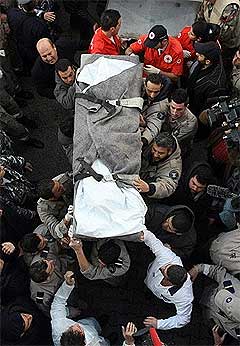
Health Minister Mohamed Jawad Khalifeh said 14 bodies and some body parts had been recovered so far by an international task force including ships from the United Nations Interim Force in Lebanon (UNIFIL), a US navy destroyer as well as aircraft from France and Britain.
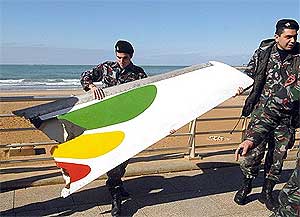
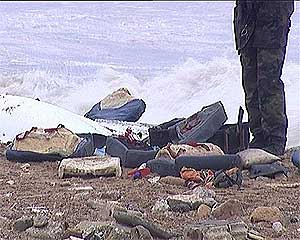
The army said debris from the plane, including part of the left wing, had washed up on shore.
No hope of finding survivors
A senior Lebanese security official said authorities were relying on the USS Ramage , which has specialised sonar equipment, to locate the flight recorders and pieces of the plane.
"We also have divers and we are using specialised equipment that can go down as deep as 200 to 300 metres," he said, speaking on condition of anonymity.
Washington and France have also sent experts to assist the Lebanese government in its probe.
Officials said there was virtually no hope of finding any survivors given the time that had elapsed, and were pinning their hope on the black boxes to provide answers to the tragedy.
 Witnesses reported seeing a ball of fire as the plane plunged into the Mediterranean at 2:37 am (0037 GMT) just south of the airport.
The 83 passengers comprised 54 Lebanese nationals, 23 Ethiopians, one French, one British, one Iraqi, one Syrian, one Turkish and another of as yet undetermined nationality. There were seven Ethiopian crew members.
The French passenger was identified as Marla Sanchez Pietton, wife of France's ambassador to Lebanon.
Khalifeh said authorities in Addis Ababa were sending DNA samples from families of the Ethiopian passengers to assist in identifying the victims.
Lebanon's cabinet was holding a meeting Tuesday evening with the crash topping the agenda.
Ethiopian Airlines, which was established in 1946 and operates an all-Boeing fleet, is considered one of Africa's best carriers.
The airline had not been involved in a major accident since 1996, when a Nairobi-bound jet was hijacked by three Ethiopians seeking political asylum.
The aircraft crashed into the Indian Ocean off the Comoros when it ran out of fuel, killing 125 of the 175 people on board.
- AFP


Are you sure you want to delete this comment?
This action cannot be undone.