




Basque leader jailed for 'glorifying terrorism'
A Spanish court on Tuesday sentenced a leader of the banned Basque separatist party Batasuna to two years in jail after convicting him on charges of glorifying terrorism.
The High Court also barred Arnaldo Otegi, the former spokesman for Batasuna, the political wing of the armed separatist group ETA, from holding public office for 16 years.
A Spanish court on Tuesday sentenced a leader of the banned Basque separatist party Batasuna to two years in jail after convicting him on charges of glorifying terrorism.
The High Court also barred Arnaldo Otegi, the former spokesman for Batasuna, the political wing of the armed separatist group ETA, from holding public office for 16 years.
Otegi, 51, went on trial last month over his presence and speech at a 2005 tribute in the Basque region to a jailed ETA member, Jose Maria Sagarduy.
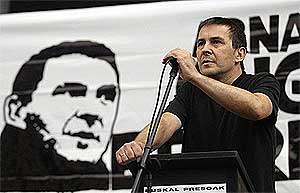 During the event Otegi said the Basque region had achieved greater powers for its regional government thanks to the efforts of "Basque political prisoners and refugees and many companions who we have lost in our struggle".
He also compared Sagarduy to former South African president Nelson Mandela, a Nobel peace laureate.
His lawyers had argued that he was exercising his right to free speech but the court ruled that the comments "constitute without a doubt the crime of glorifying terrorism."
Otegi was released from jail in August 2008 after spending just over a year behind bars after being convicted on similar charges.
He has been held in custody since he was arrested in October 2009 along with seven other people on charges of seeking to rebuild Batasuna under the guise of a new organisation called Bateragune.
Hard line stance against ETA
Batasuna was outlawed in 2003 for its links with ETA, which is held responsible for 828 deaths in a 41-year campaign for independence for the Basque region of northern Spain and southwestern France.
Prime Minister Jose Luis Rodriguez Zapatero's government has adopted a hard line against ETA since the group officially called off a 15-month-old ceasefire in June 2007, detaining dozens of suspected members of the group and of Batasuna.
Police detained Otegi in the Basque region as he was about to give a news conference just three days after ETA called off its unilateral ceasefire due to what it said was a lack of concessions by the government in their tentative peace talks.
His arrest followed a Supreme Court ruling confirming a 15-month prison sentence against him for glorifying terrorism for praising veteran ETA leader Jose Miguel Benaran Ordenana at a memorial service in December 2003.
During ETA's ceasefire Otegi was a self-proclaimed mediator in the talks with Zapatero's government, which has since ruled out any further negotiations with the outfit.
He faces two more legal cases.
Public prosecutors are seeking a 14-year jail term against Otegi related to Batasuna's alleged financing of ETA and its activities.
He also faces a trial for glorying terrorism and holding an illegal meeting related to a Batasuna gathering held in November 2004 at the Anoeta stadium in the Basque city of San Sebastian.
EU rights court backing
In March 2009 the European Court of Human Rights upheld Spain's decision to ban Batasuna, rejecting its petitions that its rights to freedom of association and expression had been violated.
A series of similar separatist parties have sought to replace Batasuna but Spanish courts have since banned them as well.
ETA figures on the terrorist blacklists of both the European Union and the United States.
Otegi's conviction came two days after French police arrested ETA's suspected military chief, Ibon Gogeascoechea Arronategui, and two others.
He is the fifth suspected leader of the armed Basque separatist group to be captured in two years.
- AFP


Are you sure you want to delete this comment?
This action cannot be undone.