




Defiant US lawmakers pass Armenia 'genocide' bill
US lawmakers voted Thursday to brand the killing of Armenians by Ottoman forces during World War I a "genocide," drawing a sharp response from Turkey which immediately recalled its ambassador.
Despite strong opposition from Turkey and the White House, the House Foreign Affairs Committee passed the symbolic resolution, albeit by the slimmest 23-22 margin, and set the stage for a full vote in the House of Representatives.
US lawmakers voted Thursday to brand the killing of Armenians by Ottoman forces during World War I a "genocide," drawing a sharp response from Turkey which immediately recalled its ambassador.
Despite strong opposition from Turkey and the White House, the House Foreign Affairs Committee passed the symbolic resolution, albeit by the slimmest 23-22 margin, and set the stage for a full vote in the House of Representatives.
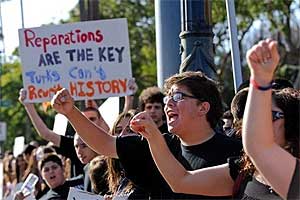 The Turkish government, which had sent its own lawmakers to Washington to lobby US congressmen and had warned of serious repercussions, responded by recalling its ambassador Namik Tan from the United States for consultations.
"We condemn this resolution which accuses the Turkish nation of a crime it has not committed," it said in a statement.
The outcome of the vote, it said, demonstrates "a lack of strategic vision" among US lawmakers at a time when Turkey and the United States "are working together on a broad common agenda.
"We are seriously concerned that this bill... will harm Turkish-US relations and impede efforts aimed at normalizing Turkish-Armenian ties."
Non-binding resolution
The non-binding resolution calls on President Barack Obama to ensure that US foreign policy reflects an understanding of the "genocide" and to label the mass killings as such in his annual statement on the issue.
Armenians say up to 1.5 million of their kin were killed during World War I by their Ottoman rulers as the empire was falling apart, a claim supported by several other countries.
Turkey argues 300,000-500,000 Armenians and at least as many Turks died in what was a civil strife when Armenians rose up for independence and sided with invading Russian troops.
The United States has traditionally condemned the 1915-1918 killings, but refrained from calling them a "genocide," anxious not to strain relations with Turkey, a NATO member and a key Muslim majority ally in the Middle East.
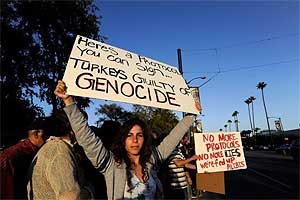 US Secretary of State Hillary Clinton had urged the committee not to press ahead with the vote for fear it might harm reconciliation moves between Armenia and Turkey and said she hoped the bid would progress no further.
"We do not believe the full Congress will or should act on that resolution," Clinton told reporters in Costa Rica.
Following US-backed bridge-building talks, Turkey and Armenia signed a deal in October to establish diplomatic relations and open their border.
But the process has already hit the rocks, with Ankara accusing Yerevan of trying to tweak the terms of the deal and Yerevan charging that Ankara is not committed to ratifying the accord.
Clinton, who had called committee chairman Howard Berman on Wednesday to try to persuade him to shelve the vote, defended an apparent U-turn on the matter by the president.
Pledged during his campaign
Obama pledged during his campaign that he would recognize the events as genocide, but disappointed Armenian-American supporters when he refrained from using the term in his message last year to commemorate the killings.
"The circumstances have changed in very significant ways." Clinton said, explaining that it became clear after the administration took office that the reconciliation process was a "very worthy one that we intended to support.
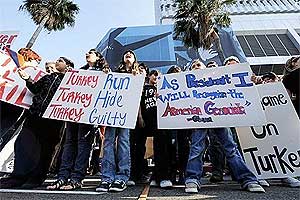 "I do not think it is for any other country to determine how two countries resolve matters between them to the extent that actions that the United States might take could disrupt this process."
Turkish President Abdullah Gul called Obama on the eve of the vote to discuss "issues concerning bilateral ties and regional affairs," a presidential aide told AFP, without elaborating.
In his opening remarks Thursday, Berman, the Democratic chairman of the Foreign Affairs Committee, said "nothing justifies Turkey's turning a blind eye to the reality of the Armenian genocide.
"At some point, every nation must come to terms with its own history. And that is all we ask of Turkey," he said, urging his fellow lawmakers to support the legislation.
Ankara also recalled its envoy from Washington in 2007 when the committee passed a similar text.
But then-president George W. Bush stopped the resolution from going to the full House, wary over reports that Ankara would block US access to a key air base essential for Iraq and Afghanistan operations.
-AFP


Are you sure you want to delete this comment?
This action cannot be undone.