




Islamist attack on Somali presidency kills 14 civilians
Somalia's Islamist insurgents launched a deadly attack on the presidential palace in Mogadishu even as the embattled president sought to drum up support at an international conference in Turkey.
At least 14 civilians were killed, dozens wounded and hundreds displaced by the fierce overnight fighting, officials and witnesses said Sunday.
Somalia's Islamist insurgents launched a deadly attack on the presidential palace in Mogadishu even as the embattled president sought to drum up support at an international conference in Turkey.
At least 14 civilians were killed, dozens wounded and hundreds displaced by the fierce overnight fighting, officials and witnesses said Sunday.
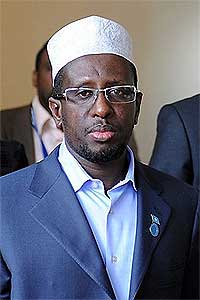 Rebels from the Al Qaeda-inspired Shebab group fired salvos of mortar rounds and closed in on the presidential area even as the world was pledging renewed support to Somali President Sharif Sheikh (
left)
Ahmed in Istanbul.
Rebels from the Al Qaeda-inspired Shebab group fired salvos of mortar rounds and closed in on the presidential area even as the world was pledging renewed support to Somali President Sharif Sheikh (
left)
Ahmed in Istanbul.
African Union troops stopped the insurgent advance and defended the shrivelled seaside perimetre housing Sharif's embattled government. The fighting had stopped by mid-afternoon.
"The number of civilians killed during the clashes overnight has reached 11 and it could be higher, because... militants using mortars attacked several other positions in southern Mogadishu," Mohamed Ali Idle, a Somali government security official, told AFP.
The victims included five members of the same family who were killed when a mortar shell smashed into their home, several witnesses told AFP.
At least three more civilians were killed in an exchange of mortar fire in the southern neighbourhoods of Holwadag and Black Sea, Ali Muse, head of Mogadishu's ambulance services told AFP, bringing the death toll to 14.
The Shebab offensive began when rebel units moved down from their bastions towards Kilometre Zero, a strategic crossroads leading towards the port and the presidential compound, according to witnesses and officials.
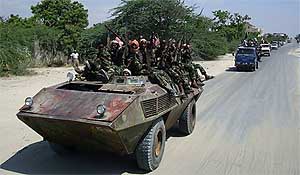 Major Ba-Hoku Barigye, spokesman for the African Union mission in Somalia (AMISOM), said the Shebab's progress required immediate action.
"People need to understand what our mandate is. We are here to protect the transitional federal institutions of Somalia and we also have red lines," he said.
This year alone hundreds of civilians have died in the crossfire as a result of both insurgent attacks and retaliatory fire by African Union or government forces.
Thousands have been killed in such incidents over the past three years and hundreds of thousands have been forced out of the city into crowded camps.
Residents and officials said hundreds of families were fleeing the worst-hit neighbourhoods on Sunday.
"Nobody can endure the heavy artillery and mortar shelling ravaging our neighbourhood. Many civilians have died already and if we don't leave, we'll just join the list of those killed in the crossfire," said Dahir Abdullahi Farey, a Shibis resident.
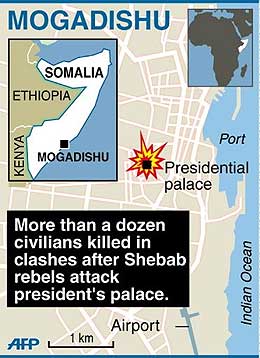 The Shebab, whose leaders have proclaimed their allegiance to Al-Qaeda chief Osama bin Laden, control most of southern and central Somalia but have failed to reach the well-protected presidential compound and topple Sharif.
The movement's top spokesman, Sheikh Ali Mohamoud Rage, claimed at a press briefing Sunday that Shebab fighters had killed dozens of government forces.
"Our fighters attacked several positions controlled by the apostate government soldiers. We killed dozens of them and took control of their barracks overnight," he said.
Another Shebab commander, Sheikh Mohamed Ibrahim, told AFP his forces were encircling government forces and expected to press on with their offensive on the presidential palace.
Although the security situation in Mogadishu - one of the world's most dangerous cities - made it difficult to obtain an independent assessment of the military situation, the insurgents appeared to have made some gains.
Sharif, a young moderate Islamist cleric, was elected in January 2009 but has since failed to assert his authority on the troubled Horn of Africa nation and to prevent the expansion of the Shebab.
The Somali president, who is also facing dissent within his own government, was in Istanbul for an international conference aimed at bolstering support for his transitional institutions and drafting a roadmap to peace.
On the opening day of the conference Saturday, UN Secretary General Ban Ki-moon told delegates from 55 nations that "the only way to restore stability is to support this government in its reconciliation effort and its fight against extremism."
Sharif was due to leave Turkey Sunday and fly back to Mogadishu.
- AFP


