




Cool mature head vs cow heads
Selangor Menteri Besar Khalid Ibrahim has once again shown himself to be the kind of mature and even-keeled leader Malaysians desperately need.
This is no mean feat, given that he's in charge of a state floundering in rough political and communal seas, magnified by an inflammatory arm of the mainstream media and a prime minister who has gone on the record to say that he wants Selangor, the jewel in Malaysia's crown, back in Barisan National's fold.
And that he'll do whatever it takes to get it.
Selangor Menteri Besar Khalid Ibrahim has once again shown himself to be the kind of mature and even-keeled leader Malaysians desperately need.
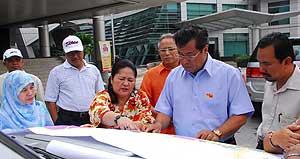 This is no mean feat, given that he's in charge of a state floundering in rough political and communal seas, magnified by an inflammatory arm of the mainstream media and a prime minister who has gone on the record to say that he wants Selangor, the jewel in Malaysia's crown, back in Barisan National's fold.
And that he'll do whatever it takes to get it.
Disrespect and discourtesy are never pretty, especially when presented mob-style in the recent Section 23 Hindu temple protest and public meeting, complete with racist overtones, profanities and threats of violence in order to achieve a group's aims.
What has alarmed Malaysians over a broad political, racial and religious spectrum is the manner in which a small but vocal group feels entitled to protest, and how they have been allowed to do so by the authorities.
These same authorities - police, the courts, the home minister - have not hesitated to crack down with the overkill of water canons, truncheons, court orders and arrests on other equally small yet far less "biadab" public protests, such as candlelit vigils for ISA detainees or black-clad mourners lamenting the "death of democracy".
It's interesting to compare two official responses to the cow-head protest of the unhappy and riled up residents of Section 23: Home Minister Hishammuddin Hussein's closed-door meeting with the protest organisers, and Khalid's public dialogue with a wider range of residents from both sides of the debate.
The home minister emerged from his private meeting with the cow-head protestors defending their action as that of voiceless "victims" who intended no harm and were ignorant of who brought the severed cow head as a "present" for state exco member Dr Xavier Jayakumar.
According to the minister, since a pig's severed head wrapped in an Umno flag had once - apparently - been used to insult Muslims, therefore a group of Muslims stepping and spitting on a cow's head (sacred to Hindus) is no big deal.
These remarks, rather than helping to calm an already inflamed situation - if that was the minister's intention - instead caused further upset and public outcry.
Now let's look at the alternative scenario. At the meeting convened to listen to dissatisfactions and possible solutions to the Hindu temple impasse, Khalid was shouted down by a few impassioned residents whose intention seemed not to dialogue but to disrupt dialogue.
Big gulf in response between MB and Home Minister
Video footage shows these people standing over others and hurling abuse at the MB and other speakers.
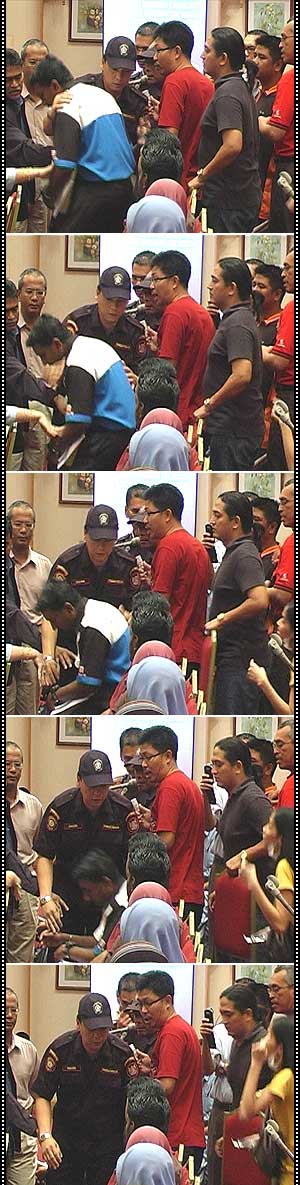 Some residents offered "traffic congestion", "crime" and "the smell" as reasons for their Muslim sensitivities being disturbed by the presence of a Hindu temple 300 metres from their homes.
Yet others proposed alternative sites and points of view.
After two hours of attempted dialogue amidst heckles and scuffles worthy of a schoolyard fracas, the MB decided to put the temple relocation on hold while the state government searched for "the best solution for all".
He was not disappointed by the boorish, disruptive behaviour of the few, saying "we understand (the residents' feelings)", and adding: "We should not be cowed by this group of people. Although this group will continue to be there ... we should not take this as a deterrent but as a challenge for us to prove them wrong".
A quick comparison between the home minister's and the Selangor MB's responses to the same problem shows us the gulf in mature leadership between the two.
Khalid behaves like a statesman, a leader who listens seriously to all Selangorians regardless of race, religion or partisanship.
He isn't flustered by a vocal, belligerent or powerful few.
Throughout his premiership of Selangor, it seems he has shown himself to be steadfastly open to input and criticism from various interest groups, while taking no offence from insulting and childish emotional outbursts.
Open meetings such as the Section 23 one, he insisted afterwards, are "essential for the state government to continue to have open communication with the people".
The home minister, on the other hand, meets in private with one side only, then emerges shooting from the hip to officially reinforce the protestors' arsenal of wishy-washy excuses for bad behaviour. "It wasn't me...", "I didn't intend to...", "Others have done it before..." all sound like the stammers of naughty children caught throwing stones.
Yet "why would we want to penalise anybody?" the minister disingenuously asks, thereby giving them - and any would-be copycat cow-head or pig-head protestors - his permission to throw stones.
Like a chastised child himself, he then goes back on his word within 48 hours, asking for "stern action" against his former protégés.
Following the leader's example
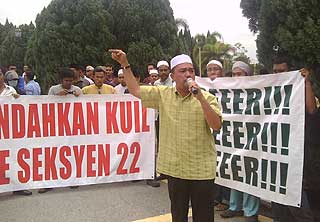 One of several protestors who placed their feet firmly on the severed cow head at the end of the infamous protest, Mahyuddin Manaf stressed in an interview on Malaysiakini.tv that "maybe they (the media) would mistakenly interpret today's action as ‘biadab' (rude or discourteous), but in reality it's these leaders who teach the people to be rude..." ("mungkin mereka [media] menyalah tafsir mengata tindakan hari ini biadab, tetapi sebenarnya pemimpin-pemimpin ini lah yang mengajar rakyat menjadi biadab...")
Mahyuddin goes on to blame Selangor's Pakatan Rakyat leaders for the "rude" behaviour of the protestors, for not listening to them.
It is not clear whether he's referring to the act of protesting as ‘biadab', or what was done to the cow head, or the fact that at least one protester openly threatened bloodshed if their demands were not met.
What is crystal clear is that Mahyuddin is right in one respect: it is our leaders who indeed teach the rakyat, by their words and actions, how to behave.
If our leaders lie and exonerate the art of lying, if they continue to elevate ‘cakap tak serupa bikin' as the surefire means to political and economic success, then so too will the rakyat.
If our leaders continue to indulge in or close one eye to corrupt practices, then so too will the rakyat.
If our leaders continue to make excuses for those who throw stones, uncaring about who gets hurt in the process, then so too will the rakyat throw stones and not care, as long as its gets them what they want.
Are protests in themselves ‘biadab'? To any advocate of true democracy they are not intrinsically so.
To mature and maturing regional democracies such as India, Thailand, South Korea - and the Selangor state government - protests are not biadab, even if some protesters are.
Lately even the home minister has proclaimed that "protests should be accepted in this world as people want their voices to be heard" (though, who knows, he may yet change his mind again in another few days).
Protests are a legitimate part of any democracy. The right to protest peacefully belongs to every citizen, and both Malay-majority and Hindu-minority residents of Section 23 are well within their rights to air their concerns and complaints about the siting of the Hindu temple in their area.
Shoot the messenger for the message
But the way in which such protests are conducted - and allowed to be conducted by authorities who enforce the law selectively - is what makes them ‘biadab', or otherwise.
Threatening violence and bloodshed, profaning a sacred religious symbol (even, or especially, if it's not yours) - these acts are indeed ‘biadab', and rightfully condemned by proponents of peaceful democratic protest.
 The civil right to protest does not give citizens the right - even if they comprise the majority - to allow hotheads to bully or threaten minorities.
Democracy is not a tool for the majority to bludgeon minorities into submission.
That method of getting what you want is called populism, which political philosopher John Keane warns is "an auto-immune disease of democracy". (Its antidote, he says, is "monitory democracy": the ongoing public scrutiny and public control of those in charge of making decisions, whether they are governments, institutions, businesses or civil society.)
Everyone wants to be popular, especially leaders.
Parties want to pull the most votes. These are the rules of democracy. Yet, to lead by resorting to populism is to let your emotional hotheads take charge of clearing the socio-political field of any alternative voices who might oppose your side.
As Keane points out in his book, ‘The Life and Death of Democracy', Hitler used this method with great efficacy in order to grab power, using an ostensibly democratic process.
He did so all the while proclaiming that the Aryan majority he represented were the "victims".
To get back to our ad hoc KPI testing of two Malaysian leaders, it is also interesting to note that despite the home minister's about-face warnings to those who "undermine the harmony, unity, national security and stability of this multiracial country", at the time of writing no "stern action" has been taken, except against the alternative media that posted video footage of the protest- another case of shooting the messenger while the perpetrators go scot free.
Needs of all taken into account
Only after dragging their feet in the wake of much public protest have the authorities announced today that concrete action will be taken against the protestors.
By comparison, as promised, Selangor's MB has considered the feelings and recommendations of both sides and come up with a solution to the temple relocation.
It may not please everyone, but it takes the overheated wind out of the sails of the Section 23 hothead majority while attempting to accommodate the needs and wishes of its minorities.
Is it not the case that the best democracies strive to look after the needs and wishes of all their citizens, the loudest and most belligerent as well as the most silenced and meek?
So, which kind of leader does Malaysia need?
One who only listens to one side, and whose stance and principles change like a weathervane, depending on where the populist winds of political fortune blow; or a mature and steadfast leader, who keeps a cool head focused on finding solutions to suit all legitimate parties, even while incendiary threats and insults fly?
I know which I'd choose.


Report this comment
Are you sure you want to delete this comment?
This action cannot be undone.