




COMMENT | New voting realities post-Malacca polls – Part 1
COMMENT | Malaccans have spoken – both those who voted and those who did not. The results are emphatically clear for different political coalitions/parties and their leaders.
BN, led by Umno, is in the political driving seat, along with its strategic partner Perikatan Nasional led by PAS, while Pakatan Harapan is in serious electoral retreat. Smaller parties such as Bersama and Bersatu did not even impact the Malacca results, suggesting serious challenges ahead for these parties.
This piece looks at major implications from voting behaviour in a preliminary analysis of the macro results using the methodology of ecological inference to determine estimates of voting. I also zero in on one seat to show how one DAP incumbent bucked a trend.
The focus is on results for parties from ethnic voting. The findings show clear changes in political fortunes. Part 2 will look at governance issues for Malacca. Part 3 will follow, looking at the results in more detail, including age cohort analysis and voter transferability, and examining how voting in Malacca and Malaysia is changing more broadly.
BN-PN’s (very) successful strategy
Let’s start with the big voting story. Malacca’s polls emphatically show that the strategic cooperation between Umno/BN and PAS/PN has delivered strongly for these coalitions. Based on these results, the political realignment will become the working foundation for these coalitions in the coming general election.

In Malacca, the BN-PN strategic partnership was even more effective than in Negeri Sembilan. BN-PN collectively captured an estimated 84 percent of the Malay vote in Malacca, the highest across the three state elections in Peninsular Malaysia this year.
While there is variation in seats, and among the coalition partners within the two main coalitions, Malay support for BN in Malacca effectively doubled – yes, doubled! Given these numbers, both BN and PN have found a working political formula accepted by the Malay electorate – for now.
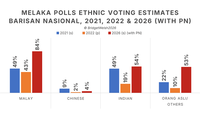
It has come at a cost for BN, as its support among Chinese has remained low, an estimated meagre four percent, less than half that of 2021 but higher than in 2022. There is variation among the seats, but working with PAS continues to alienate the Chinese ground, especially when it is being targeted by ethnic statements by PAS leaders.
Keep in mind, Malacca has been a place of ethnic political polarisation for many elections since 2008, but the preliminary analysis suggests it remains wide and is widening further.
By contrast, Indian support is more split, with BN-PN making gains among Indians compared to the two earlier elections, especially the 2022 parliament polls. A majority of Indians, an estimated 54 percent, supported BN-PN. This is in line with the gains in Johor and Negeri Sembilan, tied to the deep alienation from Harapan. Support also increased for BN-PN among Orang Asli and other communities.
Harapan’s Malay collapse
BN-PN’s fortunes have come with consequences for Anwar Ibrahim’s coalition; Harapan has lost support badly, with the parties of PKR and Amanah effectively no longer electorally competitive in mixed and Malay-majority seats.
Here the result in Bukit Katil, where the former Harapan chief minister Adly Zahari contested, is illustrative, where Amanah won only 35 percent of the vote, a decline of seven percent from the 2021 election.

The losses extend across the coalition. DAP suffered serious erosion of support in its four incumbent seats but held on despite a drop in the majority of 25 percent in Kota Laksamana, 20 percent in Kesidang, 11 percent in Bandar Hilir and 14 percent in Ayer Keroh.
To understand the Harapan losses, it is necessary to look at ethnic voting estimates and turnout.
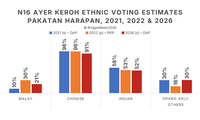
Estimated Malay support for Harapan shows a serious decline to a mere seven percent in Malacca, devastatingly low for a prime minister in a country where legitimacy is seen to be tied to Malay support. It has effectively halved. By comparison, Bersatu, which performed poorly overall, won a greater estimated share of nine percent of the Malay vote.
In contrast, Chinese support for Harapan among voters who voted effectively stayed the same at an estimated 95 percent. Indian support levels plummeted to an estimated 38 percent as did Orang Asli and others, at an estimated 46 percent.
The loss of support for Harapan crosses ethnic communities, coming on the back of similar patterns in other recent state polls. Harapan cannot escape the consistent pattern of electoral defeats.
The support of non-Malays, however, should be interpreted in combination with a significant turnout decline. It is important to caveat that state elections generally have lower turnout than a general election; thus, it is not surprising to see a drop of eight percent. Given that BN was expected to win, many voters also did not return as they did not see the impact of changing the result.
Yet, the ethnic variation in the turnout levels is telling. Malay turnout dropped marginally, an estimated three percent from 2022, while Chinese turnout dropped an estimated 11 percent, almost on par with the 2021 Covid-19 polls. Indian turnout dropped even more significantly, an estimated whopping 29 percent. Many more Chinese and Indians are choosing not to vote.
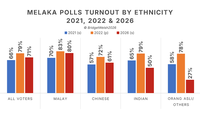
Harapan has traditionally had stronger non-Malay support – this is eroding as voters are choosing not to vote. Interviews with non-voting Malaccans reflected a common theme – a significant sense of disappointment in Harapan, ranging from treatment of communities among Indians, to positions taken on Najib Abdul Razak’s change to house arrest to a lack of meaningful reforms.
Others felt powerless to change voting trends and the overall result. The drop in turnout is not a new pattern but it is an integral part of why Harapan is losing electoral ground. It speaks to growing disenchantment among the electorate.
A look at ‘hot seat’ Ayer Keroh
To understand Harapan’s fortunes more holistically, it is useful to look at a seat that DAP maintained, the pivotal contest of Ayer Keroh led by a performing incumbent Kerk Chee Yee. Ayer Keroh has been a historic seat for the DAP, which won it in 2008, unseating the MCA in an area that had been their stronghold.

In this election, the majority effectively remained the same, at 5,604, down 20 votes, with the vote share slipping from 60 percent to 55 percent due to more voters in these polls.
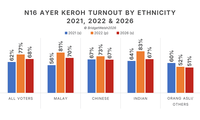
Ethnic voting patterns in Ayer Keroh did not change significantly. Malay vote dropped from when PKR contested the area in 2022 but was higher at an estimated 21 percent than in 2021, when the vote was a mere 10 percent. Chinese and Indian voter support modestly declined but remained at similar levels overall.
What mattered was the contest and turnout. Ayer Keroh was a contest where Gerakan contested for PN, with Michael Gan, without the same level of party standing and machinery as if BN or even PAS had contested.
The DAP held on due to its machinery, reducing the potential Chinese turnout drop to only an estimated six percent and the Indian turnout drop to an estimated 16 percent. Instead, Malay turnout dropped with levels an estimated 10 percent less than the state average for BN-PN contests.
DAP would have faced a more serious challenge if the main challenger had not been from the comparatively weaker Gerakan. Bersama managed to secure 7.6 percent of the vote in the seat but did not impact the overall outcome.
Ayer Keroh shows that some seats can buck the broader direction of change – a stronger candidate and weaker challengers in one of the party’s safest seats. Yet, even in Ayer Keroh, there is decline for Harapan in its traditional non-Malay base, as the coalition’s fortunes are changing even in its core seats.
For DAP, as for Harapan generally, the signs point to waning political fortunes as it made little headway in the seats where it was not an incumbent.
Small is small
The smaller parties who hoped Malacca would bring them a surprise and help strengthen their ground for the general election remained small. Bersatu, whose fortunes rose in Malacca in 2021, has been marginalised.
For Bersama, which secured 19,176 votes, or 3.9 percent of the popular vote, and managed only to hold onto its deposit in Bemban, where it secured 22.5 percent of the vote, the party faces hard questions about its future.

The party has failed to make a mark in two outings, despite having impressive hard-working professional candidates on the ground. Based on ground interviews, it remains unclear to voters what Bersama stands for, and how it is bersama (together) with the electorate, especially the electorate as a whole.
Malacca as a harbinger
The change in coalition fortunes points to a national trajectory that has gained momentum for BN-PN, and a loss of traction for Harapan.
For BN-PN, the main challenge ahead will be compromise over seats and expanding support for the cooperation nationally. This will not be easy in the seats where PAS holds supermajorities and in areas with a long-standing pattern of competition between PN and BN, such as Selangor.
BN’s electoral success has made it more of a target ahead, raising expectations as a general election approaches. BN faces its legacy issues, not least of which is that its electoral fortunes changed rapidly within six months in 2022. The Malacca results will inevitably increase internal pressures among parties within Anwar’s government.

For Harapan, the scramble for electoral survival continues, with another significant election decline. While Anwar did not campaign extensively in the Malacca campaign, Harapan’s electoral losses are inseparable from perceptions of his standing as prime minister.
Given the four election defeats in the past year since the Sabah November 2025 polls and the consistency in losses, the prime minister who did not win an electoral mandate on his own in 2022 now faces an even weaker mandate.
No question, Malacca’s result will amplify the clarion call for a general election and simultaneously push those in power to hold on tighter. Malacca’s results will become a test to see whose voices will be listened to.
BRIDGET WELSH is an honorary research associate of the University of Nottingham’s Asia Research Institute and a senior associate fellow at The Habibie Centre. Her writings can be found at bridgetwelsh.com. Her forthcoming book titled "Political Contestation in Modern Melaka" is expected to be published next year.
The views expressed here are those of the author/contributor and do not necessarily represent the views of Malaysiakini.





Not surprise the PM for Gaza lost badly and failed badly in the narrative of race N religion card with them...As PM should take care of economy, PM for all rise above the race N religion.. To counter the Malay unity narrative card, ask the voters why not vote Amanah N Bersatu Malay candidates ? Why vote for MCA, MIC N Gerakan candidates?
Report this comment
Are you sure you want to delete this comment?
This action cannot be undone.