




Lost and found
Sometimes, it is what you are willing to do for a friend that determines the quality of the friendship. One Kuala Lumpur lady, anxious about her missing schoolfriend, prompted a search that covered three countries and two continents. They were boarders in 1947 at Convent Light Street (CLS) Penang.
Sometimes, it is what you are willing to do for a friend that determines the quality of the friendship. One Kuala Lumpur lady, anxious about her missing schoolfriend, prompted a search that covered three countries and two continents. They were boarders in 1947 at Convent Light Street (CLS) Penang.
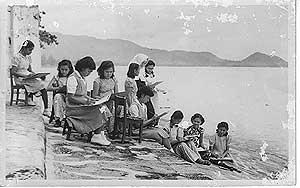 When the girls finished school and went their separate ways, their friendship waned as both pursued different interests. Despite life's interruptions, they managed to keep in touch until the mid-90s. After thirteen years of searching, Halijah and Joan finally met in Shakespeare country, Warwickshire, last weekend.
Halijah, now in her mid-70s, lost contact with 73 year-old Joan, and although it should have been easy enough to locate her, Halijah had no idea where Joan was. Christmas cards, letters or parcels were unanswered or ‘returned to sender'. Telephone calls were unsuccessful. Joan's disappearance was puzzling. She had been relatively healthy. Halijah refused to believe that Joan had died and so initiated the search.
We know that friendships forged at school endure. But children who attend boarding school share a special bond because of living together and sharing experiences. One study showed that most people meet their true friends at school (61 percent), whilst work and university only represents 48 percent and 27 percent, respectively.
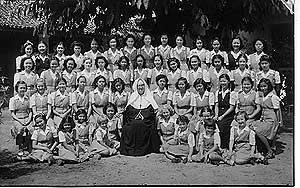 Convent Light Street, Penang, the oldest girls' school in South East Asia, was founded in 1852 by three French nuns from the Holy Infant Jesus Mission. The school was initially an attap hut but also became an orphanage when the Sisters took in unwanted babies. CLS was a boarding as well as day school. During the Second World War, the Japanese army commandeered CLS and American submariners from the USS Grenadier SS-210, damaged on 21 April, 1943 were tortured and imprisoned there.
When the war ended, schooling resumed at CLS. The boarders comprised the daughters of the expatriate community, the military, the upper crust of society, royal families and wealthy families from as far away as Thailand, Burma and Singapore. The halls, corridors and cloisters echoed with the chatter of girls from many nations and many faiths, who lived and studied under the watchful eye of the nuns.
Good friends
In 1947, Halijah and her two sisters enrolled as boarders. Joan was the daughter of an English planter from Chemor. They became good friends. Amongst their class mates were the Tunku's daughter and her cousin, the mother of the Raja Puan Besar Perak. Incidentally, there were 15 Malays in the dormitory of 60 boarders (the 1st boarders). The 2nd boarders were from poorer families.
Halijah's search for Joan took her to Teluk Intan, where Joan's half-brother owned a tyre shop. But he relocated to Kuala Lumpur and left no forwarding address. It was thought that Joan might have settled in Singapore, where she worked. Enquiries at Singapore Telekoms drew a blank.
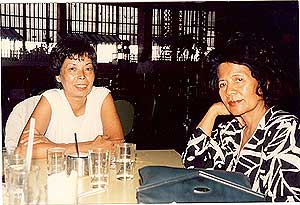 Eventually, the trail returned to Warwick where Joan
(left in white)
once worked in a hospital. The UK end of the enquiries was the most difficult because of strict data protection laws. After much correspondence and visits to the area and the council offices, Halijah's efforts finally looked promising.
Eventually, the trail returned to Warwick where Joan
(left in white)
once worked in a hospital. The UK end of the enquiries was the most difficult because of strict data protection laws. After much correspondence and visits to the area and the council offices, Halijah's efforts finally looked promising.
The two ladies met in a nursing home where Joan now resides. She is frail but has an active mind. She is unmarried and has no living family in England. The passing of time had not dimmed their affection and love for each other.
When Malaysia was formed, several expatriates found the laws on immigration and working permits, so prohibitive that they returned to their country of origin, although they considered Malaysia home. Joan's father was repatriated to England but her mother remained. There are similar sad tales of expatriate families being torn apart.
It was a poignant afternoon for these two ladies. They talked about their old schooldays and the strict nuns, of whom Sisters Francis de Sales, Rita and Fabian Butler, were their favourites.
The reunion
Joan's eyes lit up when talking about playing with red seeds under the ‘biji-saga' trees, at school. They recalled their daily routine of getting up, making their beds and going down to the communal baths - raised concrete troughs with scoops to ladle the water. There were no separate cubicles or hot and cold water-taps. They wore cotton shifts whilst soaping and rinsing themselves, and washing their smalls.
Menstruating girls had a separate bathing area. Then after performing their ablutions, all in complete silence, they trooped onto the rooftops to hang their washing before donning their school uniforms in the dressing room.
 They talked about boarders eating their simple breakfast, in the refectory in complete silence, supervised by the nun on duty, before going to class. Joan and Halijah shrieked with delight recalling how they smuggled bits of food they disliked, in their pockets or cotton hankies. They risked a hefty punishment if caught. Every bit of food had to be eaten - ‘waste not, want not' warned the nuns.
Every Sunday, whilst the Catholic girls went to chapel, the Malay girls would play or wait patiently in the hall for their friends' return. Afterwards, Joan and Halijah would endure an hour-long lecture by a nun, because they were always caught chatting during ‘prep' (homework).
These ladies sighed when relating their only opportunity at ‘seeing' boys - by standing on tip-toe to peep over the stone wall, at the boys from St. Xavier's Institution at play. During short school holidays, the nuns would take the boarders to the Tanjung Bungah beach house (near Springtide Restaurant) for a break. They slept on canvas beds, made bonfires and ate by the sea.
When asked what about her favourite food, Joan replied without hesitation - "belacan with rice and curry". Before Halijah said goodbye, Joan tearfully expressed a desire to return to Malaysia, her birthplace. With sadness, she said that she spent most of her life in Malaysia and hoped to meet her half-brother, her distant relatives and remaining friends again. Sadly, her residential care home may forbid her from doing just that.
MARIAM MOKHTAR is a non-conformist traditionalist from Perak, a bucket chemist and an armchair eco-warrior. In 'real-speak', this translates into that she comes from Ipoh, values change but respects culture, is a petroleum chemist and also an environmental pollution-control scientist.


Are you sure you want to delete this comment?
This action cannot be undone.