




Hindraf-Pakatan marriage of convenience?
Should we wait another 54 years before we are given another golden opportunity to show unity and vote for change?
Should we wait another 54 years before we are given another golden opportunity to show unity and vote for change?
As we approach the final lap in the race towards Putrajaya, Pakatan Rakyat and Hindraf are having a lover’s tiff. Hindraf appears to be doing all the wooing whilst Pakatan is playing hard to get. And the hapless matchmaker trying to reconcile the two in this odd union is DAP’s Karpal Singh.
 Hindraf has agreed to have a reconciliation with Pakatan and focus on ousting BN in the next general election. Its national adviser, M Ganesan, has acknowledged that as a stand-alone party, Hindraf will never be able to unseat BN.
The critical question is whether the leaders in Pakatan think it can win enough votes to gain control of Putrajaya.
Or will Pakatan accede that every little helps?
In a detailed comparative study of voting patterns conducted by independent analysts compiled by Hindraf and displayed on its website, general election results for 2004 and 2008 confirmed earlier analyses that the Indian votes are split 50:50 between Pakatan and BN.
 The role played by Hindraf which spearheaded the Pakatan advance in 2008 has been acknowledged by Karpal, who intimated that he would approach Pakatan to see if the alliance would be of benefit to Pakatan.
He said, “In view of Hindraf-HRP extending the olive branch, I would surely talk to Pakatan top leaders about it.
“We will consider it in a fair and just manner before deciding on it. If such cooperation proves to be useful to Pakatan, why not?”
The camaraderie between Pakatan and Hindraf activists convinced Indian voters to switch allegiance from BN to Pakatan in 2008.
But when the honeymoon period was over, the attraction between Pakatan and Hindraf waned and the knives came out. With the formation of the political offshoot of Hindraf, the Human Rights Party (HRP), the rift between the two parties deepened further.
Souring blamed on failure of Pakatan
Hindraf’s pro-tem secretary-general P Uthayakumar blamed the souring of the relationship on the failure of Pakatan to address the problems experienced by the Indian community.
He said: “In the last general election, we gave Pakatan a chance where for the first time BN lost its two-third parliament majority and lost control of five states.”
His warning for GE-13 is that political analysts have predicted that the Indian votes will swing back to BN: “This will not happen if the Pakatan leaders had looked into the problems of the Indian community.”
Some Pakatan members have conceded that the issues of the Indian community were not seriously addressed, which led to the evaporation of Indian support for Pakatan.
Indian leaders in Pakatan who have not gone to the ground, who did not speak Tamil and who did not identify with the marginalised Indians become ready ammunition for those who sought to gain political advantage; an anomaly which has been used by BN to show that Pakatan is not committed in addressing the needs of the Indian community.
Although many people think that Hindraf is being unreasonable, too demanding and Hindu-centric in its approach, Uthayakumar has a valid point.
 The marginalised Indian community of 2.5 million people has been used by both BN and Pakatan to secure Indian votes with offers of money and gifts in the run-up to every election. Even before the dust over the counting of votes has settled, the socio-economic problems of the Indian community is by and large, forgotten.
With no one person or party willing to address the pressing problems of the Indians, is it any wonder that Hindraf has been accused of being a racist party just because it tries to tackle the problems that others think are insurmountable and perhaps, unimportant?
Many may wonder how Hindraf managed to mobilise the Indians in one great wave in 2008. Pakatan has limited funds but Hindraf, which is even more cash-strapped, received small donations from many people. These are not rich donors but the poor who believe in the cause.
Contrary to what BN and Pakatan think, no amount of Internet access or publications will help poverty stricken people, some of whom may be unable to read. Perhaps, the very process of collecting these donations creates a network for the dissemination of information for Hindraf.
Last February, Prime Minister Najib Abdul Razak claimed that Hindraf did not need to represent the Indian community because the government was capable of looking after the interests of the Indians.
He said, “We have taken action on the question of Indian community interests, meaning that they don’t need Hindraf, they only need BN.”
In July, Najib made other cosmetic changes like making G Palanivel, the MIC president, an unelected minister in the PM’s department.
After 54 years of BN, and the MIC, does anyone believe that the Indian community has seen an improvement in living standards, educational and work opportunities?
When the estates were dismantled and several hundred thousand estate workers were displaced, there was no provision to resettle them. Social problems escalated and continued to overwhelm the community with issues like birth certificates, citizenship, identity cards, forced conversions, housing, abject poverty, police brutality, schools, high suicide rates, and threats to Hindu places of worship and burial grounds.
Hindraf has been accused of having overseas links with the Liberation Tigers of Tamil Eelam, and also of a plot to overthrow the government, but none of the politicians or any social activist defended Hindraf.
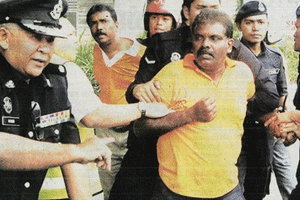 The same happened when Hindraf’s orange T-shirts were banned because they were perceived to be a threat to national security. When the children of Hindraf’s supporter were arrested, again no one spoke on their behalf.
Did any politician, BN or opposition, support the Hindraf demonstration against racism in February 2011?
Hindraf has tried to help the Indians but they have achieved very little. They are continually let down by politicians who use them as a political football, for their own means and to fulfil their own agendas.
Despite 850,000 Indian voters in Malaysia, there is not one single constituency with an Indian majority.
Hindraf’s Uthayakumar has said of a pact with Pakatan, “…this time Hindraf would not give a ‘blank check’ and make the same mistakes. Our demand is very simple. Let’s work together and vote Umno out”.
Hindraf has nothing to lose and Pakatan has much to gain.
If we all pull together and oust BN, we will all have much to gain. It is time to put aside petty differences and petty power struggles, and act symbiotically.
But will the Pakatan and Hindraf union be a marriage of convenience or a marriage made in hell?
MARIAM MOKHTAR is a non-conformist traditionalist from Perak, a bucket chemist and an armchair eco-warrior. In ‘real-speak’, this translates into that she comes from Ipoh, values change but respects culture, is a petroleum chemist and also an environmental pollution-control scientist.


Report this comment
Are you sure you want to delete this comment?
This action cannot be undone.