




'Little dragons girls' and my post-Merdeka Day reverie
I have always been keen to gauge the opinions of others on certain issues, and recently I asked my students of media studies at New Era College, Kajang, in regard to their views on mainland Chinese. They did not disappoint me: the majority of them see the men from China as either 'unscrupulous traders of counterfeit goods' or 'cheats', while the women are no more than 'little dragon girls', a euphemism for 'hookers'.
Asked further as to how did they gather such impressions of mainland Chinese, 90 percent of them attributed it to the media and the press, while others simply said 'hearsay'.
As I argued before, racism and sense of cultural superiority are nothing new to the Chinese in Malaysia, although they find it difficult to address the issue. After all, it is already insulting enough for the Chinese to be treated unfairly and discriminated against by the state, would it not be a double affront to wash dirty linen in public?
But ethnic pride and prejudice vis vis the Malays or the Indians is only one aspect of the issue. In the entire discourse on racism, what is often overlooked is the stereotype and the negative impression of the Chinese from mainland China - supposedly a people group sharing the same racial and cultural roots with Chinese Malaysians.
In my last article, I touched on briefly the derogatory representation of mainland Chinese women in our Chinese media, and no-one, practically no-one, finds this repulsive. The most puzzling reaction can perhaps be found in some women's groups, especially those affiliated with Chinese associations, which seize every opportunity possible to sue for equal rights for womenfolk.
I have always been keen to gauge the opinions of others on certain issues, and recently I asked my students of media studies at New Era College, Kajang, in regard to their views on mainland Chinese. They did not disappoint me: the majority of them see the men from China as either 'unscrupulous traders of counterfeit goods' or 'cheats', while the women are no more than 'little dragon girls', a euphemism for 'hookers'.
Asked further as to how did they gather such impressions of mainland Chinese, 90 percent of them attributed it to the media and the press, while others simply said 'hearsay'.
As I argued before, racism and sense of cultural superiority are nothing new to the Chinese in Malaysia, although they find it difficult to address the issue. After all, it is already insulting enough for the Chinese to be treated unfairly and discriminated against by the state, would it not be a double affront to wash dirty linen in public?
But ethnic pride and prejudice vis vis the Malays or the Indians is only one aspect of the issue. In the entire discourse on racism, what is often overlooked is the stereotype and the negative impression of the Chinese from mainland China - supposedly a people group sharing the same racial and cultural roots with Chinese Malaysians.
In my last article, I touched on briefly the derogatory representation of mainland Chinese women in our Chinese media, and no-one, practically no-one, finds this repulsive. The most puzzling reaction can perhaps be found in some women's groups, especially those affiliated with Chinese associations, which seize every opportunity possible to sue for equal rights for womenfolk.
Yen Yen has to respond
However, when confronted with the 'menace' posed by mainland Chinese, they turn themselves, rather conveniently, into an accomplice of patriarchalism by putting the blame solely on the 'little dragon girls' for all the extramarital affairs that occur, as if those men who are prone to womanizing never had to be taken to task. Does it not take two to tango?
Last month at the Wanita MCA annual meeting, Dr Ng Yen Yen, the unopposed leader, urged that 'the public should alert the police whenever they come across any suspicious woman from China', and was successful in attracting a strong-worded response from a mainland Chinese lady, a Miss Wu Yafang, who is married to a Malaysian man.
 In her letter to the
Oriental Daily News
, Wu could barely conceal her outrage by expressing categorically her disgust at the way women from China were lumped together as 'potential hookers', precisely what was implied by Ng. Rightfully, Wu demands an unqualified apology from the head of Wanita MCA and the ball is now in Ng's court.
In her letter to the
Oriental Daily News
, Wu could barely conceal her outrage by expressing categorically her disgust at the way women from China were lumped together as 'potential hookers', precisely what was implied by Ng. Rightfully, Wu demands an unqualified apology from the head of Wanita MCA and the ball is now in Ng's court.
This episode in fact highlights the chronic failure of the Chinese Malaysian community in speaking up for other minority groups living in our midst. For decades, our concern has been primarily revolving around the community issues, ranging from culture, language, politics, education to economy. But it is not to be denied that our civil society if it does exist in the first place is mainly a self-centric and parochial one.
That our Chinese press has been stereotyping the mainland Chinese is nothing new, and many hardly think such distorted representation in need of remedy. It is not much different from the way our society turns a blind eye to the stigmatization of the guest workers by the Malaysian media in general. Why bother, one asks, since we are not on the receiving end?
Ng Yen Yen, in my opinion, deserves the beration for her gaffe. But the problem does not end here; it goes much deeper that that. Despite our need for foreign tourists to contribute to our nation's coffer, and guest workers to do the dirty, difficult and dangerous jobs, we continue to be distrustful and apprehensive of them. Ng is not alone. In fact, it would not be too far-fetched to say that our acquiescence on the issue creates and emboldens many ignorant and arrogant politicians like her.
Another politician of perpetual scepticism this week is none other than Deputy Information Minister Zainuddin Maidin, who in a very polite way suggested that the non-Malays were less visible at the Merdeka events.
But he was most likely merely echoing the sentiments of the 'grassroots'. In a letter to Utusan Malaysia , a writer took umbrage at the lack of enthusiasm on the part of the non-Malay youths over the Jalur Gemilang.
Patriotic citizens
Coming from Utusan , perhaps this is only to be expected whenever the Merdeka Month is just around the corner. At times I do find it incredulous that some still think joining the army and the police is the only way to repay the nation's 'benevolence', and only the Malays are patriotic. Little wonder that the 'loyalty' of the non-Malays - not non-Bumis though as they think the non-Muslim Bumis in Sabah and Sarawak as lesser patriots too - is constantly in doubt.
Now that the police is found by a Royal Commission to be among the most corrupt institutions in Malaysia, there must be plenty of patriots in there?
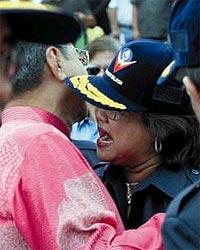 Finally, if my memory serves me correctly, it was Deputy Prime Minister Najib Tun Razak who reminded the Malaysian public that hugging was not part of our culture. But look
who was doing it
.
Finally, if my memory serves me correctly, it was Deputy Prime Minister Najib Tun Razak who reminded the Malaysian public that hugging was not part of our culture. But look
who was doing it
.
Having said that, it is always good to see people patch up their differences and reconciled. I just think to myself had the DPM seen this, he would probably let out a heavy sigh that his kind reminder had fallen on deaf ears.
And for those who turned up for the not-so-lucah pre-Merdeka party at my humble abode, many thanks for your pleasant presence. But perhaps just like you, I overslept and missed the parade in Putrajaya the next day.
Happy belated Merdeka.


Are you sure you want to delete this comment?
This action cannot be undone.