




A fish rots from the head first
Years ago, during another fasting month, I was informed by a voice on the telephone to pick up the identity card of a kampong boy on whose behalf I had made the application. A trip to the local office of the National Registration Department brought me face to face with a youngish officer, who appeared resentful of my presence, probably because of the discomfort caused by his abstinence.
He demanded a fee of RM10. I forked out the bill without thinking, having been conditioned to make such small payment all my life during numerous visits to numerous government offices. Why, in some places, you even pay for application forms of one sort or another.
The youngish chap shoved the red bill under some files without giving me a receipt, and handed the identity card in his sullen manner. In the span of one second, I understood, and left.
Like being fined on the spot by traffic policemen instead of being fined by a magistrate in a court of law for some minor or imagined infraction of traffic regulations, I, like almost all Malaysians I know, have come to accept this sort of palm greasing as the unseen cost of living in Malaysia as a citizen. The rent paying is part of a black market economy that must amount to a huge sum of money nation-wide. It also probably occurs daily, at all levels of government, involving too many people for us to keep track of.
Years ago, during another fasting month, I was informed by a voice on the telephone to pick up the identity card of a kampong boy on whose behalf I had made the application. A trip to the local office of the National Registration Department brought me face to face with a youngish officer, who appeared resentful of my presence, probably because of the discomfort caused by his abstinence.
He demanded a fee of RM10. I forked out the bill without thinking, having been conditioned to make such small payment all my life during numerous visits to numerous government offices. Why, in some places, you even pay for application forms of one sort or another.
The youngish chap shoved the red bill under some files without giving me a receipt, and handed the identity card in his sullen manner. In the span of one second, I understood, and left.
Like being fined on the spot by traffic policemen instead of being fined by a magistrate in a court of law for some minor or imagined infraction of traffic regulations, I, like almost all Malaysians I know, have come to accept this sort of palm greasing as the unseen cost of living in Malaysia as a citizen. The rent paying is part of a black market economy that must amount to a huge sum of money nation-wide. It also probably occurs daily, at all levels of government, involving too many people for us to keep track of.
Well, there are different levels of acceptance. For me, I am always overwhelmed by rage after every incident. I conjure up ten ways of taking action in my mind.
I could lodge a complaint with the anti-corruption agency. But like all the Malaysians I know, I have very little faith in this beleaguered body that answers to the prime minister. It would be far more reassuring if they answer to Parliament. In any case, unless they take actions against the top corrupt politicians I know, their credibility is suspect at best. An Ombudsman would have functioned better.
Remorseful individual
Then I could have lodged a complaint against the offending officer with his superior. This is something that I did as a matter of routine when I had the official capacity of acting as an elected legislator. To be fair to them, the superiors always took disciplinary actions after a proper enquiry. This was an unpleasant task indeed, because you are breaking a serving officer's career. It is one thing to fight corruption. It is quite another matter facing the fallible, and sometimes very remorseful, human individual.
Then where do you start, and where do you end. In the case of the clerk dealing with me on the matter of identity card for a kampong boy, he was probably paid a subsistence wage, with all the pressures of Hari Raya spending looming on the horizon. He did refuse to look me in the eye, and appeared fidgety. What was the use of getting small fish fired, when everyday, we all know well how his superiors and his political masters across the land are raking in unimaginable large sums of ill-gotten money. The petty government officer is just following leadership by example.
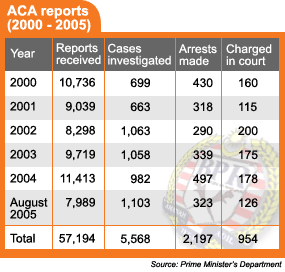 It is a moral dilemma indeed. By not taking actions, am I not condoning this evil practice, and let the culprit free to prey on the next victim? By giving up and surrendering to my sense of futility and inevitability, am I not joining the millions of citizens who have actually accepted palm-greasing as semi-legitimate? Would my more self-righteous friends condemn me for my negative fatalism, and would they not remind me that the Ten-Thousand-Mile-Long-March begins with the first step, and that Rome cannot be built in a day?
Naturally, those who run and manage small and medium businesses as well as petty traders would shrug off my misgivings without a moment's reflection. I am nave, they would observe. This is the Malaysian way. One cannot live a life, from cradle to the grave, and make a living in between, without greasing palms, they would add. Finally, with some justification perhaps, they would declare it is the same the world over.
A friend who runs an engineering consultancy firm is particularly candid. The TNB, he says, is rotten through and through. If you do not pay your usual unofficial and unseen due, the chap who holds the power to make or break your business venture would never be available. He is always on leave, or away for a meeting, and just plain busy. He did make a complaint against one officer at first, and the fellow was transferred laterally to another post, rather than being sacked. The whole system stinks, he says. Nowadays, he says, you even have to tip the dispatch boy for him to deliver your document into the right hand.
An educated prejudice
Therefore, I was not all that surprised when the press revealed that petty traders have been known to pay tens of thousands of ringgit for a license to trade at the Masjid India area in Kuala Lumpur during Ramadan.
It is as yet a mere allegation, and one should not conduct a trial by media. But growing up and working in the Malaysian ethos, one finds such allegations believable. If it is a prejudice, it is an educated prejudice.
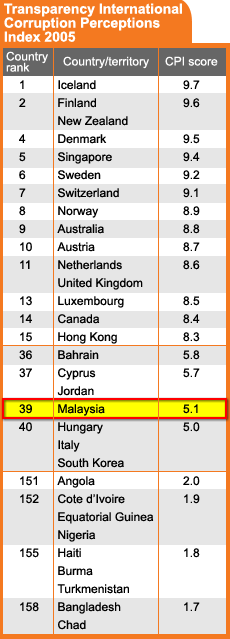 After all, the Dewan Bandaraya Kuala Lumpur sits atop the premier capital city of the nation, the hub of business, government and finance. It controls everything within this the most valuable real estate of the whole country, in its capacity as the unelected local government. The people there with such awesome power of life and death over the daily life of the millions of citizens have the opportunity, the means and the motivation for self-enrichment. There are no institutional checks and balances to ensure public accountability and transparency. The media is, by and large, ingratiating. It would be a major shock if the City hall is found to be squeaky clean indeed.
I have no access to big business and big money. But the small businessmen, the petty traders and the underworld are a rich source of covert information. Such information is all the more credible because the victims have nothing to gain, and everything to lose, by divulging the open secret of massive graft within the City Hall.
The most powerful weapon at the disposal of a corrupt bureaucracy is their numerous laws and by-laws enacted with the objective of controlling and regulating private activities. Everything you try to do to make a living requires a legion of permits and licenses.
A chap trying to open a restaurant has to procure approval from the local council an endless series of applications and inspections. There could be long delay, causing unbearable holding costs, and there could be more delay in processing the final approval. The businessmen understand the rules of the game, and quietly, the whole painful process can be speeded up as if by the waft of the magic wand, by the payment of an unspecified sum agreeable to both parties.
Just because the laws and regulations are bent to work in strange malleable ways - for a price - all sorts of anomaly are allowed to exist, and the borderline between what is legal and what is not legal becomes blurred. The Rule of Law has lost both its effectiveness and its moral authority in the hearts of the citizens. As my businessmen friend tell me, if you follow the innumerable laws strictly, nobody can do any business at all.
Way of life
And so, I know of one lucrative 24/7 coffee shop that has been in business in the heart of the Golden Triangle for ten years without a valid license!
So it has become a way of life for Malaysians who want to do some kind of business, in all corners of the country where there is a local council that controls and manages their activities. But none suffers so much and know so much as the property developer and construction sector.
 Theirs is essentially a huge business with many people depending on them for a living both upstream and downstream. The stake is high. For whatever purposes the properties are developed, there are countless approvals to be obtained from the "relevant authorities", all the way to the final issuance of the CF, and the handing over of the key. The cost of lubricating the slow grind of officialdom is the inevitable though invisible production cost which investors and businessmen have to factor into the cost-benefit analysis.
At the end of the day, you have to conclude that the government is too big. It needs to deregulate, so as not to strangle the free spirit of private enterprise. With a political philosophy that is bent on social control as the most effective means of self-perpetuation of power, more regulation and control is likely to be the trend for a long time to come.
Those people in high places paying lip service to purging the scourge of corruption from our public life may demand facts. Without facts, my narrative is a mere empty accusation without supporting evidence that makes possible prosecution and conviction of the offending parties.
The fact is that facts about corruption are everywhere, except that they are either opaque or hidden. That is why corruption is the most open of secrets. Too much of it is probably protected by the Official Secrets Act anyway.
After all, political leaders set the tone and standard for public morality. When it is the most glaring silent feature of our national life, that top politicians feather their nests profusely while in office, without fear of investigation and prosecution, and most vigilant citizens know who they are, there is little hope for banishing this cancerous political disease from our body politics.
A former MCA president is well known for his saying that "A fish rots from the head first." He should know.


Are you sure you want to delete this comment?
This action cannot be undone.