




The erosion of democracy
Driving to work yesterday morning, I was flipping radio stations frustratingly. The hosts of Chinese programmes were parroting news about the upcoming election without in-depth comments, one of them actually delving into why Prime Minister Abdullah Ahmad Badawi had chosen Feb 13 to be the day of announcement. Was it his lucky number? She was giggling. How trivial, and pathetically so.
A Malay channel was playing music, with on and off reminders of the dissolution of parliament to the listeners. Bored, I tuned to the English ones. It was worse as all of them were pretending that life was as usual. The two hosts of a breakfast show were making fun of each other as if we lived in a carefree world.
Driving to work yesterday morning, I was flipping radio stations frustratingly. The hosts of Chinese programmes were parroting news about the upcoming election without in-depth comments, one of them actually delving into why Prime Minister Abdullah Ahmad Badawi had chosen Feb 13 to be the day of announcement. Was it his lucky number? She was giggling. How trivial, and pathetically so.
A Malay channel was playing music, with on and off reminders of the dissolution of parliament to the listeners. Bored, I tuned to the English ones. It was worse as all of them were pretending that life was as usual. The two hosts of a breakfast show were making fun of each other as if we lived in a carefree world.
I finally slotted in a cassette for some oldies, feeling almost exasperated. The traffic, still recovering from the Chinese Lunar New Year lull, was amazingly clear, but my mind was restless nonetheless.
Perhaps the DJs were not to blame. When you have a prime minister, an Islam Hadhari advocate at that, who had assured the public that the dissolution of parliament would not happen but showed no qualms contradicting himself the next day, how do you expect the ordinary folk to behave?
 So I am not in the least excited about the election, now scheduled to take place on the International Women’s Day (March 8) this year. With nearly the entire media and press industry serving the agenda of the ruling coalition, churning out (or concocting)
‘positive’
news while hiding the negative (and often true) ones, and a supposedly impartial Election Commission acting as a government agency by gerrymandering the electoral map, the fate of the masses has long been sealed.
So I am not in the least excited about the election, now scheduled to take place on the International Women’s Day (March 8) this year. With nearly the entire media and press industry serving the agenda of the ruling coalition, churning out (or concocting)
‘positive’
news while hiding the negative (and often true) ones, and a supposedly impartial Election Commission acting as a government agency by gerrymandering the electoral map, the fate of the masses has long been sealed.
Barisan Nasional, despite (or because of) its decades-long dominance, is in dire need of ideological renewal as well as the courage to face realities. Sadly, the top leadership is still in denial. Deputy Prime Minister Najib Razak, in an exclusive interview with several Chinese dailies, reminded the Chinese that only the BN could ensure continued prosperity for the community - the same tune that he and his MCA colleagues had been repreating for years. If others are still not fatigued, I am already snoring.
Likewise, Thaipusam was declared a holiday in the Federal Territory of Kuala Lumpur (only) after the massive peaceful protest by Hindus last November. The babies that cried the loudest seem to have been cradled for now, but other issues remain - the yet-to-be-known root causes of the Kampung Medan clash in 2001, the mysterious death of Indian youths in police custody, the series of temple demolitions and the sorry state of Tamil schools, to name a few.
Debased democracy
And Umno always loves to present itself as a force of modernity, and can be religiously so at times. In its drive to modernise the Malays, scores of kampongs were razed to ground, the biggest outcry being Kampung Berembang in late 2006. The Selangor state government did not even bother to pacify the residents until only recently.
Abdullah practically squandered the historical mandate that he secured in 2004, yet still has the nerve to ask for a fresh one this time around. More mandate for what? Perhaps more petrol hikes, toll roads and highways (and cracking ones at that), privatisation, urbanisation, APs, religious zealots, keris -wavers/kissers and what not.
The original principle of democracy was to make those in power accountable to the people. ‘The worst form of government, except for all those other forms that have been tried’ as famously remarked by Winston Churchill, is now used only to enrich a select few, creating a political fiefdom along the process.
But I am not just despondent at the debased form of democracy in this country. Everywhere in the world, I can see democracy being eroded in various manners.
 Since 2001, democracy in the US has become a euphemism for neo-conservatism. It is common knowledge now that American oil interests and the forecast capacity limitations of the energy industry persuaded President George W Bush and his cohorts to wage war in Iraq.
One of Bush’s immediate tasks following the fall of the Saddam Hussein regime was to set up the Facilities Protection Service under Paul Bremer for effective control of major Iraqi utilities, rather than putting in a democratic system.
When hundreds of thousands of conscientious Americans took to the streets in New York, Washington and Los Angeles against the planned invasion, Clear Channel Worldwide Incorporated, the largest radio station owner in the US and a financial backer of the Bush administration, used radio stations to organise the pro-war ‘Rallies for America’.
While the US has been lecturing the world on democracy, there still exist American citizens and taxpayers who are denied a voting in a member of Congress for over 200 years. These are people who reside in US territories such as Guam and Puerto Rico.
Clumsiest, ugliest
And the biggest controversy in the US democratic system lies in the electoral college, a defect severely criticised by many Americans when Al Gore won the popular vote but lost the electoral college against Bush in 2000. So much for democracy.
Early this week, British Foreign Secretary David Miliband pledged to make democracy a key element of UK foreign policy. Surprisingly, his speech drew flak from Simon Jenkins and Adrian Hamilton, columnists with The Guardian and The Independent respectively, at a time when British opinion believes London must pressure Beijing to do more in Darfur.
Jenkins sees it as imperialism in new clothes, while Hamilton accuses the British government of hypocrisy
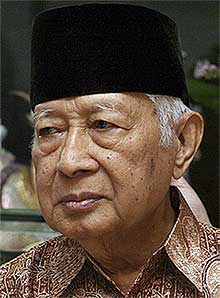 In fact, when one considers how the US and Britain have supported their ‘chosen democrats’ in the past, Miliband’s rhetoric deserves no serious thought at all. Those who refused to shed tears for President Suharto when he died because of the 1965 massacre are again humbugs if they ignore the role of the CIA in it.
Even if democracy can buy one accountability at home, it cannot always restrain state actions beyond national boundaries. Scores of Okinawan women have been raped over the years by US soldiers stationed on the island, but it has failed to trigger withdrawal of American troops there. Okinawa is never a concern for the US electorate, and continues to be treated by its own ‘democratic’ government of Japan like a colony.
In January 2006, Hideki Kobayashi, Japanese Ambassador to Thailand, even told The Bangkok Post that Japan-Thai relations could date back 600 years when Okinawa was trading with Southeast Asia in the 1400s. A plain lie.
Ryukyu Islands, as Okinawa was previously known, did not become Japanese territories until they were annexed by the Meiji government in 1879. Before that, the islands had been struggling to maintain its independence in between China and Japan. Stretching historical facts or distorting them have long been a trade that smug and cunning officials, democratic or not, excel at.
Enough of rambling. Back in Malaysia, media bombardment by state propagandists may dampen the joy of the Chinese Lunar New Year, but I take solace in the fact that all democracies are flawed. It is only that our version is among the clumsiest and ugliest. One reason to put the country into the Guinness Book of World Records perhaps.


Are you sure you want to delete this comment?
This action cannot be undone.