




Historians mourn death sentence for Pudu Prison
Within its high walls lined with razor-sharp barbed wires once roamed notorious criminals, including the likes of legendary armed robber 'Botak Chin' who was hanged in 1981.
Within its high walls lined with razor-sharp barbed wires once roamed notorious criminals, including the likes of legendary armed robber 'Botak Chin' who was hanged in 1981.
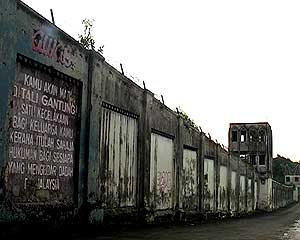 Five years later, the spotlight fell on Pudu Prison again when two Australians, Kevin Barlow and Henry Chambers, who were convicted of drug trafficking, were hanged.
Built in 1895, the prison which sits in the heart of Kuala Lumpur and accommodated up to 2,000 inmates, witnessed its last execution in 1993.
Pudu Prison is also in the Guinness Book of Records for the mural painting on its walls that measured 384 metres by 4.5 metres. This was noted as the first, largest and longest in the world.
In the mid 1990s, the prison was moved to Sungai Buloh and the current site was turned into a museum.
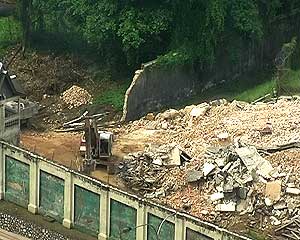
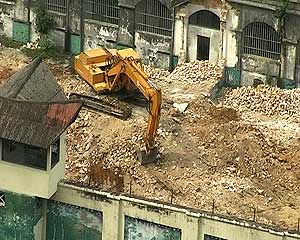 But now this historical building is being taken apart piece by piece to pave way for an underpass and road widening project.
This move has angered historians, who feel that the nation's past is being sacrificed at the altar of development.
Malaysiakini speaks to a few of them.
Omar Mohd Hashim, Malaysian Historical Society executive committee chairperson
Pudu Prison is a national heritage and tourist attraction. It is one of the main historical buildings in Malaysia and it was supposed to be retained for its historical value as it was built in the 19th century.
The country cannot just have new buildings. It is a sentinel to the younger generation. Therefore, it should be preserved for its special value.
Khoo Kay Kim, Professor Emeritus of Universiti Malaya
It is very saddening to destroy Pudu Prison. It seems to be one of the many heritage buildings that has been demolished for money making. Tourists are not interested in high rise buildings but they want to see the buildings that can be traced historically.
 For example in England, Oxford and Cambridge are old towns that have been preserved. And people appreciate such buildings.
The government has to be more strict, they cannot always give in, in the name of development.
Now the government is talking about 1Malaysia. It is a cultural concept. How do we promote nationalism and patriotism, when we do not preserve our culture. A nation must have roots and history, without which 1Malaysia would have no meaning.
It is particularly important to start education from young. An education of history is not confined only to textbooks. It should include trips to monumental buildings for children to understand the history and appreciate the past.
Sadly now Kuala Lumpur is all about tall buildings with no cultural values.
Elizabeth Cardosa, Badan Warisan Malaysia executive director
Pudu Prison is part of the unique story of Kuala Lumpur's development - its history and its geography. It was originally located in an area well away from the city centre but more than a century later, with the growth of the city especially over the past four decades, the jail is sitting on prime land. From reports in the media, we understand that its demolition is part of a plan to reduce KL's traffic woes, it is apparently also to make way for a new shopping centre and residential high-rises.
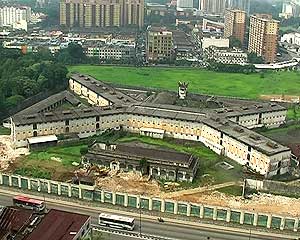 While the building as an institution has a chilling history - one of brutality and crime - yet, it represents a part of the social history of KL. The preservation of Pudu Prison and its restoration and adapting it to new use would have been an opportunity to place it on the same page as Port Arthur in Australia, or Robben Island in South Africa whose communities fought to preserve their landmark jails as important memories of their past, and where these landmarks have subsequently become great tourist destinations.
If the jail complex were to have been preserved, with a little creative thinking and innovative planning, we could have found a narrative which would fit into our contemporary community and provide a first-hand experience of a unique piece of social, cultural and architectural history. Its demolition denies us this opportunity.
The silver lining has been the expressions of dismay and calls for the preservation of the jail seen especially in blogs and online commentaries from the general public, not just heritage advocates. At the very least, proposals are for the memory of the site to be retained by keeping the main gate and sections of the wall flanking it and to incorporate this into the new development.
Badan Warisan Malaysia believes that there is a great need for open public discourse on the future of Pudu Prison and that it is time due consideration is exercised by the official custodians of heritage into preserving and restoring not just this site, but all of Malaysia's significant built heritage. Laws, guidelines and standards to position heritage conservation as a critical activity for maintaining our nation's identity is crucial and we can ill afford to keep losing our fragile heritage.
Pudu Prison was built in 1895 and used to house criminals and drug offenders. It was built by state engineer Charles Edwin Spooner. However, after operating for more than 90 years, it was closed down following the in 1986. Nevertheless, it was reopened in 1997-1998 as a museum and briefly in 2004.


Are you sure you want to delete this comment?
This action cannot be undone.