




High Court: MACC's night interrogation illegal
In a landmark decision today, the Kuala Lumpur High Court ruled the Malaysian Anti-Corruption Commission is not entitled to interrogate witnesses late at night.
In a landmark decision today, the Kuala Lumpur High Court ruled the Malaysian Anti-Corruption Commission is not entitled to interrogate witnesses late at night.
Justice Mohd Ariff Md Yusof ruled that it was illegal for the MACC to question its witnesses at night as such questioning must be done in the daytime, during office hours.
 "The term day to day as stipulated under Section 30 (3) (a) of the MACC Act cannot mean round the clock. To do so, will offend the intention of the legislature and to curtail the ambit of personal liberty.
"The court allows the application for the declaration," he said.
He also ordered costs to be paid to the plaintiff, Kajang councillor Tan Boon Hwa ( left ).
Despite the differences in opinion on the time when Tan was interrogated, Karpal agreed to the one stipulated by the MACC officer in his affidavit which was between 9.45pm on July 15 and 2.53am on July 16.
Hence, Mohd Ariff directed the court's senior assistant registrar to assess the damages for wrongful detention based on those stipulated time.
Tan filed a suit on July 22 claiming that the MACC had falsely imprisoned him when he was detained and questioned at odd hours.
 He said that he was questioned late at night along with political aide Teoh Beng Hock (
right
) on July 16.
MACC meanwhile had contended they had the right to interrogate witnesses at odd hours.
Senior federal counsel Noorin Badaruddin, who appeared on behalf of the MACC, said she has received instructions from the Attorney General to file an appeal.
Tan, commenting today's judgment, said the decision was important to all Malaysians.
"What is important is that no one should be subjected to such interrogation late at night. This is a victory for all Malaysians," said the Kajang municipal councillor.
Oxford dictionary meaning used
Mohd Ariff in his judgment had used a federal court case and also the Oxford English dictionary second edition, in arriving at the decision.
In the federal court decision, the judge noted that personal liberty as enshrined under Article 5 of the Federal Constitution should have been expanded.
He also noted that within the MACC Act, there was no definition of "day to day".
Section 30 (3) (a) states: A person to whom an order has been given under paragraph (1) (a) shall attend in accordance with the terms of the order to be examined orally to assist investigations, and shall continue to attend from day to day where so directed (by the MACC) until the examination is completed.
As a result of this, Justice Mohd Ariff said the court was empowered to interpret the meaning.
"Looking at the definition under the Oxford Dictionary "day to day" means daily. It does not mean 24 hours a day but at anytime of the day. Hence, it should mean within normal working hours as stipulated between 8.30am and 5.30pm," he said.
Justice Mohd Ariff, also noted that the MACC had summoned Tan to give his statement on July 20, at 10am. Hence, this was within the right definition of day to day. This means, he can be brought in or come another day (during office hours) to help assist in the investigations.
Karpal: Decision has serious ramifications
Karpal, who represented Tan, said today's judgment was a landmark decision, as never before had the court interpreted the limits of conducting interrogations.
He said the MACC Act gave an avenue for the public to address the issue.
The senior lawyer also pointed out that even under the Lock-Up Rules, a person must be in his cell (jail) between 6.30am and 6.30pm and hence, interrogation could not conducted outside those time.
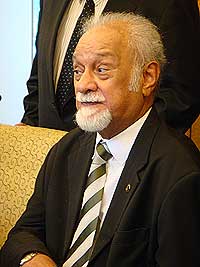 He said in previous Acts, there was no specific reference on 'day to day' in the conduct of interrogation for witnesses.
Asked whether the judgment would mean that Teoh's family could file a similar suit for wrongful detention, Karpal ( right ) said it would mean that and more.
"Under the Public Authorities Protection Act, civil liability on the government is limited to three years. Hence, witnesses for the past three years, who have been unlawfully detained and where interrogations were conducted after office hours could file for damages claim," he said.
As a result of Tan and Teoh's matter, the Selangor government has also issued a circular barring its officers from being interrogated by the MACC after office hours.
The attorney-general has, however, sought to set it aside on the basis that the circular is against the law, because it violates the legal rights accorded to the MACC officers in performing their duties.
The case is pending in Shah Alam High Court.


Report this comment
Are you sure you want to delete this comment?
This action cannot be undone.