




MACC chief: Don't talk to media after lodging complaint
Newly-appointed Malaysian Anti-Corruption Commission chief commissioner Abu Kassim Mohamed said, from this year, action will be taken against those who disseminate information to the media on a complaint they have lodged.
Newly-appointed Malaysian Anti-Corruption Commission chief commissioner Abu Kassim Mohamed said, from this year, action will be taken against those who disseminate information to the media on a complaint they have lodged.
In his maiden press conference as MACC chief, Abu Kassim, 48, said based on Section 29(4) of the MACC Act, any person found to disseminate information on a complaint which has been lodged can face legal action.
Pointing to the action of several politicians, Abu Kassim said they are reporting allegations on corruption but at the same time releasing such information to the public.
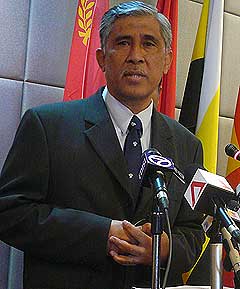 "Under the act, action can be taken against the person giving the information including the reporters who report this," he said.
"Such information should have been made to the MACC officers or the public prosecutor."
Abu Kassim ( left ) said MACC has to react as the situation involves justice and the dignity of the person who is the subject of the complaint.
"There are some instances where a complainant lodges a report with an ulterior motive other than wanting to curb corruption.
They are using the commission to (cause) a person's downfall. This is about the rights of an accused, justice. It is not fair for a person to be on trial by the public," he said.
"These people are hampering investigations. I'm not trying to curb media freedom or the rights of the complainant but this has to be enforced in the interest of justice."
Abu Kassim said MACC can initiate a complaint and take legal action against them.
"That is what I want to tell them and to educate editors too. I will write to your editors to educate them also so you all would not face any headaches.(Those convicted) face two years' jail or a fine of RM100,000," he said.
 "Please do not make corruption cases drama series. A person making a statement today is highlighted by the media and the next day another person appears in the media, and then another person.
There are some cases referred which I can see are not genuine cases," he said.
"When cases are made public, the witnesses who can be family members, relatives, friends or co-workers would hide the evidence.
These witnesses will also face a dilemma to provide statements to MACC. Imagine how hard it is us to get co-operation from the witnesses. When we fail you will accuse the commission of being ineffective."
Abu Kassim was also asked about a report lodged on Yayasan Basmi Kemiskinan Selangor.
Investigate big or small fish
Abu Kassim, who was previously MACC's number two, assured that the commission was committed to lifting its image and improve public perception following a decline in Malaysia's position in the Corruption Perception Index last year.
"Our main thrust is to improve on the commission's effectiveness, independence, transparency and professionalism. This would help improve the commission's image," he said.
When asked to comment on the perception they were investigating small fishes not big fishes, Abu Kassim said there was no truth to such a notion.
He explained that the commission's task was to investigate and not to prosecute.
"Our main task is to investigate. We will investigate and have been investigating all cases which have been reported to us. In the past, there was no mechanism for the public to view this."
"However, as we have the Operations Value Panel, all cases would be monitored by the panel to ensure its progress and they are being investigated.
If the investigations are not complete it would be tabled to the panel for further action. If there are no investigations done, we will also explain it to the panel. We are being transparent about this as never before."
He also denied that he received orders to either initiate or close investigations by those higher-up, saying "I have not received such orders".
The chief commisisoner also revealed the MACC secured 75 per cent convictions of its cases last year, and this year, he hopes to achieve 80 per cent.
To ensure further transparency, Abu Kassim said he would be holding monthly briefing sessions with the media to address any issues.
Meanwhile, his newly appointed deputy Mohd Shukri Abdull revealed the commission investigated 5,825 cases, where 937 investigation papers were opened.
He also revealed that throughout last year, 14 politicians were charged for corruption of whom 11 come from Barisan Nasional and three from Pakatan Rakyat.
Mohd Shukri also said two senior civil servants were also charged last year, and 17 people from the private sector comprising chief executive officers, directors and lawyers weres also prosecuted.
Abu Kassim reiterated the MACC would investigate anyone or any company regardless of political affiliation or standing.


Are you sure you want to delete this comment?
This action cannot be undone.