




Rehabilitating the 'training school' for criminals
‘A finishing school for criminals’, this was the perception many have of the Simpang Renggam Rehabilitation Centre.
‘A finishing school for criminals’, this was the perception many have of the Simpang Renggam Rehabilitation Centre.
This is an image that both the Home Ministry and the Prisons Department are hard at work trying to correct, both in the eyes of the public and for the care of its inmates.
 “We are now segregating the high-risk and high-profile criminals from the general populace,” said the correction facility’s director, deputy prisons commissioner Jamaluddin Saad.
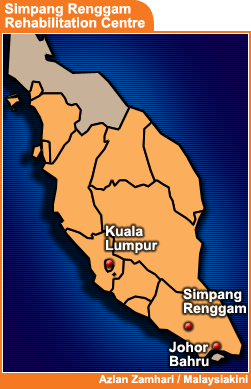
Jamaluddin was speaking to journalists from Kuala Lumpur and local bureaus in Johor Bahru - about 75km from Simpang Renggam - who were feted to a guided tour of the notorious rehabilitation centre, organised by the Home Ministry on Thursday.
He explained that the move to house detainees in separate compounds was because “high-risk criminals like the members of the ‘Mamak’ and ‘Steyr’ gangs often pose a danger to other detainees with their violent behaviour and run a higher risk of perpetrating escape attempts.”
 “Often high-profile criminals, who are influential figures with their money and charisma, can ‘buy’ or ‘influence’ other inmates,” he added.
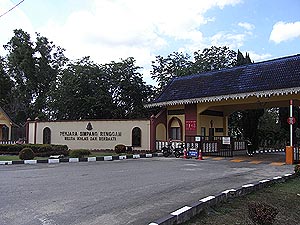
The camp sits on 82.6 hectares of land, nestled within a congenial resort-like outer area of landscaped gardens, tennis courts, multipurpose hall, comfortable clubhouse and living quarters for prison staff and their dependents.
The correctional facility proper, however, is a cluster of roughly-built cement buildings in a rectangular pattern. They are connected to one another via a complex series of claustrophobic walkways partitioned by steel-reinforced doors.
The outer face of the centre is adorned with rows of barbed wire, iron fencing and dour walls. Inside, 10 by 15 feet dilapidated cells hold between three to five inmates - all of whom are detained under the Emergency Ordinance or Dangerous Drugs Act.
 Long-worn corridors serve as the stage for the prisoners’ daily workshops, talks and other activities, while several walled inner courtyards help provide natural light, allowing for open air drills and leisure activities.
Jamaluddin took pains to quash the popular perception that inmates admitted into the camp for petty crimes often exited as hardcore hardened criminals.
“Simpang Renggam is not the rumoured place where you enter here with a ‘diploma’ and graduate one step up the criminal ladder.”
“Our inmates are instead being schooled in discipline, personal development, spiritual well-being and vocational skills,” he said.
Serious overcrowding
Jamaluddin, however, conceded there were problems in the centre, especially during the period between 2005 and 2007.
During those few years, he said, the centre was severely overcrowded and had to contend with several major issues resulting from this.
“We were housing upwards of 4,000 inmates at the time, despite the centre having only been designed to handle 2,500.”
This, he added, led to “a shortage of water and a skin infection broke out. The skin infection was especially difficult for us to handle as we had only one medical assistant then.”
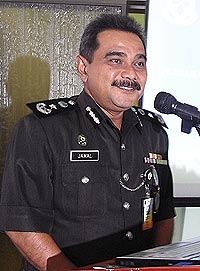 Jamaluddin (
left
) said there was no longer any overcrowding in Simpang Renggam today.
Jamaluddin (
left
) said there was no longer any overcrowding in Simpang Renggam today.
“We have transferred out the remand prisoners and women inmates to other detention facilities. Currently, we are housing inmates well within our capacity.
“Nor are there any problems with water and medical concerns. We have negotiated for an increase in the water pressure with the Johor water company to ensure sufficient supply,” he added.
Jamaluddin also said that the detention centre now has a full-time doctor and three medical assistants.
The correctional facility’s sick bay have also been upgraded, according to the doctor in charge, to one which can handle minor traumas like fractures.
For more serious cases, the centre has contingencies planned with nearby hospitals.
Jamaluddin also said that the currently dilapidated cells that inmates are living in are being upgraded in stages to provide a better living environment for them.
Rebranding exercise
The Home Ministry and the Prisons Department are determined to portray that they are serious in improving the situation in Simpang Renggam and other detention facilities.
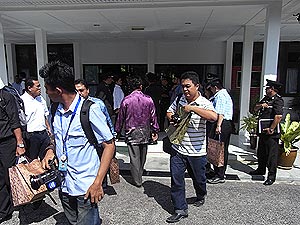 At least, this was what one can draw from Thursday’s public relations exercise which the Home Ministry’s corporate communications department arranged for members of the press.
However, whether or not these measures they are taking will bear fruit and improve the lot of detainees at the centre is yet to be seen.
Especially since the visit did not allow for direct interactions between journalists and those interned within to get a glimpse of the real story.


Report this comment
Are you sure you want to delete this comment?
This action cannot be undone.