




Teen's fatal shooting: Police overstepped bounds
While police procedures allow them to “use all necessary action to affect an arrest” on a suspect, they have overstepped their bounds in firing the shot that killed 14-year-old Aminulrasyid Amzah in Shah Alam last month, said a legal expert.
While police procedures allow them to “use all necessary action to affect an arrest” on a suspect, they have overstepped their bounds in firing the shot that killed 14-year-old Aminulrasyid Amzah in Shah Alam last month, said a legal expert.
Universiti Islam Antarabangsa law professor Raja Badrol Hisham Raja Mohd Ali explained that the Inspector General’s Standing Orders (IGSO) allows for the use of firearms in ‘extreme situations.’
The IGSO is a set of guidelines on police procedures, including the permissible use of firearms, issued to, and to be complied with, all district police chiefs.
 “In Aminulrasyid’s case, the pertinent question is, was (the situation) ‘extreme’ enough to justify the firearm being drawn and fired?” he asked.
The answer, in the academician’s expert opinion, is no.
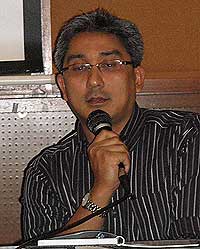
Badrol Hisham ( right ), who lectures in criminal procedure law, said this to around 120 students, politicians, activists and reporters during last night’s forum demanding justice for the fatal shooting of teenager Aminulrasyid.
“Let’s revisit the facts without any emotional baggage. Aminulrasyid was driving very fast and he ran a red light. We can say that this exhibits criminal behaviour: he was fleeing from police, he did not stop when allegedly ordered to.”
“The Criminal Procedure Code (CPC) allows the police to overpower suspicious individuals from fleeing and arrest the person or persons. They can also use their firearms, but there are limits.”
He said that under the CPC, shoot to kill is only allowed if the suspects are:
1. Involved in a crime punishable by death
2. Involved in a crime punishable by life imprisonment
By both these standards, Badrol Hisham contends that the police officers have failed to follow proper procedures, because they shot to kill despite the victim not presenting a threat to the police and not suspected of a serious crime.
He also alleged that the police may be attempting to distract the public from this truth, with the ‘discovery’ of the machete in the car and the questionable story of the deceased ‘reversing’ the car towards the police.
First of all, said Badrol Hisham, with the machete being in the trunk, it was never a threat to the officers, unless it was being waved around by the victim. Even then the police should have shot to disable and not to kill.
More importantly, the machete was only discovered afterwards, making its use as a justification to shoot irrelevant, as police would not have known about its existence at the point of shooting.
As for the deceased allegedly reversing the car, he said that according to witness Azammuddin Omar, Aminulrasyid was already dead when the car crashed and there were no skid marks to indicate a sudden reverse at the scene of the shooting.
‘Police ignorant of guidelines’
“The death of Aminulrasyid could have been avoided if the police understood the IGSO. I don’t know why only OCPDs are issued with the document. It should be given to everyone in the police,” he said.
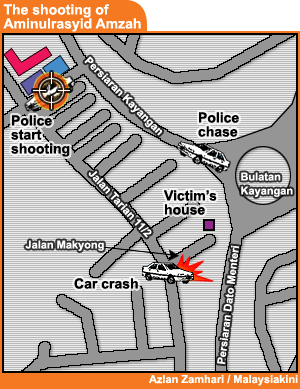 He added that more importantly, police could have shown more prudence before jumping to conclusions.
“They could have checked the number plate of the car to see if it is linked to known criminals. All patrol cars nowadays are in constant communication with their control centres, have radios, and some are even equipped with computers,” he said.
“On a more serious note, almost all the OCPDs are unaware that the CPC has been amended. In 2007, there were substantial revisions to the code. But they mostly don’t know about it. I found this out when I sent my students to interview OCPDs,” said the law professor.
Badrol Hisham said that it is disturbing for law enforcers not to know about the law.
“How can we put our lives and safety in their hands?” he asked.
The forum, organised by National Union of Malaysia Muslim Students (PKPIM) at the Selangor and Kuala Lumpur Chinese Assembly Hall featured a panel comprising Badrol Hisham, civil activist Wong Chin Huat and lawyer for the late Aminulrasyid’s family N Surendran.


Are you sure you want to delete this comment?
This action cannot be undone.