




Penang denies economic data to sow confusion
A member of a Penang think-tank has ticked off “certain quarters” for exploiting the state government’s move to engage consultants to collect economic data for more making effective policy decisions.
A member of a Penang think-tank has ticked off “certain quarters” for exploiting the state government’s move to engage consultants to collect economic data for making more effective policy decisions.
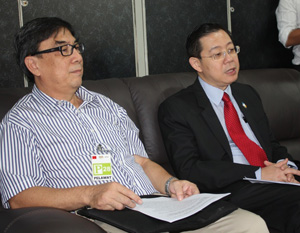 Socio-economic Research Institute (Seri) senior fellow Chan Huan Chiang
(left in photo)
said the gathering of facts and figures is a required practice in making economic policy.
Chan, who is attached to the Centre of Policy Research at Universiti Sains Malaysia, said the media has turned the matter into a political issue although the task is required in all states for better implementation of policies.
He went on to say that many have come to "mistrust the press", and that the confusion that has arisen over the matter following the chief minister’s speech last week is a case in point.
"What is wrong with gathering facts and figures to assist in making economic policies?" he asked.
"It is highly irresponsible to make policy, especially economic policy, without any basis or without relying on facts and figures. Failure to rely on facts and figures will only result in a failed state with failed policies."
The state government, via its business arm Penang Development Corporation (PDC), had directed Seri to publish the data in a ‘Business Intelligence Report’.
 Last week, Chief Minister Lim Guan Eng
(right)
launched the Report at the PDC building in Bayan Baru and introduced Chan as the main consultant for the project.
In response, state assemblyperson for Pulau Betong, Muhamad Farid Saad, accused Lim of trying to distort figures and confusing the people with new state economy indicators.
Muhammad Farid, who is a state Umno liaison committee member, claimed the country already provided official data and analyses on economic matters to the public through the Statistics Department of the Economic Planning Unit.
For Penang to produce its own, he said, was an attempt to sow confusion among the people and potential investors.
Five-year wait for data
Chan, who holds a PhD, explained that the report was necessary as state economic figures were released only every five years - by Bank Negara (in March) and the Treasury before the annual budget speech in Parliament (around September).
Economic performance at the state level was not well analysed and the only place where official figures were publicly reported were in the five-year development plans.
“It will be another five years before the public will see official state-level economic numbers again,” Chan said.
Asked whether Penang was attempting to stand apart from the rest of Malaysia by making the move, Lim said the suggestion was ‘mischievous’.
He said only those with “bad intentions” would question the task as this was not a political issue, but one related to state policy planning and implementation.
Lim noted that the state had not been able to obtain data on single mothers from the Statistics Department to help Penang develop an effective programme for them.
“Due to the federal government’s refusal to provide us with the data, we had to start a registration process throughout the state to obtain the figures,” he added.
“We cannot make decisions based on emotions, whims and fancies, but only by applying facts and figures.”
Seri was set up under the Gerakan-led state government in 1997, and was launched by then chief minister Koh Tsu Koon.


Report this comment
Are you sure you want to delete this comment?
This action cannot be undone.