




Aluminium plant rains misery on town folk
Kidurong state assemblyperson Chiew Chiu Sing turned emotional yesterday when relating the sad plight of longhouse residents suffering from health, environment and social problems caused by an aluminium smelting plant, about 38km from Mukah Town.
"Nothing of this sort ever occurred to them in their 20-odd years of stay there before the plant was built two years ago," he said during the debate on the motion of thanks on Yang di-Pertua Negeri Abang Muhamad Salahuddin Abang Barieng's opening address.
Kidurong state assemblyperson Chiew Chiu Sing turned emotional yesterday when relating the sad plight of longhouse residents suffering from health, environment and social problems caused by an aluminium smelting plant, about 38km from Mukah Town.
"Nothing of this sort ever occurred to them in their 20-odd years of stay there before the plant was built two years ago," he said during the debate on the motion of thanks on Yang di-Pertua Negeri Abang Muhamad Salahuddin Abang Barieng's opening address.
"How can this be? I mean the people had been staying there happily for so long, and nothing like this has ever happened, but, when the aluminium smelting plant is built, all changed.
 "Farms produce are not growing well, folks are not feeling well, getting clean water is becoming a bigger problem," he said.
He said the semi-rural town's longhouse residents told him that the vegetables in their farms are not doing as well as in the past, making it harder for them to find food and in the market place, people also do not want to buy their produce unlike before.
"Their fruit trees like coconuts, mangoes, starfruit and others are not as bountiful as before," he said.
"The women complain of dizziness, difficulty in breathing, frequent coughing, pain in the bones and are just generally not feeling well.
"The rain water which they use smells different, bathing with it makes the body itch and children suffer from diarrhea when they drink it," he added.
Steady deterioration in living conditions
The air in their houses smells, they do not know what they are breathing in day and night, he said.
Their pile of problems also include their ponds which unlike before are so polluted that bathing and washing in them results in much itching, and scratching ends in a rash of red spots all over, he added.
"One person said that when the plant first started, fish in his pond also died. Today, there is hardly any there.
"Suffering longhouse folks there had gone in and out of the hospital and medical people had also come visiting them, but their problems still persist," he said.
He urged the government do something to help these people before things turn for the worse and investigate whether the problems are actually the direct results of the gas and water emission from the smelting plant.
"And to what extent is fluoride being leaked into the air?" he asked.
"If the answer is yes, like I have talked many times before in this august House about the ill effects of the aluminium smelting plant, shouldn't the plant then be closed down pending further investigations, because we are talking about boosting production in the near future, from the present 50 kilotonnes of aluminium ingots per year, to eventually 115 kilotonnes per year, twice the present capacity," he said.
More woes on the way
He also expressed worry over the huge potential for problems that are bound to impact on the Mukah residents' lives as well as those living in Nyalau and Bintulu from the few more aluminium smelting plants proposed for Samalaju Industrial Park and Similajau , Bintulu.
"I know the eventual capacity of one of the proposed plants is 1.5 million tonnes a year. That is 30 times that of the present Mukah plant capacity. And what about the capacity of the other two?
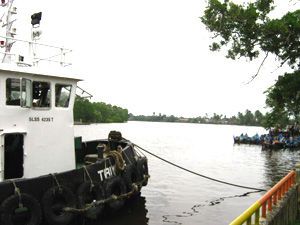 He said Kuala Similajau people have been leading their precious way of life since time immemorial as the Sungai Similajau and the sea are rich in fish and prawns among others, on which they could depend for a living.
He said they believed that development must benefit the people on the ground also and not cause harm to the environment, land, water and life.
"There are so many developments projects which one can choose, but let us pick the good ones.
"So the folks asked that the land near the bank of Sungai Similajau from the mouth of the river going inwards for about one thousand acres be earmarked to be Kampong Kuala Similajau," he said.


Are you sure you want to delete this comment?
This action cannot be undone.