




Academicians demand end to probe against Aziz Bari
More than 120 academicians and researchers have called on the authorities to cease investigations against Universiti Islam Antarabangsa (UIA) law professor Abdul Aziz Bari and accord him his full right to academic freedom and free expression.
More than 120 academicians and researchers have called on the authorities to cease investigations against Universiti Islam Antarabangsa (UIA) law professor Abdul Aziz Bari and accord him his full right to academic freedom and free expression.
As an academician, Aziz's expertise is in the area of the country’s constitutional law his prerogative but also his responsibility to share his thoughts with the ppeople on matters related to his field of interest and scholarship, they said.
 “As academicians and researchers, we view the action taken by IIUM (UIA) as a gross violation of Prof Aziz Bari's academic freedom as well as his right to free expression...
“In fact, Malaysia needs more scholars like him to give their expert views without fear or favour on issues of national concern,” said the joint statement endorsed, among others, by scholars such as Clive Kessler, Edmund Terence Gomez, Denison Jayasooria and Lim Teck Ghee ( left ).
Condemning Aziz’s suspension - which UIA lifted yesterday - they also demanded that the police end their investigation against the law expert under the Sedition Act and the Malaysian Communications and Multimedia Commission (MCMC) under the Communications and Multimedia Act 1998.
The probes are into Aziz’s remarks carried by Malaysiakini involving the Selangor Sultan Sharafuddin Idris Shah and the raid at a church in Damansara Utama by the Selangor Islamic Affairs Department.
Aziz is of the opinion that the sultan’s decree was “unusual and inconsistent”.
“Prof Aziz Bari's suggestion that a ruler has acted beyond his constitutional bounds is a legitimate one. There is no evidence that he has acted, overtly or by implication, to incite hatred against the ruler.
“Our reading of the Sedition Act 1948 is that it validates any criticism of a ruler if such criticism is intended to constructively show that the ruler has erred,” they said.
'UIA an extension of government'
The academicians also said they were “extremely perturbed” by the statement of UIA rector Zaleha Kamaruddin that Aziz had acted “against the interests of the university”, since his interpretation of the constitution had nothing to do with compromising or undermining the interests or integrity of UIA.
“The hallmark of any institution of higher learning is the celebration and promotion of intellectual freedom, autonomy and responsibility by its faculty and student body.
“The credibility of a university is undermined if its management does not value intellectual freedom of expression through the pursuit of open discussions, debates and dissenting opinions in a scholarly and civil environment.”
In addition to calling for the authorities to end their investigations, the academicians also demanded that academic rights and freedom be fully respected by the repeal of the Sedition Act 1948, which they said “has unacceptable potential for abuse against fundamental freedoms of expression to be repealed” as well as the University and University Colleges Act 1971, which jeopardised “academic freedom and campus democracy”.
The Malaysian Bar also blasted UIA’s action against Aziz as suggesting it was an “insidious extension of the machinery of the government”, which was already investigating the constitutional law expert for sedition arising from the same comment.
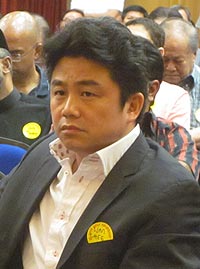 “Such an attitude is wholly out of place in a democratic society, and unbecoming of someone entrusted with a position of leadership in an academic institution that claims to be world-class,” Bar Council president Lim Chee Wee (
right
) said in a statement.
“Such an attitude is wholly out of place in a democratic society, and unbecoming of someone entrusted with a position of leadership in an academic institution that claims to be world-class,” Bar Council president Lim Chee Wee (
right
) said in a statement.
“Higher-education teaching personnel, like all other groups and individuals, should enjoy those internationally recognised civil, political, social and cultural rights applicable to all citizens.
“Therefore, all higher-education teaching personnel should enjoy freedom of thought, conscience, religion, expression, assembly and association as well as the right to liberty and security of the person and liberty of movement.
“They should not be hindered or impeded in exercising their civil rights as citizens, including the right to contribute to social change through freely expressing their opinions on state policies and on policies affecting higher education.”
'1993 saw worse comments'
Recounting the debates that were sparked surrounding the 1993 amendments to the federal constitution, Lim said Aziz’s comments were considerably milder than comments that were expressed during the discussions two decades ago.
“Those comments, which involved far stronger criticisms (if not attacks) against the royalty, made in Parliament and in the media, all went unchecked,” he noted.
Lim also lauded the stand taken by Deputy Higher Education Minister Saifuddin Abdullah against Aziz’s suspension by UIA.
Related stories


Are you sure you want to delete this comment?
This action cannot be undone.