




Beware of Bersih 3.0 aftershocks
COMMENT Bersih 3.0 is the government's silly but dangerous cat-and-mouse game. The cat hid in a dark and slimy corner to lay the trap. The mouse got snared. Then the cat came out and beat the daylights out of its quarry: "We finished them; the reformasi is over." Really?
COMMENT Bersih 3.0 is the government's silly but dangerous cat-and-mouse game. The cat hid in a dark and slimy corner to lay the trap. The mouse got snared. Then the cat came out and beat the daylights out of its quarry: "We finished them; the reformasi is over." Really?
Let's get one thing clear. The whole attack was premeditated and calculated to inflict maximum injury. And it did. This was to silence public dissent against an increasingly unpopular regime.
But the storm is far from over. It has become a global phenomenon spreading to over 80 cities across 35 countries where there are Malaysians.
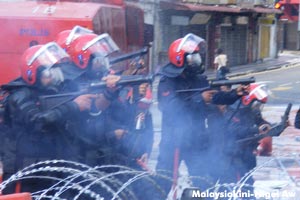
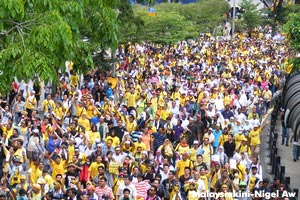 The world is watching yet it was another brutal and senseless attack on a peaceful assembly. Just like last year and the one previously.
Police have been accused of manhandling and assaulting media personnel during the Bersih 3.0 rally, with several reports of mainly videographers and photographers being arrested while attempting to record incidents of the carnage.
Yet, some in the establishment media were quick to start the blame game, declaring the government innocent of wrongdoing when the jury's still out.
Among those arrested was Malaysiakini photojournalist Koh Jun Lin whose camera and memory card were confiscated. His camera was later returned.
Another photographer was ordered to delete his shots of the fiasco, but when he refused, a policeman removed his memory card and destroyed it.
A Guangming photographer was arrested and later released. But his camera, worth about RM12,000, went missing.
A Sin Chew reporter was beaten to a pulp. It was also reported that a Channel News Asia video cameraman, Kenny Lew, was punched.
A Merdeka Review photographer also claimed she was assaulted by four police personnel who attempted to seize her camera and mobile phone.
 In a live crossover interview,
Al Jazeera
journalist Harry Fawcett reported that he and his cameraman were faced with alleged police violence as well.
In a live crossover interview,
Al Jazeera
journalist Harry Fawcett reported that he and his cameraman were faced with alleged police violence as well.
"I'm coming to you via Skype from an iPad because the Malaysian police have just busted our camera," said Fawcett.
Malay Mail has confirmed that its photographer Arif Kartono was punched by a uniformed police personnel and had his camera smashed.
Grand deception
Even as they were doing that, people were furiously posting videos and still shots onto YouTube and social media instantaneously. And the police were silly enough to believe they can hide this from the eyes of the world.
It was the grand deception by Home Minister Hishamuddin Hussein that provoked protesters. He had said the Bersih protest against electoral fraud and the demand for a clean and fair election was not a security threat.
In the same breath, he ordered the police to crack down and sealed off Dataran Merdeka.
The police got a last minute court order to keep the protesters away.
His actions made a mockery of Prime Minister Najib Abdul Razak's so-called law reforms to open up public space.
The last straw was when police started encircling Dataran, not with barbed wires as reported by the media but with razor-sharp barbs - the kind used to protect security establishments like prisons. The kind that the Israeli army uses against Palestinians.
"It was the barbed wire that did it for me," blogged Marina Mahathir.
"Up till Friday afternoon I was still unsure about going.
"Then I saw the photos of the police rolling out the barbed wire. I saw red. Since when did our police, or whoever is their boss, roll out barbed wire against their own people? Are we thugs? Terrorists? Thieves?
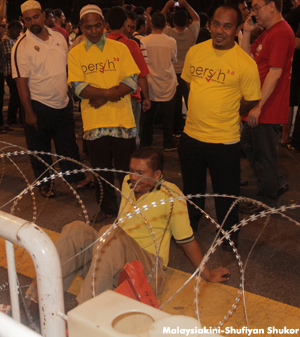 "This is razor wire... so I decided to go." This is no hothead but a respected blogger and civil society advocate.
"I'm sorry that there were people who got injured, both protesters and police. None of that was really necessary. A few weeks ago, at the International Women's Day rally in PJ, 5,000 people turned up and there was absolutely no violence because the police left everyone alone to do their thing. The same could have happened today, if only the powers-that-be could have been wiser."
Why is the ruling coalition trying to rob the bank in broad daylight?
Because, as Professor Damien Kingsbury said two days earlier: "Malaysia is facing a political crisis. Its government appears to have lost electoral legitimacy and is facing its biggest challenge to holding on to power since independence half a century ago."
Kingsbury is director, Centre for Citizenship, Development and Human Rights at Deakin University, Melbourne, and is coordinator of the Australian Friendship observer mission to the East Timor elections, as well as having been an accredited observer to elections in Indonesia and Cambodia.
The government's handling of the Bersih sit-in protest at Kuala Lumpur showed its authoritarian nature, according to Australian Senator Nicholas Xenophon, who was at the rally. He is part of a seven-member international polls watch team.
Prime Minister Najib Abdul Razak was conspicuous only by his thundering silence throughout the whole episode, leaving his cousin the home minister to lure the mouse into the trap.
Finally, he broke his silence when protesters were roughed up and many arrested.
Bernama quoted him as saying in Kuching (the Cat City) that people, including those from the opposition, are allowed to hold gatherings so long as they are peaceful and held at appropriate venues.
"We tell them if you want to gather we give you the Bukit Jalil Stadium, we are even willing to give you Stadium Merdeka," he said. He said the same thing last year. Then the police were ordered to open fire.
A cat has nine lives, they say. Now Bersih has a few more lives to go.
BOB TEOH is a retired journalist, a polls watcher and a soul agent.


Report this comment
Are you sure you want to delete this comment?
This action cannot be undone.