




MPPP gets earful on hillslope development
Penang municipal councillor Lim Mah Hui has taken the council (MPPP) to task for sidelining the public interest when it comes to development in general and projects on hillslopes in particular.
Penang municipal councillor Lim Mah Hui has taken the council (MPPP) to task for sidelining the public interest when it comes to development in general and projects on hillslopes in particular.
He was referring to the spate of protests by angry residents in various parts of Penang island, whenever development has threatened the environment and their lifestyle.
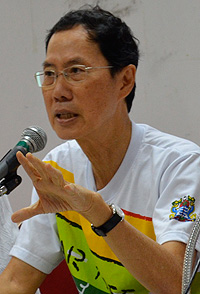 Mah Hui
(right)
said the residents are mainly those in the middle class or above.
Mah Hui
(right)
said the residents are mainly those in the middle class or above.
They live in such areas as Pykett Avenue, Moulmein Road in Pulau Tikus, Lembah Permai and Mount Pleasure in Tanjong Bunga, Savoy Garden in Ayer Itam, and Taman Desaria in Sungai Ara.
"Suddenly a 30-storey apartment is approved in a low-rise residential area where individual house owners have difficulty getting permission to build three-storey houses," he said in a 10-minute speech at the full council meeting yesterday.
"Or suddenly a high retaining wall appears a few (metres) from their backyard threatening their safety; or a steep hillslope is cut, causing erosion and flooding to their houses as happened in parts of Tanjong Bungah.
"If (this were) limited to one or two (incidents), it would be bad enough. But when they appear in increasing frequency, it should serve as a signal to the MPPP that something is not quite right.”
The Pakatan Rakyat state government under Chief Minister Lim Guan Eng has frequently reiterated that hillslope development was the work of the previous BN administration.
At a recent dialogue session, Guan Eng had assured residents from Sungai Ara that his administration will not approve hillslope developement (on slopes of 75m gradient or more) as long as Pakatan is in power.
Consultative approach urged
Mah Hui, who was appointed councillor under the NGO quota, also lamented the "growing gap between planning and people", saying that people should be at the centre of the development and planning process.
Planning, he said, should not be a top-down, technocratic process, but should start as a bottom-up process involving ordinary people in making decisions that affect their everyday life.
"But right now many neighbourhoods are beginning to feel that the planning and approval process has left them behind as it is top-down, bureaucratic and developer-centric with little concern for the interests of ordinary citizens and residents.”
Mah Hui also noted that special committees have been set up to liaise with developers, architects and engineers to facilitate and fast-track development projects.
However, there are few, if any, committees or avenues to solicit or to address the concerns of ordinary citizens, beyond the monthly meetings to hear complaints from ratepayers.
Mah Hui suggested that MPPP takes the initiative to hold consultative meetings with not only those neighbourhoods affected by development projects, but the public at large, to explain the possible impact of major projects and to solicit input and feedback before approval.
This would be better than the process of checking off technical requirements and approving the projects speedily, only to deal with objections, appeals and protests from irate residents down the line, he stressed.
 "I suggested last year that, instead of relying on reports of consultants hired by developers, we should have developers contribute to a common pool of funds which the council can (use to) hire independent consultants," he said.
"This would minimise conflicts of interest. What has happened to this suggestion?"
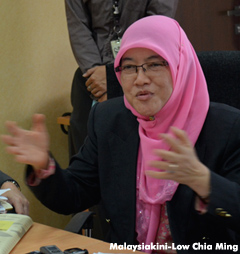
MPPP president Pattahiyah Ismail (right) , who was present, told reporters that she would reply to Mah Hui's suggestions via a written reply.
"This way, I can addresss each and every issue that he brought up," she explained.


Are you sure you want to delete this comment?
This action cannot be undone.