




Tariq warns against 'playing with Islam and hudud'
As the country’s Malay based parties - PAS and Umno - try to outdo each other by showing who is more Islamic, an influential Islamic thinker and philosopher has warned against using hudud on non-Muslims.
As the country’s Malay based parties - PAS and Umno - try to outdo each other by showing who is more Islamic, an influential Islamic thinker and philosopher has warned against using hudud on non-Muslims.
In a lecture organised by the Penang Islamic Foundation, Prof Tariq Ramadan said even in the harshest Islamic position, to say hudud is to be implemented on non-Muslim is “un-Islamic”.
Tariq - who lectures at Oxford University - warned against political parties “playing with Islam” and using hudud as a means of competition to show who is more Islamic.
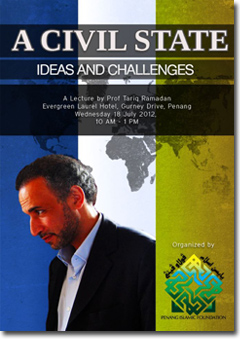 “Why attract the emotions of Muslims? To feel that this is good is in fact something that is wrong. Be careful with this type of politics, it is not right,” he warned during the two-hour lecture in Penang themed ‘A Civil State’.
“Don’t try to use Islam to attract vultures because the elections are coming. The first people to resist is you, the citizens who must be clear on what Islam is and not to play or be distracted by these discourses,” he told the 500-strong crowd yesterday.
Tariq - who is scheduled to speak in Kuala Lumpur today - cautioned against the implementation of the Islamic jurisprudence in the current context as the victims would eventually be “the poor and the women who are more fragile”.
He added that the Islamic law would most probably not be used against the royalty - who he claims use public funds to travel overseas for their personal enjoyment.
“I see this every day. In Switzerland, we see them involved in corruption and prostitution but nothing has happened to them,” he said, referring to Arab kings and princes.
“Back in their countries, for example, the poor Pakistani guy who is involved in the same would have to face hudud as the leaders want to show people how Islamic they are,” he added.
“But they are not. They are just being hypocrites,” he quipped, at the session launched by Deputy Chief Minister I Mansor Othman and chaired by Islamic Renaissance Front chairperson Ahmad Farouk Musa.
‘Implement justice, not punishment’
Instead of hudud, Tariq advocates focussing more on the Sharia’ - which he describes as mainly Islamic principles and not a set of laws to punish people.
He added that the Sharia’ is a set of objectives to promote respect for justice and dignity of all people, and not just for the Muslims as Islam is based on principles and ethics.
“If you want to start implementing justice, stop talking about punishing, and start talking about social justice and transparency,” said the grandson of Hassan Al-Banna who founded the Muslim Brotherhood’
“If you want to punish, punish the corrupt. Don’t play with Islam,” warned the 49-year-old Swiss citizen of Egyptian origin.
In Malaysia, Tariq proposes that to promote Sharia’, the government must be more serious about education, justice, fighting corruption and the manner in which women and migrants are treated.
Women are to be given their rights to be “present and vocal” as the Prophet was very clear about the matter, he added.
He advocates focussing more on implementing Sharia’ in the heart - to be generous, tender and courageous - and to immediately act against corruption and injustice.
“I said all this at an Islamic convention and was heavily criticised. But my position is clear. I am against the death penalty because I am for justice and God is justice,” he said.
“I am not going to support a symbolic representation of my religion but go against the very essence of what God is and that is justice.”
‘Suspend death penalty’
Meanwhile, Tariq spoke passionately against the death penalty - which is still implemented in Malaysia - and reiterated his call for a moratorium on the punishment.
Although Muslims cannot avoid the fact that the matter is stated in the Quran while stoning is mentioned in the Hadith, he asked if the law is to be carried out “literally without considering the current context and the evolution of time and situation”.
He called on Muslim scholars to consider three questions before supporting capital punishment: (1) what the Quran or Hadith says? (2) what are the conditions to consider? and (3) what is the current context?
“I am stressing that we have to suspend the death penalty because we cannot implement it in societies we have today. We can’t kill people like this. Whatever you do in Islam, you cannot forget your ethics or justice,” he said.
“Justice is justice for all and even tyrants need to be judged according to the rule of law , not by killing people as this is not the dignity of our religion,” he added, citing the case of how former dictator Muammar Gaddafi was killed.
“He may be a tyrant and I oppose what he has done in history but the way in which he was killed was unacceptable, as if he was as animal. And we are happy because he was a tyrant?” he queried.


Report this comment
Are you sure you want to delete this comment?
This action cannot be undone.