




No more comment on hill slope projects in Penang
The Penang state government and the Penang Municipal Council (MPPP) have decided to stop further comments on hill projects because of the many cases related to the matter that are pending in court.
The Penang state government and the Penang Municipal Council (MPPP) have decided to stop further comments on hill projects because of the many cases related to the matter that are pending in court.
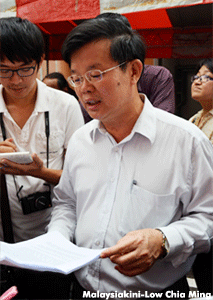 State executive councillor in charge of local government Chow Kon Yeow (
right
) said today there are also a number of cases related to hill land that have been filed with the Appeal Board.
State executive councillor in charge of local government Chow Kon Yeow (
right
) said today there are also a number of cases related to hill land that have been filed with the Appeal Board.
Chow, who is also MP for Tanjong, said the state government and MPPP will from now cease to make any statement that could be deemed prejudicial to the ongoing appeals.
"The legal issues are still debated and all involved parties will present their arguments when the cases are heard by the Appeal Board," added Chow, who is state DAP chief.
He said this at a briefing for journalists in Penang to clarify in detail the burning issues on hill slope development, including MPPP's decisions related to hill projects categorised under 'special status'.
Chief Minister Lim Guan Eng has pledged that his administration will not approve such projects.
He told an NGO forum last week that the State Planning Committee, which oversees the approvals of development projects, would review the 19 projects approved under special status.
The state BN, while distancing itself from approvals given to hill projects prior to 2008, has asked for more transparency in the release of minutes of meetings related to hill slope project approvals.
A former MPPP acting director, Khoo Boo Soon, has claimed that special projects could be revoked in the public interest, while MPPP president Patahiyah Ismail shot back, saying such action would bankrupt the municipal council.
This is Chow's response to the various questions surrounding the issue, which has hogged media headlines of late:
Q: Is development allowed on land 250ft above sea level in Penang?
Chow: Policies related to hill land development on the island of Penang can be traced back to 1989 when, for the first time in our history, a mention of height control can be found in the 1987 MPPP Structure Plan, which was approved by the State Planning Committee on Oct 19, 1989. In this document, it is stated that development on land above 200 feet has to be closely controlled.
 On Sept 13, 1996, a Development Control and Planning Master Plan was approved by the State Planning Committee chaired by the then Chief Minister Dr Koh Tsu Koon and also attended by the then MPPP president Dr Teng Hock Nan.
Among the functions and purposes of this plan was to better reflect the aims, objectives, and strategies of the 1987 Structure Plan as well as to introduce a system of classification for land use. Under this plan, there are indeed plots of land above 250 feet that were zoned for residential use.
Structure Plan exception for 'special projects'
The 250-feet control came into effect after the Penang Structure Plan 2020 was gazetted on June 28, 2007. This plan forbids development in areas exceeding 250 feet above sea level and on hill-slopes with a gradient of more than 25 degrees.
However, there is an exception for "special projects", allowing limited development requiring stringent control with regard to development guidelines, EIA approval, as well as approval from the State Planning Committee.
There was no definition given for "special projects" in this plan, which was approved by the SPC chaired by then Chief Minister Dr Koh Tsu Koon and attended by the exco members, including Dr Teng Hock Nan, Teng Chang Yeow, Koay Kar Huah, and Lau Chiek Tuan.
Q: Doesn't the Penang Structure Plan 2020 say housing development above 250ft is not allowed?
Yes, DK3 L2 in the Penang Structure Plan 2020 states that housing, hotels, resorts, commercial, and industrial development cannot be allowed on hill land gazetted under the Land Conservation Act 1960, and land above 250ft and/or with gradient exceeding 25degrees.
However, DK3 L4 states that limited development for "special projects" on land above 250ft is allowed. Despite the lack of definition and elaboration on what constitutes "special projects", the council has been approving development on land above 250ft, even during the few months between the gazetting of Penang Structure Plan in 2007 and until the change of state government in March 2008.
If BN is so keen on saving the dying and crying hills, it must at the very least account for the six projects it approved in this very short period of time.
Going back to the question, yes DK3 L2 says no development, but DK3 L4 further states "limited development" is okay under stricter control. What does "limited development" mean? Feedback from JPBD, the council's planning department and legal adviser all agree that DK3 L4 serves as an exception to DK3 L2.
Q: What are "special projects"?
DK3 L4 of the Penang Structure Plan 2020 does not spell out explicitly what a "special project" is. In June 2009, the State Planning Committee approved guidelines for the abovementioned "special projects".
The purpose of creating the new guidelines was to address the lack of definition in DK3 L4 in relation to DK3 L2 as well as DS30 (relating to housing), which states "housing development will only be allowed in areas that have been identified".
DS30 L5 further states that zones that are approved for housing include areas that have been re-zoned for housing and approved before the adoption of the Penang Structure Plan.
Going by DS30 L5, areas zoned for housing in the 1996 Development Control and Planning Master Plan should therefore remain to be allowed for housing development.
To address this overlap in policies and intentions, the SPC in 2009 approved new guidelines to define "Special Projects" under two categories. Category 1 includes public infrastructure projects like cable cars, roads, railway, reservoirs, bridges, helipads, etc.
Category 2 - housing development: (i) change of land use approved before the adoption of Penang Structure Plan 2020; (ii) development projects which have prior planning permissions; and (iii) areas shown as housing zones according to the 1996 Development Control and Planning Master Plan (until the Local Plan is gazetted).
Q: Is the council automatically approving renewals of planning permissions without reviewing and imposing new conditions? Can the council revoke planning permissions?
Section 24(1) of the Town and Country Planning Act 1976 states "A planning permission granted under Section 22(3) shall, unless extended, lapse 12 months after the date of grant thereof if, within that time, the development had not commenced in the manner specified in the planning permission."
Penang Structure Plan 2020, DS31 L1 states that a planning permission can only be extended for five times.
Section 24(5) states that in granting an extension, the local authority may impose new conditions. The council can even revoke a planning permission, but unless prior conditions or laws were broken, the council's practice has been to grant extensions according to existing guidelines.
In the landmark case of MPPP vs Sungai Gelugor Co-op Society Bhd, the Federal Court held that the council's new condition when granting extension to a planning permission was wholly null, void and of no effect.
The council's legal adviser would be a better person to elaborate on this. However, it appears that even imposing new conditions have to be reasonable, fair and not oppressive.
The MPPP vs Sungai Gelugor case decided that conditions must not be unreasonable, as conditions can be held void for uncertainty and consequently, unenforceable.
This case also decided that although the Town and Country Planning Act confers discretion to the local authority to attach conditions as they ‘think fit', this power is not unlimited. It must have a planning purpose and it must relate to the permitted development - i.e. there must be connection between the permitted use and the conditions imposed.
Q: What compensations are involved if a planning permission is revoked?
Section 25(7) provides for compensation for expenditure incurred in implementing the approval prior to the revocation.
However, if development is completely disallowed, without giving regard to the change of land use or previous approvals given before the Penang Structure Plan came into effect, there is no guarantee that landowners who have purchased land at high prices will not seek compensation for unfair denial of development rights. This is also relevant to land already marked for housing development purposes in the 1996 plan.
Relevant to this is Section 30(1), which provides that the local planning authority may, with the approval of the State Authority, by a requisition notice discontinue any use of land or impose conditions for the continued use of land.
An appeal can be filed with the Appeal Board and the notice shall be suspended until the determination or withdrawal of the appeal.
Section 30(5) provides, if the owner of the land has, in consequence to the requisition notice, suffered damage in the form of depreciation in the value of the land or incurred expenses or costs in carrying out works in compliance with the notice, he may claim from the local planning authority compensation for the damage, expenses or costs.
Further, Section 37 allows a land owner who has been denied planning permission under Section 22(3) on grounds that the land is indicated in the development plan for a public purpose or whose land has been affected by a requisition notice under Section 30, to claim that the land is incapable of reasonable beneficial use and may therefore serve on the local planning authority a purchase notice requiring his interest in the land to be purchased.


Are you sure you want to delete this comment?
This action cannot be undone.