




BN 'will lose Baram seat' if mega-dam is built
The BN risks losing a stronghold - the Baram parliamentary seat in Sarawak - in the next general election if the state government persists with building a mega-dam there.
The BN risks losing a stronghold - the Baram parliamentary seat in Sarawak - in the next general election if the state government persists with building a mega-dam there.
This is because more than 80 percent of the 21,716 voters and their families are claimed to be against the project.
 “If the anger of the people can be translated to votes, the BN is certain to face defeat,” said Thomas Jalong
(left)
, the president of Jaringan Orang Asli Semalaysia.
“If the anger of the people can be translated to votes, the BN is certain to face defeat,” said Thomas Jalong
(left)
, the president of Jaringan Orang Asli Semalaysia.
BN’s Baram MP Jacob Sagan Dunggau, a senior vice-president of the Sarawak Progressive Democratic Party, has been re-nominated by his party to defend the seat for the fifth time.
In the 2008 parliamentary election, he won the seat with a majority of 4,044 votes. At that time, the dam had yet to be proposed.
In last year’s state election, BN candidate Dennis Ngau did badly in areas along the upper and middle Baram River because more than 60 percent of the Orang Ulu community voted against him.
 He only won the seat because of strong support from the Iban living along the lower reaches of the river.
“This time (around,) more people are against the BN. The people are angry with the BN government,” said Jalong.
“In Long Anap, where Dunggau (right) and I come from, more than 90 percent of the villagers including his relatives are strongly against the construction of the dam. Our longhouse, church, school and (ancestral) land will be (submerged) by the proposed dam.
“We are not against Dunggau per se . We love him, but our love and concern for the future of our children are greater. If we are removed from our lnad, where would we go?”
 Jalong was speaking after he and more than 50 indigenous peoples delivered a petition supported by thousands of signatures to the Chief Minister’s Office at the state secretariat building in Kuching yesterday.
The group represents at least 18 longhouses in the upper and middle Baram areas.
Jalong said he views the planned construction of the dam with great concern, because of its potential adverse implications, particularly on the rights, livelihood and future of the indigenous peoples.
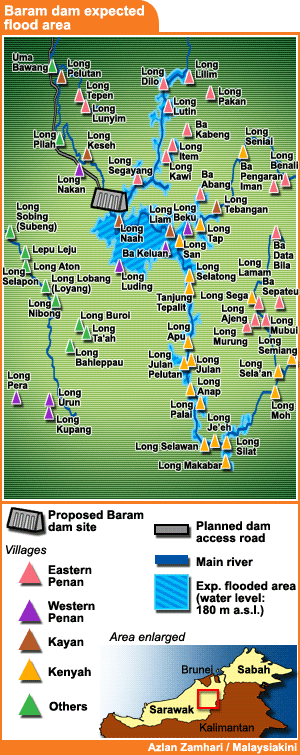
About 20,000 residents would be forced to move away from their ancestral lands, homes and farms in order to accommodate the RM4 billion dam, which will submerge an area the size of Singapore.
“Land is not only regarded as an economic resource but is fundamental to our social, cultural, spiritual and political identity and survival,” Jalong explained.
“No, we do not have any political agenda. Our agenda is to save our people and our land. I was born and bred in my village and I love staying there.”
‘People not consulted’
Echoing these sentiments, Peter Kallang, who heads Save Sarawak’s Rivers Network (Save Rivers), reiterated that the majority of the people of Baram do not want the dam.
 Save Rivers is a coalition formed by indigenous peoples and NGOs to stop 12 proposed dams in Sarawak.
“If you look at the United Nations Declaration on the Rights of Indigenous Peoples, which Malaysia has agreed to adopt, the plans for constructing the dams have to stop immediately," said Kallang (right) .
“All work on access roads to the dams, including the soil studies, have to be stopped (as well).”
Commenting on the issue, Baram Protection Action Committee head Philip Jau said: “The government has not been transparent at all with the plans for the Baram dam.
“They have not asked the people what they think, but have commenced (work) to start (land) surveys for access roads. We do want development and roads, but we don’t want an access road specifically for the mega-dam.
“When we met with the superintendent of the lands and survey department in Miri, he did not mention the access road or why it is being built.
"This is an example of how they continue not to be transparent with their plans.”
He said he hopes the government will listen to the voices of the Baram residents and stop all construction related to the dam.
“All our protests and signatures are in the petition which we handed to a representative of the chief minister,” he said, expressing disappointment that they were unable to explain their objections personally to Abdul Taib Mahmud.
Copies of the petition will be sent to Prime Minister Najib Abdul Razak, the Human Rights Commission, Sarawak Energy Bhd CEO and contractors involved in the project.
Related story:
Baram natives: Don't submerge our homes
The writer, who uses a pseudonym, is based in Sarawak.


Are you sure you want to delete this comment?
This action cannot be undone.