




'Rich Malaysia, Poor Malaysians'
BOOK REVIEW Oftentimes, we are urged to tolerate the worst of economic strains. Inequality, overworking, environmental destruction and privatisation of services for basic needs are all justified on the basis that these are necessary to maintain some standard of life.
We’re told that humankind will be blessed with a self-regulating market fulfilling all needs at fair prices that match wages, courtesy of the freedom exercised by billionaires and their gradually trickling down of ‘goodwill’.
But when probed further, the yearning for a profitable universe is not so practical after all: ultimately logic says that no such perfect market has ever existed.
The connection between ideals and reality, and principles and policy, must be kept in mind. For the temptation is to slide into thinking that practicality answers everything, without ever considering the logic which grounds the choices to begin with. This merely replicates the problem of contemporary society in general.
With already so much cynicism in the air, hopes for anything beyond than the confines of our individuality dissolve into either general platitudes or bitter self-absorption where the only thing that matters is personal pleasure, with the residual hope that someone else might benefit from it.
This relationship between ideals and reality gets a much needed reorientation, and indeed emphasis, in ‘Rich Malaysia, Poor Malaysians’ by Anas Alam Faizli, where reflections on the major issues facing Malaysia’s economic uncertainties are woven with reflections about education, love, philosophy, politics and protest.
It is a breath of fresh air. Rarely in discussions of policy do we ever hear a perspective that reminds us of such an important truth: that the personal is political, that economic policies must be grounded on firm ideals whether we like it or not, and that as human beings our potential depends not on how many trips to the mall we should take, but the opportunity to flourish as human beings through an education that acknowledges one’s talents and potential.
The message, ultimately, is clear as day: a responsible, and indeed humane, government should recognise and actualise that state of affairs to the best of its ability.
But Anas does not stop there. Ordinary citizens too can make a difference without merely demanding from the government. Three articles to this anthology present careful reflections on the importance and ideals of volunteerism to safeguard a process of change, outreach and education that is organic and youth driven.
Thus, the quest for a better Malaysia is not merely about changing the government, but also galvanising the hearts and minds of Malaysian youth towards playing a role as active educators making a change beginning with their immediate communities.
Indeed, overall his writings on education stand out significantly. This in fact is where the book is bravest: contrary to the cosmetic initiatives we typically come across (more gadgets or facilities) Anas calls for more human development: he urged for a greater reading culture towards a system that embraces critical discourse and a social conscience.
This would not only lead to a more intelligent workforce, it would make room for moral citizenship, where students see their roles as agents towards ending oppression, not merely careerists seeking only material comforts.
Rightly, Anas reflects deeper. It is not only new policies that are needed, but an appreciation of teaching as a form of love - fundamentally, a relationship between feeling, thinking, living, expressing and searching individuals, vulnerable in a world that is increasingly anxious to reduce them both as mere ‘human capital’.
Conserving resources
Make no mistake though. This book is not one that merely moralises. Anas’ conclusions are grounded on a careful consideration of the latest facts and figures, enhanced significantly by his experience working locally and internationally in the oil and gas sector.
Here the important issue of Malaysia’s oil reserves and the right policies to safeguard it for the future is given meticulous treatment. It comprises the first four chapters of the book, setting the tone for the rest of the pieces with the message that ultimately a nation’s future is meaningless if it does not secure its most valued natural resources.
Though evidently proposing concrete alternatives, the book is grounded on a deep concern for activism - that is, about reaching out on the ground. This is not surprising after all, as Anas’ intellectual and political outlook was deeply shaped by his experience during Reformasi, which spurred his desire to play an active role in changing Malaysia for the better.
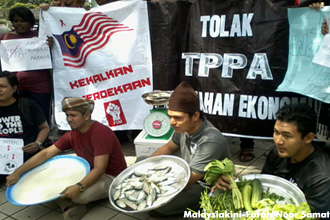 He found it in intellectual discourse, where he clearly did not disappoint. One must acknowledge the boldness with which he steered Bantah TPPA, a coalition of NGOs worried about the compromises Malaysia will make in the name of the TPPA, towards a full-fledged grassroots movement, with support from student groups and average households who otherwise would be indifferent to such technical technocratic jargon.
This in many ways is where the book is most practical, for it presents two essays serving as a guide for the average citizen on how to better understand the complexity that is the TPPA.
A personal favourite of this reviewer would by the ‘Myth of the Rich and Poor’, a piece that reflects on the problem of inequality.
It dissects the dangers of the libertarian myth which continues to be propagated, implicitly and explicitly not only by certain technocrats and think tanks, but have come to shape the perspectives of ordinary Malaysians.
It also dismisses the idea of hard work as a miracle road to wealth, as it complicates some of the taken for granted assumptions about simplistic claims about meritocracy.
Overall, the spirit of the book could have addressed the issues of labour in more detail and this is something I hope Anas will address in his subsequent endeavours.
Regardless ‘Rich Malaysia, Poor Malaysian’ remains a tour de force in the local intellectual landscape, as a venue for ideas that bridge policies and the hopes of the people, the responsibility of educators and the potential of their students and more important the problems of the present and the potential of a brighter future.
AHMAD FUAD RAHMAT is the editor of projekdialog.com .


Report this comment
Are you sure you want to delete this comment?
This action cannot be undone.