




Abdullah blames war on terror for anti-Islamic bigotry
Prime Minister Abdullah Ahmad Badawi said that reaction to the Sept 11, 2001 attacks on the United States had spawned anti-Muslim "bigotry" that equated Islam with terrorism.
Prime Minister Abdullah Ahmad Badawi said that reaction to the Sept 11, 2001 attacks on the United States had spawned anti-Muslim "bigotry" that equated Islam with terrorism.
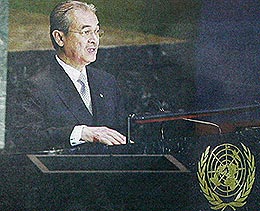 "There is an urgent need to stop tarnishing the Muslim world by unfair stereotypes," Abdullah told world leaders gathered at the UN General Assembly in New York on Monday.
"Most damaging of all is the increasing tendency to attribute linkages between international terrorism and Islam," he said. "The time has indeed arrived for us to debunk, once and for all, the theory that there is a clash of civilisations."
Abdullah is the current chairperson of the 57-member Organisation of the Islamic Conference, the world's largest grouping of Muslim countries.
Arguing that terrorism could not be fought with military force alone, Abdullah stressed the need to address the "root causes" of the problem.
"We must promote genuine dialogue and rid ourselves of the prejudices and bigotry triggered by Sept 11," he said.
"We must cease associating Islam with violence, poverty and indignity. We need to clear the confusion of linking the problems faced by some Muslim countries with Islam the religion."
Reforms needed
And in a thinly-veiled reference to the US-led invasion of Iraq, the prime minister condemned any international intervention launched without the backing of the United Nations.
 "If the law of the jungle were to apply, the small and the weak would certainly perish," he said, calling for reforms that would curtail the veto power wielded by the five permanent members of the UN Security Council.
"It is unjust that any one single country should be allowed the impunity of overruling at will, the wish of the majority," he said.
Urging the United Nations to take the leading role in restoring stability in Iraq, Abdullah also called for the deployment of a UN peacekeeping force in the Middle East to help revive the moribund "roadmap" aimed at ending the Israeli-Palestinian conflict.


