




Was Bank Negara aware of 1MDB fund transfers?
The authorities have frozen six bank accounts in the investigation into 1MDB and allegations that US$700 million had been banked into Prime Minister Najib Abdul Razak's accounts.
However, the question that remains is whether Bank Negara was aware of the alleged transactions, long before the accounts were frozen.
The authorities have frozen six bank accounts in the investigation into 1MDB and allegations that US$700 million from it had been banked into Prime Minister Najib Abdul Razak's personal accounts.
However, the question that remains is whether Bank Negara was aware of the alleged transactions before the accounts were frozen.
Malaysiakini has enquired of Bank Negara regarding the matter, as well as its role in the taskforce but the central bank declined to comment.
According to The Wall Street Journal and Sarawak Report , the largest sum reportedly transferred to the prime minister was RM2.6 billion (US$681 million) which was allegedly wired by the Abu Dhabi fund, Aabar, into the Najib’s private AmBank account in Kuala Lumpur in March 2013.
This is over 50,000 times more than the RM50,000 threshold set by Bank Negara for transactions that do not raise suspicion.
According to the central bank's anti-money laundering guidelines, any transaction above RM50,000 should raise a red flag among banks, which are then required to conduct 'customer due diligence' (CDD) by identifying the account holder, and the person who ultimately owns the accounts.
The identification includes the customer's name, IC number, occupation and purpose of the transaction. The bank is then required to submit a report to Bank Negara's Financial Intelligence and Enforcement Department, should the transaction be suspicious.
The first example of a suspicious transaction given by the central bank is an unusually large deposit, which means a RM2.6 billion deposit should have aroused suspicion.
Banks required to conduct risk assessments
The Bank Negara guidelines further state that banks are required to conduct a risk assessment on politically-exposed persons (PEP), such as heads of state, and if the risk is high, the bank must verify both the PEP's source of wealth and source of funds.
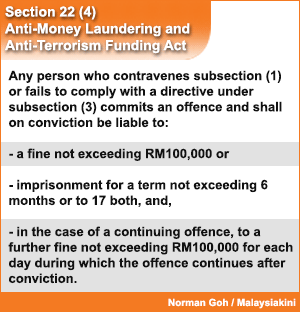
Non-compliance is punishable under Section 22 of the Anti-Money Laundering and Terrorist Financing Act, which carries a fine of up to RM100,000 or six months’ jail, or both. Those who commit a general offence under the Act can also be fined up to RM250,000.
 However, Bank Negara does give some wiggle room to banks. If there is concern that a CDD check may tip off the customer, the bank does not need to perform the check. However, it is still required to inform the central bank.
Bank Negara launched a formal investigation into 1MDB on June 3, and last Saturday Attorney-General Abdul Gani Patail revealed that the central bank was part of a special taskforce investigating the investment firm.
Gani said the taskforce, which he heads, discovered documents showing large sums of money had been transferred into Najib's personal account.
The taskforce has also obtained more documents after raiding three companies linked to the scandal, and today six bank accounts were frozen in relation to the investigation.
The 1MDB funds transfer into Najib’s bank accounts surfaced last Friday in reports by American financial daily The Wall Street Journal and whistleblower website Sarawak Report .
Najib has denied the allegations, calling it political sabotage masterminded by former prime minister Dr Mahathir Mohamad.
Related reports
Three of six frozen accounts belong to PM, says source
Was Bank Negara aware of 1MDB fund transfers?
WSJ dumps money trail docs online
Six accounts frozen in 'RM2.6b for PM' probe
Penang aims to put brakes on 1MDB land deal
Can the Agong act to depose a sitting PM?
So it’s okay for Najib to ‘steal’ elections?
If not PM, who benefitted from the RM2.6b?
PM must step down pending investigations
Najib, please, listen to these words of mine
Malaysia, the new ‘sick man of Asia’?
C4 wants to meet Bank Negara on WSJ claims
WSJ didn't implicate PM, says Tajuddin
Enough of fudging, straight answers please


Report this comment
Are you sure you want to delete this comment?
This action cannot be undone.