




Harakahs shake up will not affect editorial policy
The editorial policy of PAS party organ Harakah will not change although a new man has taken over as the paper's editor-in-chief, chairperson Mustafa Ali said today.
The editorial policy of PAS party organ Harakah will not change although a new man has taken over as the paper's editor-in-chief, chairperson Mustafa Ali said today.
He said Harakah , under the new stewardship of Suhaimi Mokhtar will continue to carry out its duties as the mouthpiece of the party and a platform for Malaysians to raise their views.
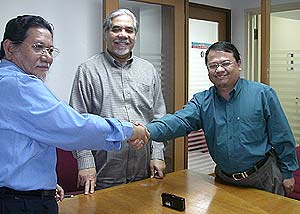 "There was never a need to change the policy. We will convey the party's aspirations and a platform for the rakyat to air their grouses," he told a press conference after witnessing the official handing over of duties from Zulkifli Sulong to 60-year-old Suhaimi.
Suhaimi who has been in the media line since 1967 will also continue as the press secretary to party president Abdul Hadi Awang, Mustafa said.
"The work is not new to him. He has been helping the paper indirectly after his retirement from Utusan Malaysia (in 2001). Zulkifli will also be with us at HarakahDaily (the paper's online version) and will also be handling other media-related programmes."
Mustafa who is also the party's vice-president had dismissed suggestions that the change would mean that the fortnightly paper - which boast a circulation of 150,000 per edition - would be more strict on articles that are critical of top party leaders.
Carrying out orders
"We accept constructive criticisms. Of course no one man is perfect and I don't think any leaders in PAS would reject any constructive criticisms," he said.
When asked of the reason for the change, Mustafa said as the paper's chairperson, he was merely carrying out the wish of party leaders in the Dewan Harian.
 "They did not tell me why and neither did I ask. The board of director which I head, is under the direction of party leaders. So more rightly you should ask them, not me," he said.
However, he did not dismiss the possibility that the decision may be due to the complaints against Harakah that were raised by delegates in the recent muktamar (PAS general assembly).
"But the complaints were not only editorial in nature. Administrative and financial management were also queried. On that point, I have stated that the party can always change the board of directors. But for reasons only known to them, they decided to only make minimal changes, which was to transfer Zulkifli out."
He also admitted that the grouses on editorial policy raised by leaders and grassroots were related to the paper's decision to publish the article by academic Farish A Noor.
Majority against writer
"On that issue, we have made the necessary decision which is not to publish any article by the writer (Farish)," he said.
He disagreed that the decision to ban Farish from Harakah would impinge on freedom of expression and stressed that the contents of his article which criticised the ulama (religious scholars) leadership was not the reason behind it.
"Like I said earlier, we are open to constructive criticism. But it's not the contents that are questioned, but the personality of the writer (Farish). I may not have the same opinion but the majority in the party seemed to think so."
 Farish's credibility was attacked by Muslim scholars including former PAS president the late Fadzil Noor, following an
interview
with a business weekly in which he was said to have humiliated Prophet Muhammad.
Farish's credibility was attacked by Muslim scholars including former PAS president the late Fadzil Noor, following an
interview
with a business weekly in which he was said to have humiliated Prophet Muhammad.
In addition, he was reported to written an article which allegedly claimed that the Prophet had sexual relations with 15 women, including a slave, Rayhana who until her death, did not convert to Islam.


