


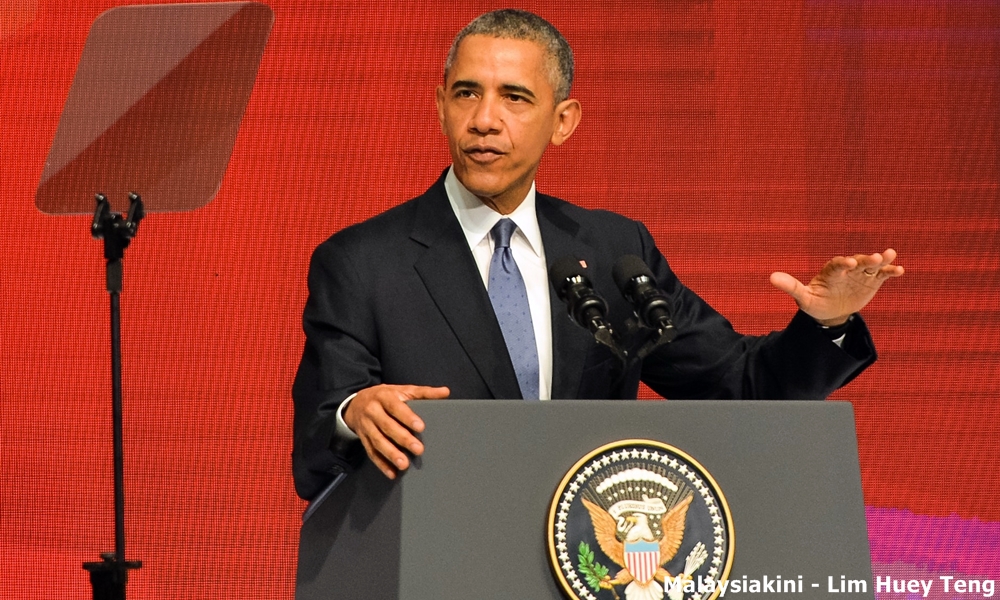

Obama meets M’sian civil society groups
The civil society groups which met United States President Barack Obama today were told that while the US recognised the violations of human rights in Malaysia, it must balance the issue with economic ties between the two countries.
"He said while the US recognised the civil liberties violation in Malaysia but at the same time they have to balance the issue with the economic ties they have with Malaysia.
"So that tells you quite a bit and this message was repeated not once but twice," Bersih chairperson Maria Chin Abdullah told Malaysiakini ...
The civil society groups which met United States President Barack Obama today were told that while the US recognised the violations of human rights in Malaysia, it must balance the issue with economic ties between the two countries.
"He said while the US recognised the civil liberties violation in Malaysia but at the same time they have to balance the issue with the economic ties they have with Malaysia.
"So that tells you quite a bit and this message was repeated not once but twice," Bersih chairperson Maria Chin Abdullah told Malaysiakini .
Senior US officials have repeatedly said that Obama would be "direct" in raising issues of civil liberties, human rights, and the treatment of the opposition in his meeting with Najib during his second visit to Malaysia.
Obama himself repeated the promise in a dialogue with students but the issue was barely highlighted in his public remarks after meeting Najib yesterday.
The closest statement which resembles this after Obama's meeting with Najib was a mention of civil society in passing.
"And as the prime minister discussed, we talked about the importance of civil society and issues not just in Malaysia, but in the region generally, and how we can promote those values that will encourage continued development and opportunity and prosperity," said Obama.
Maria acknowledged that Obama's public statement did not come out strongly on human rights but said the US president could be trying to be diplomatic.
However, in the meeting today, Maria said Obama briefed the group that he did indeed raise several issues when he met Najib yesterday.
National Human Rights Society (Hakam) president Ambiga Sreenevasan, who was also present at the hour-long meeting, said among the issues Obama said he raised with Najib included human rights, the jailing of former opposition leader Anwar Ibrahim and the treatment of political dissidents.
Both Ambiga and Maria said Obama was better prepared this time as he has a deeper understanding of the situation in Malaysia since his last meeting with civil society groups in April last year.
"He was well-briefed about what was happening in this country and recognised there are issues confronting us human rights defenders.
"I also expressed that since we met last year, the current situation has deteriorated and he listened and appreciated that we are now facing some difficulties," said Ambiga.
'RM2.6bil, other issues highlighted to Obama'
Among other issues raised with Obama included the RM2.6 billion in Najib's personal bank accounts, the dismantling and weakening of institutions, use of repressive laws, selective prosecution, and the Trans-Pacific Partnership Agreement (TPPA).
Meanwhile, Centre to Combat Corruption and Cronyism (C4) executive director Cynthia Gabriel, who was among the eight Malaysians at the meeting, said she was uncertain whether the message got across when Obama raised these issues with Najib.
"There is only so much we can count on there; the US president told our prime minister (what needs to be told) but he (Obama) wants his voice (US interests) to be represented as well," she said.
Malaysiakini chief executive officer Premesh Chandran said that Obama also reiterated his country’s commitment to press freedom.
"Obama said the US will put the spotlight if journalists or the media are being persecuted," he said.
Premesh added that the US president also gave his commitment to raise human rights issues, even though there were economic interests involved.
"We will engage on business and trade, but we will also speak on civil liberties. Don't think we can't do both," Obama was quoted as saying.
The general impression from the civil society leaders during the meeting was also that Obama was personally vested in the TPPA and wanted to see the agreement sealed as part of his legacy.
Obama had pitched the TPPA to civil society leaders as a tool that went beyond trade and can help improve human rights and strengthen anti-corruption measures due to specific chapters in the pact.
However, Cynthia said she was concerned whether there is sufficient mechanism to ensure compliance.
"This is something Obama must account for in the text - how to bring it to life," she said.
Among other leaders present include Bar Council president Steven Thiru and Justice for Sisters activist Nisha Ayub.


Report this comment
Are you sure you want to delete this comment?
This action cannot be undone.