



'Am I going to die?' - student journo reports from conflict zone frontlines
MALAYSIANS KINI Before his forays into several conflict zones in the Middle East, Chris Lau said he had no problems with balloons.
But after his stints as a freelance reporter in Syria, Afghanistan, Lebanon, and Iran, he admitted that he is now fearful of the mere sight of balloons.
MALAYSIANS KINI Before his forays into several conflict zones in the Middle East, Chris Lau said he had no problems with balloons.
But after his stints as a freelance reporter in Syria, Afghanistan, Lebanon, and Iran, he admitted that he is now fearful of the mere sight of balloons.
The sound of balloons popping reminds him too much of the warzone.
Lau, a 23-year-old Sarawakian, is a final-year journalism student at KDU College, and he has a keen interest in taking journeys off the beaten path and reporting from conflict zones.
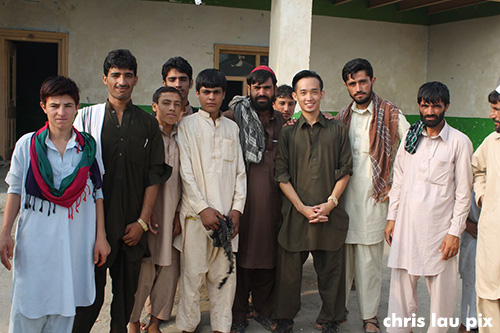 As such, he has been to Syria three times, Afghanistan twice, and once to Lebanon and Iran, as a freelancer. His articles have been published in the Chinese press and travel magazines in Malaysia, as well as in Malaysiakini .
On the frontlines of the conflict zones, Lau said he has faced mortar bombs and snipers.
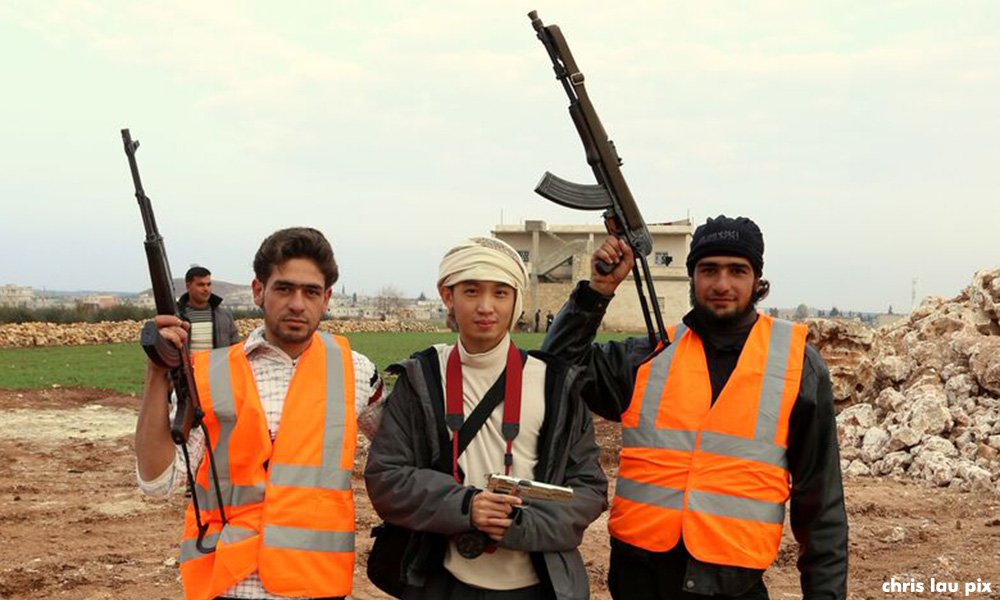
During one of his stints, Chris Lau had embedded himself with the Free Syrian Army as they marched to the Aleppo frontline.
The soldiers he was with had shot mortar at the enemy and within three minutes, the enemy returned fire, Lau said.
The enemy mortar dropped about 50 metres in front of him, he recalled, and the impact from the bomb shook everything.
"At that time, I thought, ‘Am I going to die? Are they going to shoot me?’ " Lau told Malaysiakini during an interview.
Another time on the frontline, he recounted, there was a sniper who was shooting at them as they tried to get across from behind the trenches.
"Every time I go to the frontlines, I am very scared.
"Sometimes I feel like I should have gotten out of the country as soon as I could," he said.
Trauma inside
When he returns from the Middle East, he said he would spend a couple of weeks working on his stories, and then try to distance himself from any news about the restive region.
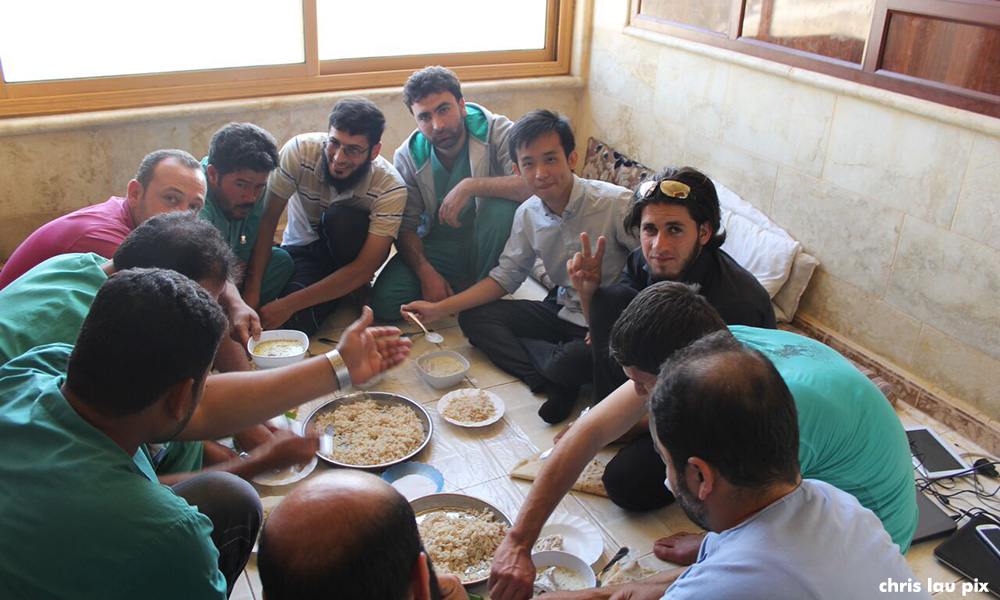 “You think you don’t have any trauma, but I think inside, there is trauma. You feel quite sad sometimes when you’re alone and you don’t know why.
“You feel worried for your friends there, and guilty because you want to do more.
”My friends (in Malaysia) say it’s very fun, exciting, and cool, but I don’t tell them how I feel after that, the period where you feel traumatised, but I get through it after a few weeks,” he mused.
People have told him to seek professional help before, though he has decided not to, as he prefers to work through this by himself.
However, Lau said that after a while, he gets the urge to return to conflict zones.
Reaching a 'fixer'
Usually, before he travels to these conflict zones, he does a lot of research and tries to establish contact with a middle person or a fixer.
Even then, he still gets turned away at the borders sometimes, such as the time he got turned away at the Syrian border when he tried to enter from Turkey.
That was right after the brutal beheading of Japanese reporter, Kenji Goto, and the Syrians were worried about the safety of reporters, he said.
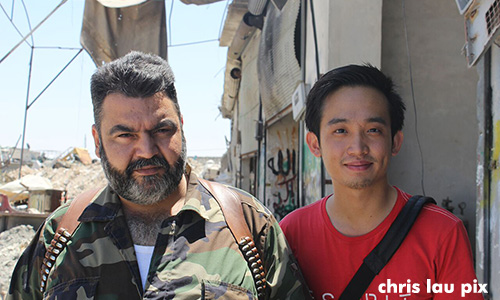 He has made many friends in the Middle East, he said, most of them around his age.
War has become such a normal part of the lives of the youths there, he said, citing the fact that they cannot continue their studies as it is too dangerous.
He recounted the time he was staying in a small apartment in Aleppo, Syria, where he was sitting in the living room with a friend after his reporting work for the day.
Three men with black scarves covering their entire faces except for their eyes invaded the house; two with AK guns and one holding a phone to record the encounter.
The men blocked the door, and Lau and his friend quickly knelt down and raised their hands, thinking they were about to be taken away.
“My thoughts were blank. I thought they were al-Qaeda; I thought I was going to be kidnapped,” he recalled.
A few moments later, the masked men burst into laughter. They were his Syrian friends, and the whole thing had just been a prank!
“I was so angry, but this is so normal for them. They can easily play with guns and bombs,” he said.
There are airstrikes every day, he added, from morning to night, and whenever it comes, all they can do is just run.
In the first airstrike he experienced, 80 people died and the bodies had to be put in a tent outside the hospital because there was no space left inside that afternoon, he said.
That was when he realised how daunting his task was.
“I realised I can’t do much. I thought I could save them somehow, but I don’t know how. I realised it’s not easy to save the world. All I can do is to just snap the pictures and write the stories,” he said.
Iran LGBT community
One of his more recent stories was from his visit to Iran, and it was a focus story on the LGBT community in Iran, he said.
He remembered how difficult it was to find contacts in the LGBT community there, as homosexuality is a crime punishable by imprisonment, corporal punishment and even execution in Iran.
Walking around and talking to people eventually led him to the LGBT community, for which he is grateful.
 He added that he has an interest in reporting on the issues of marginalised groups.
Lau has not always thought of journalism as his calling, having studied actuarial science for two years before realising he did not enjoy it.
"I was really lost back then. I thought traveling can help me find my path, so I took the risk and went traveling," he said.
During his gap year, he spent half of it working to save up money for his trip, and then travelled to eight countries in seven months.
Afghanistan was the conflict zone he visited, though only as a backpacker, he said.
Afghanistan was not originally on the itinerary, he noted, and it was added in because of the book ‘The Kite Runner’ by Khaled Hosseini.
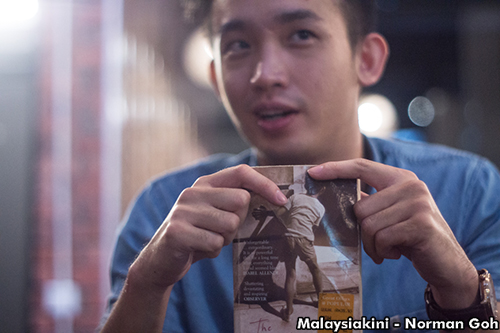 "I was really young and easily affected by the story (of The Kite Runner), so I decided to include Afghanistan in my trip.
"I spent two months there without telling my parents," he said.
After his first month there, he finally told his parents he was in Afghanistan.
His mother did not receive the news well, he admitted, saying that she scolded him for choosing to go to such a dangerous place.
"She's getting better about me travelling to conflict zones," he said.
Finding his calling
During his two months in Afghanistan, he visited a small village and met an elderly man who thought he was a reporter from China.
He remembered the man had grasped his hand gently and told him to report on their plight to the Chinese government.
 "I felt so guilty, because I am just a backpacker (then). I have no way of telling the Chinese government this," he said.
After coming back from that trip, he said, on the advice of his friends, he decided to try writing about his experiences on a freelance basis for publications.
That was when he realised he had found his calling.
So now, he is trying to do activism through his journalism, as a way of repaying ‘debts’ when he was backpacking alone without much money and had to get help from the locals.
"The people who helped me then, they were mostly middle class and not rich, but they were willing to open up and help me.
"I think this is me giving back. I know how it feels to be isolated and helpless with no one knowing about your situation.
“If I write about these things, I don't know how big the impact will be, but I hope at least some people will read about their stories," he said.
MALAYSIANS KINI is a series on Malaysians you should know.
Previously featured:
Snubbed by Masterchef, M'sian youth wins over refugees in Greece
The radicalisation of Mandeep Singh - from suits to streets
Malaysia's accidental Bob Dylan says he's no guitar warrior
Razlan Rafii - Umno 'thug' or misunderstood modern man?
Saving Pekan Ampang, the small town in a big city
How the indie publishing mafia sparked a reading renaissance
Subversive book club thrives in Shah Alam and beyond
Meet Syed Saddiq, your freedom of speech crusader
‘ It’s not punk rock, it's punk ideology’
Paramedic goes ‘white to black’ to lead medic team at Bersih 4


Report this comment
Are you sure you want to delete this comment?
This action cannot be undone.