




Chin Peng launches legal battle to return home
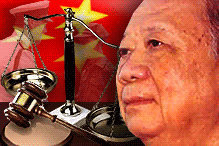
Exiled former Communist Party of Malaya (CPM) secretary-general Chin Peng has filed an application to return to Malaysia with hundreds of his comrades at the Penang High Court today.
Exiled former Communist Party of Malaya (CPM) secretary-general Chin Peng has filed an application to return to Malaysia with hundreds of his comrades at the Penang High Court today.
The application, filed through his counsel Darshan Singh Khaira, wants the government to abide by the peace treaty, known as the 1989 Haadyai Peace Accord, inked between the party and the government.
 The Home Ministry, inspector general-of-police, the armed forces and the government were named as defendants in the application.
The lawyer will obtain a sealed copy of the application and serve it on the government.
In the application, Chin Peng, who currently resides in Thailand, is seeking a declaration for him and between 300 and 500 of his comrades to be given the right to enter, stay and reside in Malaysia.
They also want the court to order the defendants to issue them with documents that permit them to enter the country.
Abide by treaty's terms
Apart from these, they also urged the court to ensure that the defendants abide by all the terms and conditions agreed in the 1989 Haadyai Peace Accord.
"The main argument is the Malaysian government should abide by Article 3 in the treaty which allows Chin Peng and his followers to enter Malaysia," said Darshan when contacted later.
Article 3, which is titled 'Residence in Malaysia' reads: "Members of the CPM and members of its disbanded armed units, who are of Malaysian origin and who wish to settle down in Malaysia, shall be allowed to do so in accordance with the laws of Malaysia".
Whereas another sub-section under Article 3 states that CPM members who are not Malaysian "maybe allowed to settle down in Malaysia, in accordance with the laws of Malaysia, if they so desire".
A copy of the treaty was incorporated in Chin Peng's 15-page supporting affidavit.
The affidavit stated that Chin Peng and his followers were hoping to return to Malaysian and reside here in order to reunite with their families. It also said that they have not been citizens of other countries.
Darshan said his clients promised to adhere to Malaysian laws, regulations and terms agreed upon as well as not "interfere and involve themselves in any activity prejudicial to peace, honour, pride and sovereignty of the Malaysian land".
Asked on the chances of the application, the lawyer said he has no idea but stressed that the arguments raised to support the application were on valid ground.
"It was a biding agreement so how can they deny it (the rights)?," he said, adding that the court has not fixed any date for mention.
Darshan also said Chin Peng was hoping to visit the grave of his parents in Sitiawan, Perak - where he was born.
The lawyer, who refused to divulge how he was approached by the former communist leader, is expected to file another application to allow Chin Peng enter Malaysia temporarily to attend the court proceedings under Article 5 of the Federal Constitution.
'We have no choice'
In a statement to news agency AFP , Chin Peng said his followers and him had sought to comply with the government's conditions so they could return to their homeland and "live peacefully in our last days" but to no avail.
"We now have no choice but to file this application in court as a last resort. We wish to come back to be good filial children and visit our ancestors, parents and family graves.
"We do not ask for any monetary gains at all. Even now, we are willing to withdraw all court proceedings if we are allowed to settle in Malaysia.
"It is ironic that we, who fought for our country's independence and were more than willing to die for it, should now be denied entry and residence to die in our motherland," he said.
Chin Peng, the nom de guerre of Ong Boon Hua, 80, was the 11th secretary-general of the once powerful CPM, which fought against British colonialism, the Japanese occupation and the newly independent governments of both Malaysia and Singapore for over half a century.
He won the Order of the British Empire (OBE) and two medals for helping the British fight the Japanese in Malaya during World War II.
The party's armed struggle, which began in June 1948, ended with the peace agreement signed between CPM and the governments of Malaysia and Thailand in 1989.
In September 2003, the government rejected his request to return home to visit his ancestral graves and launch his new book ' Alias Chin Peng: My Side of History '.
The reason given was that Chin Peng is linked to a banned organisation with a "history of perpetrating terrorism" in the country.
His book was recently published as a series in a local Chinese daily.
 In an immediate reaction, Prime Minister Abdullah Ahmad Badawi was quoted by
Bernama
news agency as saying that the government previously barred Chin Peng from returning to the country due to protests from various parties.
The Ex-Servicemen's Association of Malaysia had called for the ex-CPM leader to be banned from entering the country.
Abdullah said he would leave it to the court to decide on Chin Peng's fate.
"We cannot stop him from filing an application in court... he has a right. If he has no right, then surely the court will not entertain it," he added.


Report this comment
Are you sure you want to delete this comment?
This action cannot be undone.