




What to do in an earthquake
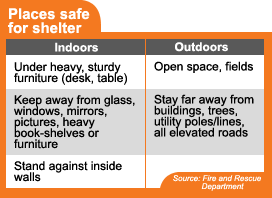
The first thing to do in the event of an earthquake is to find a place of comparative safety either under a table or a sturdy frame within the premises, a Fire and Rescue Department senior officer said.
The first thing to do in the event of an earthquake is to find a place of comparative safety either under a table or a sturdy frame within the premises, a Fire and Rescue Department senior officer said.
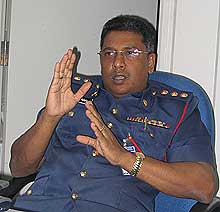 Public relations senior assistant superintendent S Kobalakrishnan (
right
) said those inside buildings should take cover quickly under heavy furniture or by standing against an inside wall.
Public relations senior assistant superintendent S Kobalakrishnan (
right
) said those inside buildings should take cover quickly under heavy furniture or by standing against an inside wall.
"Stay inside and hold on. The most dangerous thing to do is to try to leave the building because objects could fall on you," he told malaysiakini in an interview in Putrajaya today.
"It is inadvisable to leave your house or to rush down from high-rise apartments as it could be more dangerous in case the building collapses.
"In earthquake-prone countries, people are advised to stay indoors and find a safe place to hide as an immediate response to reduce risk of death or serious injury during impending disaster."
He said that those already in the open should move away from the nearest buildings, utility poles and structures. (See chart)
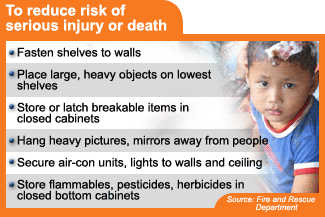 "Stay there until the tremors stop. If you're in a moving vehicle, stop quickly and stay put. Once the shaking has stopped, proceed with caution. Avoid bridges or ramps that might have been damaged by the earthquake."
He was commenting on media reports that apartment dwellers had rushed out when tremors were felt in several parts of Malaysia early Tuesday morning.
There are currently no mandatory requirements for emergency evacuation of residential premises or high-rise dwellings, unlike for office towers and commercial buildings.
This is part of the international safety guidelines adopted in Malaysia following information exchanges with earthquake-prone countries such as Japan, the United States and China.
'Exercise caution'
Although Malaysia lies outside the earthquake and volcanic belt known as the Pacific Rim of Fire, the precautions practised in countries with a high occurrence of earthquakes should be considered urgently.
"We are outside the belt and have never experienced strong tremors until last December, and now we have experienced earthquake tremors twice already," Kobalakrishnan said.
 "Even if these are only tremors of varying strength, we should still exercise caution as per the international guidelines, which are based on expert findings and experiences of other countries."
He said identifying potential hazards and planning in advance can greatly reduce the risk of death, serious injury or damage to property.
"It is now imperative that we prepare ourselves as individuals and within our neighbourhood for impending calamities, whatever the extent of potential damage or loss," he said.
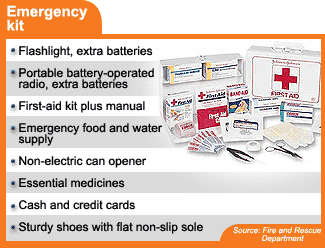
Outlining the do's and don'ts of response during an earthquake, he said, families and communities should set up a system that can also be used to cope with disasters such as fires, floods or tremors.
"Teach all family members how and when to turn off the gas, electricity and water. Teach children how and when to call the police, fire department or ambulance. Adults and children should also know which radio station to tune to for emergency broadcasts."
He said more information on earthquakes would be available from the local emergency management office, usually the meteorological services department or a building management committee for high-rise apartments.
Kobalakrishnan, who has been with the department for 21 years, said that equally important during an earthquake is an emergency communication plan to reunite separated family members.
 "This is real if the earthquake occurs during a weekday where adults are at work and children are at school.
"One solution is to ask a relative living out of town to serve as a family contact whom the separated family members can contact for confirmation of one another's location and condition.
Make sure everyone in the family knows the name, address and phone number of the person."
Cautioning that aftershocks smaller in magnitude than the main temblor which could cause additional damage and result in the collapse of already-weakened structures, he said updates should be obtained from the meteorological services department.


Are you sure you want to delete this comment?
This action cannot be undone.