




Evacuation procedures lacking for high-rise apartments
The management committee and residents of high-rise residential buildings will have to formulate their own emergency evacuation procedures that can be deployed in the event of impending disaster, said a Fire and Rescue Department officer.
The management committee and residents of high-rise residential buildings will have to formulate their own emergency evacuation procedures that can be deployed in the event of impending disaster, said a Fire and Rescue Department officer.
Public relations officer Senior Assistant Supt S Kobalakrishnan said there is no law governing emergency procedures for high-rise apartment blocks, unlike legal requirements prescribed for commercial high-rise buildings.
"It is crucial to formulate a specific procedure for immediate and orderly evacuation in high-rise residential buildings," he told malaysiakini today.
 "We do conduct public awareness programmes but the response has been very bad so far, even when we schedule the sessions on weekends for the benefit of residents.
"It is only when the environment becomes hostile, such as the two times we've experienced so far, that everyone gets interested in safety procedures."
Kobalakrishnan was asked to comment on the chaos reported in residential areas in the wake of a 8.7-magnitude undersea quake off the Sumatra coast at 12.09am.
Disorderly evacuation
Most high-rise dwellers were shocked by strong tremors which rocked the west coast of Peninsular Malaysia just after midnight yesterday. Tremors were also felt along the east coast.
In cities where most high-rise buildings are located, people were seen cramming into elevators and stairwells in a rush to exit the blocks and move away to a safe distance.
"For commercial buildings, it is mandatory for all occupants/tenants to comply with established procedures under the Occupational Safety and Health Act 1994, particularly on the duty of care required of them," Kobalakrishnan said.
"Our department also sets out fire-safety precautions for commercial buildings, for example, with regards to horizontal and vertical evacuation."
He said the standard procedures that are triggered by a fire alarm in high-rise commercial buildings could also be used in the case of tremors.
"The fire alarm does not necessarily mean it is only to be used in the case of a fire."
In such situations, said Kobalakrishnan, the fire alarm is triggered or an announcement is made over the public address system, which is usually the case for hotels and hospitals.
"But it may be a problem with regard to residential buildings where such systems are not mandatory.
"If a calamity is in the offing, the top priority is to get everyone out of the building away to a safe distance before a head count is done by the head of the family, floor or block."
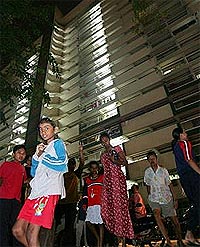 Given that emergency evacuation procedures for residential high-rise units are not governed by law, he advised each occupant to be conscious of the presence or absence of neighbours at the assembly place.
"If it happens that an aged or disabled person, or someone who is still sleeping, is missing from the head count, then someone should go and help them down, provided there is no imminent danger to themselves."
Based on a warning by the meteorological services department, the authorities ordered people to evacuate their homes along the northwest coastline in anticipation of a "widely destructive tsunami". However, they were allowed to return to their homes several hours later.


Report this comment
Are you sure you want to delete this comment?
This action cannot be undone.