




Gomez: Lack of political will to eliminate graft
EXCLUSIVE Prime Minister Abdullah Ahmad Badawi would demonstrate political will in wiping out corruption if institutions are given the autonomy to investigate complaints independently, said University Malaya (UM) economics associate professor Dr Edmund Terence Gomez.
EXCLUSIVE Prime Minister Abdullah Ahmad Badawi would demonstrate political will in wiping out corruption if institutions are given the autonomy to investigate complaints independently, said University Malaya (UM) economics associate professor Dr Edmund Terence Gomez.
"Abdullah, if he is sincere about eradicating corruption, should allow institutions such as the Anti-Corruption Agency (ACA) to act independently," he told malaysiakini in an exclusive interview recently.
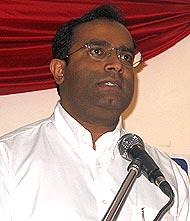 Gomez who has written extensively on issues of corruption and money politics said the ACA should not be taking orders from the executive.
"It is not enough to say 'I have set up an integrity institute to deal with this problem'. You must also show the capacity to allow institutions to act independently," he stressed.
He said since Abdullah became the premier in November 2003, only two high profile corruption cases - that of former Land and Co-operative Development Minister Kasitah Gaddam and ex-Perwaja Steel managing director Eric Chia - have been brought to light.
"The rest have been minor cases. However, I know for a fact from my own research, that there have been serious allegations of corruption involving abuse of power by senior people," he said.
He added that the definition of corruption includes nepotism and political patronage.
"The politicians in power can distribute concessions to particular businessman who will then use this to gain money, which will then be channelled back into the party, which is used to secure grassroots support, which will then allow politicians to remain in power. This is an abuse of the system.
"But the original distribution of concessions was through the implementation of government policies. Technically it is not corruption, but it is abuse of power."
Unemployed graduates
On the nation's economic development, Gomez said the government should give more support to small-and medium-scale enterprises and industries.
"The state has not channelled enough support to these companies which have shown their entrepreneurial capacity, but have little or no money to spend on R&D so that they can continue to climb the technological ladder," he said.
Gomez also decried the declining standard of university graduates, saying this has contributed to the high rate of unemployment among them.
 He said the university students face three fundamental problems - language deficiency, lack of critical thinking skills and the poor quality of lecturers who train them.
"For these three reasons also, the students who come through our public education system are not adequately trained by the time they get through the university," he added.
The first part of the interview, in which he spoke about favouritism in academic promotions, monitoring of the internal e-mail system and tampering with examination marks in UM, was published on Monday.
In the second part yesterday, he highlighted the lack of transparency in promotional exercises in UM, saying the curriculum vitae of promoted lecturers should be publicised.
Gomez is currently on two years' unpaid leave from UM in order to take up a secondment to lead a research project at the Geneva-based United Nations Research Institute for Social Development.
This was made possible when the government over-ruled the university last Friday to approve his leave application and reject his resignation letter, which had earlier been accepted by vice-chancellor Prof Hashim Yaacob.
At a private meeting with the premier on Monday, Gomez said he had been encouraged to speak out on matters involving public interest.
Q&A: Pak Lah has powers to wipe out graft
Part 2
Publicise CVs of promoted lecturers, UM urged
Q&A: Why I want to stay on with UM
Part 1


Are you sure you want to delete this comment?
This action cannot be undone.