




Gurkha guards - a security threat?
 SPECIAL REPORT
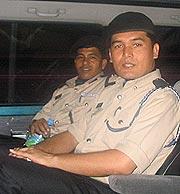
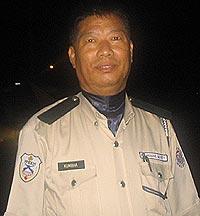
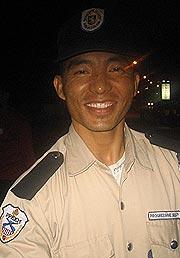
If you have recently seen a security guard of a foreign national guarding your neighbourhood bank, would you have guessed that he was formally a member of the revered Gurkha military regiment from Nepal?
SPECIAL REPORT
If you have recently seen a security guard of a foreign national guarding your neighbourhood bank, would you have guessed that he was formally a member of the revered Gurkha military regiment from Nepal?
There is now a trend among local security services companies to recruit these Gurkhas, and Security Services Association of Malaysia (SSAM) president Rahmat Ismail (left) is not amused.
 SPECIAL REPORT
If you have recently seen a security guard of a foreign national guarding your neighbourhood bank, would you have guessed that he was formally a member of the revered Gurkha military regiment from Nepal?
SPECIAL REPORT
If you have recently seen a security guard of a foreign national guarding your neighbourhood bank, would you have guessed that he was formally a member of the revered Gurkha military regiment from Nepal?
There is now a trend among local security services companies to recruit these Gurkhas, and Security Services Association of Malaysia (SSAM) president Rahmat Ismail (left) is not amused.
Rahmat believes that employing highly trained foreign military men guarding business centres and government buildings is a cause for concern.
"The government must take action to curb the practice before anything untoward happens. Not much is known about these ex-Nepalese army personnel. They could be spies," he told malaysiakini .
 The number of Nepalese security guards is on the rise as they are known to be diligent, disciplined and honest workers, said Rahmat.
He also said if this trend is left unchecked, the security services industry may be taken over by foreigners as what has happened in the construction and plantation sectors.
It is estimated that the minimum wage of Gurkha security guards is around RM1,200.
"Compare this to the local security guards whose minimum wage starts at a mere RM500. For them to get RM1,000 they have to work over time. Because of the low pay, our local youths are shying away from the industry," he said.
Vetting process
Rahmat said that the vetting process of Gurhkha guards is open to abuse, as applications are made through recruitment agencies based in Nepal and Malaysia.
 "Applications are approved based on the information provided in the documents presented to our officers who do not personally witness how the process of recruitment of security guards are made in Nepal. They therefore cannot detect elements of fraud, forgery and corrupt practices," he asserted.
Rahmat also claimed that he was offered a bribe by a local recruitment agent to support an application involving a former military personnel from Nepal.
"I was offered money by the agent to support an application. Of course I turned it down," he said.
However, a spokesperson from the Internal Security Ministry, which oversees the issuance of licences to security services companies, allayed fears regarding the vetting process.
He explained the process of the applications starts when the companies submit their applications to the ministry. The application must be accompanied with details of the Nepalese and proper documentation stating that they are ex-military personnel.
 "If there is any doubt in an applicant's biodata, we would quickly refer to the Nepalese Embassy in Kuala Lumpur to get further confirmation," said the spokesperson who requested anonymity.
The ministry would then refer the applications to the Immigration Department for final approval.
Strict conditions
According to the Internal Security Ministry's regulations, security guards of foreign nationals are not allowed to guard 'sensitive' buildings.
For example, prior approval must be obtained from the ministry before these guards can man local government buildings.
"The foreign security guards are only allowed to be armed with a baton. If any of these conditions are breached, stern action will be taken against them including deportation and revoking the company's license," added the spokesperson.
Furthermore, the ministry prohibits the Gurkhas from marrying local women, while their work permit limits them to working as security guards.
Enforcing the enforcer
Only former security service officers are allowed to set up security services companies but many - including politicians - are flouting the rules imposed by the Internal Security Ministry, in the name of profit.
 Although the ministry only issues permits to former officer holding the ranks of lieutenant-colonel (for military) and assistant commissioner (for police), many companies are in fact owned by politicians and non-security related companies.
Allied Security Sdn Bhd assistant general manager Major (R) Jamaluddin Abdul Ghani told malaysiakini that most security companies are run by non-security experts who bought the permits from those wanting to make a quick buck.
What is worrying is that when those managing the security companies have little experience and knowledge of the industry, the workers welfare would be affected, said Jamaluddin.
"This happens when companies put profit above everything else and indirectly neglect the welfare of the security guards," he said, adding that problems include late payment of salaries and Employees Provident Fund (EPF) arrears.
Jamaluddin believes that the government's inability to enforce the law as one of the contributing factor to the problem.
The Internal Security Ministry spokesperson admitted that enforcement of security services companies was lacking, mainly due to manpower constraints.
 "To date there are only three officers in the ministry in charge of the employment of Nepalese nationals as security guards. So it's difficult for us to do any enforcement."
Tax collection
Jamaluddin also called on the government to collect service tax from these companies to boost the country's income.
He is puzzled as to why the government has never made efforts to collect the tax - which is five percent from total gross income - from the companies.
"The value of the security services industry in Malaysia is estimated at about RM2.4 billion but service tax has never been collected from them. Can you imagine how much the government is losing out?"
He said although the security services industry is the third largest contributor to the country's economy after the industrial and services sectors, it is largely ignored by the government.
Nonetheless, Jamaluddin firmly believes that the industry must be given due attention by all parties, especially the government as it has potential of playing a major role in the country's economic well-being.


