




Trade deal: M'sia opens auto market to Japan
Malaysia will progressively open up its sensitive auto industry over 10 years in exchange for Japanese technical expertise under a wide-ranging bilateral economic pact signed yesterday.
Malaysia will progressively open up its sensitive auto industry over 10 years in exchange for Japanese technical expertise under a wide-ranging bilateral economic pact signed yesterday.
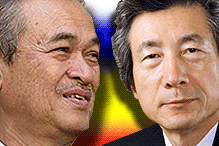
Japanese Prime Minister Junichiro Koizumi and Malaysian Premier Abdullah Ahmad Badawi inked the Japan-Malaysia Economic Partnership Agreement on the sidelines of regional summits here.
Liberalisation of the auto sector "will be complemented by industry collaboration," a Malaysian trade ministry statement said.
 "Malaysia and Japan have agreed to undertake cooperation projects in order to promote the development of the automotive and automotive parts and components industry in Malaysia," it said.
The projects include technical and expertise assistance as well as training by Japan.
The move is apparently aimed at allaying fears that the entry of Japanese cars after the market is liberalised would hurt national car-makers Proton and Perodua - an emotional issue in Malaysia.
Broad consensus
The pact, Malaysia's first ever bilateral free trade agreement, "will further strengthen and enhance economic and industrial cooperation on a long-term basis, and create favourable conditions for bilateral trade and investment," the statement said.
Japan and Malaysia reached a broad consensus over the agreement in May after launching official negotiations in January 2004.
The deal will cover the liberalisation of trade in goods and services and ease regulations on cross-border investments.
It will also facilitate cooperation in agriculture, information and communication technology, personnel training and science and technology.
Under the agreement, tariffs will be abolished on nearly all industrial goods and agricultural products within a decade.
Malaysia said the implementation of market access commitments in goods and services is expected to start in the later half of next year.
Import duty on textiles and clothing, agriculture and wood products will be eliminated immediately upon the agreement's entry into force.
Malaysia will eliminate duties on rubber products, food, plastics, paper and downstream iron products over six to eight years.
Tariffs on chemicals and petrochemicals, iron and steel, paper products and automotive parts and components will be removed or reduced over 10 years.
Production hub
Japan will maintain duty-free treatment on 6,613 industrial products, tropical fruits and forestry products from Malaysia.
Import duties on fishery, rubber and leather footwear and cocoa products will be slashed or wiped out in eight years.
For Malaysia's automotive sector, the progressive liberalisation will allow for investments in the manufacturing and assembly of vehicles and production of component parts, the statement said.
The deal will make Malaysia a production hub for the automotive industry and enhance the capacity utilisation in existing plants. It will also expand the market for domestic automotive components and increase economies of scale.
Japan is Malaysia's third-largest trading partner and one of the biggest investors here.


Report this comment
Are you sure you want to delete this comment?
This action cannot be undone.