




Press pooh-pooh Zaid over council move
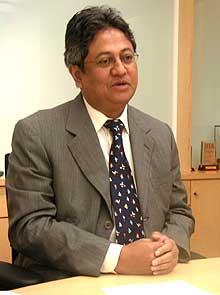
Umno politician Zaid Ibrahim plans to table a Private Member's Bill for the setting up of a press council in Parliament next month.
But before he does that, he was gracious enough to inform the media about it. So he called a press conference this morning to share his views of the press council and how it should function.
Umno politician Zaid Ibrahim plans to table a Private Member's Bill for the setting up of a press council in Parliament next month.
But before he does that, he was gracious enough to inform the media about it. So he called a press conference this morning to share his views of the press council and how it should function.
Little did the Kota Baru MP realise that he would be facing a barrage of fiery questions from the journalists present on his plan, some of which apparently caught him.
At the end of his meeting with the journalists in his Kuala Lumpur office, Zaid conceded that it would be very difficult for him to see the bill through if today's reaction from the journalists is any indication.
Earlier, Zaid had argued that one of the reasons behind his move was the view that the Malaysian media currently "enjoys much more freedom and laxity" than before due to more open and tolerant policies of the current administration.
 "This new found freedom is precious and must be managed with care or we will lose them forever. Recent problems relating to
China Press
, the
Sarawak Tribune
and the overkill in exposing shortcoming of the police force highlight the urgent need of a press council," he said.
"This new found freedom is precious and must be managed with care or we will lose them forever. Recent problems relating to
China Press
, the
Sarawak Tribune
and the overkill in exposing shortcoming of the police force highlight the urgent need of a press council," he said.
Platform to seek redress
He said the proposed council will set out guidelines and statements of principles in which all newspapers will be guided in their duties and to provide for censure and punishment for infractions and code violations.
The council is also needed, he added, because the public deserves an independent forum for resolution of complaints against the "powerful" press. He stressed that press freedom carries with it equivalent responsibility to the public.
Citing the "unfair" coverage of a Kelantan MP alleged of involvement for sexual abuse, Zaid said the press must be aware and sensitive enough to realise that their reports may cause harm and irreparable damage to individuals or groups if no care is taken to ensure fair reporting.
However, Zaid's proposal was silent on the restrictive Printing Presses and Publications Act (PPPA) 1984, especially on the much-criticised provision to make newspapers apply for a licence every year. The approval is a discretion of the internal security minister.
He said: "We still have laws that restrict the publication of newspapers and maybe one day we may not need such restrictive laws. Meanwhile, it is important that the media proves to the public and the government that it is capable of regulating itself."
"We have seen how news agencies put too much publicity and emphasis on sensational news which have little news value other than to sell newspapers. We have seen how politicians become the subject of ridicule," he added.
'PPPA repeal won't happen'
Later, he was queried on his intention - without a commitment to repeal the licensing provision - whether that would be seen as a further attempt to muzzle the press in view of the fact that the current PPPA is actively regulating the press.
Zaid disagreed with the view, and said that the press council will be granted certain authority in discharging its duties and there will be "consequences" (law amendments) to that - by way of amending certain provisions in the PPPA, which he did not specify.
Responding to the appeal from journalist groups for a self-regulatory body over a statutory one, he argued that when "the council passed through an act of Parliament, it does not mean it can't be self-governing". He added that a press council is common in other countries.
When a journalist remarked that those countries do not have the PPPA and the licencing provision, the MP - who appeared irritated - responded: "My friend, I am okay (to repeal PPPA), but I don't think that is going to happen."
"Whether it's realistic to expect a repeal? No, it's not going to happen," he stressed.
To another question, Zaid - who runs one of the biggest legal firm in the country - conceded that he has not engaged journalist groups for consultation on his move despite efforts by journalists to form such a council has been in existence. He also denied his plan was one made in haste.
"It's not a sudden decision, people are talking about it but what had happened? So I think I may try the Parliament route (to make it possible). A press council is timely," he said, adding that he will consult the stakeholders when the draft bill is ready.
Expressing the concerns of journalists who feel that his idea could render the council merely as a 'complaint bureau', Zaid stood by his opinion that his proposal will be better than the present system and it could help the public to seek redress over unfair media reporting.
At one point, he said: "If this is the view of the press, I think I am not going to be successful, but this is your (journalists') views and I have my views."
What greater freedom?
He was also grilled by the journalists on his statement that the current press enjoyed greater freedom.
One journalist asked whether he has conducted any study to indicate that the press is enjoying greater freedom now, he replied, 'no'. When the journalist asked further how he could substantiate his claim then, he replied: "This is my personal opinion".
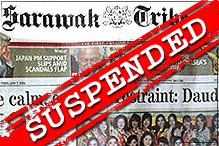 Another journalist present then remarked: "How do you say there is greater freedom when the press regulations remained, and Pak Lah (Prime Minister Abdullah Ahmad Badawi) has censured two papers (
Sarawak Tribune
and
China Press
) so far while (ex-premier) Dr Mahathir (Mohamad) censured three papers in his 22-year administration?"
Another journalist present then remarked: "How do you say there is greater freedom when the press regulations remained, and Pak Lah (Prime Minister Abdullah Ahmad Badawi) has censured two papers (
Sarawak Tribune
and
China Press
) so far while (ex-premier) Dr Mahathir (Mohamad) censured three papers in his 22-year administration?"
(The three - Sin Chew Jit Poh (now known as Sin Chew Daily ), Watan and Star were suspended during the 1987 Operasi Lalang crackdown)
To this, Zaid said that although restrictive press regulations remained unchanged, he still stood by his statement, as he argued papers are given more freedom to criticise government policies.
The idea for a press/media council came about in 1999 when more than 500 journalists signed a petition to then Home Minister Abdullah Ahmad Badawi calling for the repeal of the PPPA, with particular reference to repeal the licensing provision.
In return, they offered voluntary self-regulation via the council as an alternative governing structure for the industry in place of the laws. They however opposed the council to be set up as a statutory body because they fear it might not be independent of government interference.
The government later commissioned a report by the Malaysian Press Institute (MPI) which recommended for a statutory media council. The government however has not made any commitment on the demand to review the PPPA.


