




Contentious statements in Ethnic Relations textbook
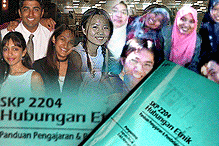
Below are some the debatable, questionable, controversial and outright mistakes contained in the contents of the 'Ethnic Relations' textbook, currently in use in some universities. The textbook is at the centre of a storm for its interpretation on various issues involving religion, history and politics.
Below are some the debatable, questionable, controversial and outright mistakes contained in the contents of the 'Ethnic Relations' textbook, currently in use in some universities. The textbook is at the centre of a storm for its interpretation on various issues involving religion, history and politics.
 Higher Education Minister Mustapa Mohamed told the Dewan Rakyat today that the
textbook's content
comprised 'historical facts that cannot be disputed'. He said the ministry had no plans to suspend the subject or withdraw the textbook for the time being.
Higher Education Minister Mustapa Mohamed told the Dewan Rakyat today that the
textbook's content
comprised 'historical facts that cannot be disputed'. He said the ministry had no plans to suspend the subject or withdraw the textbook for the time being.
On the lobby group Malaysian Chinese Organisation Election Appeals Committee (Suqiu)
Such extremist demands should no longer exist, in order to defend the harmony that has so far been experienced and to preserve the relations and cooperation between the various races in Malaysia... (Chapter 9, page 79)
On the following incidents
May 13, 1969
'...the DAP, which is made up mostly of Chinese, conducted a procession in Kuala Lumpur in which they insulted and uttered statements that upset the Malays...' (Chapter 9, page 78)
'.... In the May 10, 1969 general election, the Alliance lost Pulau Pinang to the Gerakan party, while Kelantan stayed in the hands of PAS. For states such as Selangor and Perak, the Alliance faced problems in setting up (state) governments because of the weak majorities that they held. (May 13) was triggered by the war of words that occurred when some quarters uttered statements that humiliated another race. This incident happened during the victory processions of DAP and Gerakan.
'... the procession passed through Kampung Baru, the biggest village inhabited by Malays, of whom 30,000 resided there. While passing that area, members of DAP and Gerakan threw statements such as 'The Malays have fallen', 'Kuala Lumpur now belongs to the Chinese', 'This country does not belong to the Malays, we want to kick out all the Malays'. (See Tunku Abdul Rahman, 1969) .
Chapter 14, page 116
Kampung Medan, 2001
"...The Malay community in the said area had lost their patience with the anti-social attitude of groups of Indian youths and wanted to teach them a lesson...' (Chapter 9 page 78)
On Umno and Barisan Nasional
'...efforts to create a united Malaysian nation are still being actively carried out by the governmental authorities and the people of Malaysia must give their full support to these noble efforts...' (Chapter 1, page 3)
'... In Malaysia, political accommodation can be clearly seen in the BN as the pioneering body that encompassed race-based parties ...' (Chapter 9, page 73)
'...the (BN) symbol of the scale shows that the BN is a party that emphasises equal and equitable rights between its component parties and, indirectly, presses for equal rights among all groups ...' (Chapter 9, page 74)
'...BN gives emphasis to efforts at ensuring that all races are represented through the practice of power-sharing in order to guarantee peace, prosperity, harmony amongst all Malaysians regardless of ethnic affiliation. In line with that, BN emphasises national unity and ensures one system of governance for the whole people ...' (Chapter 9, page 76)
On mixed marriages
'... mixed-marriages rarely occur in peninsular Malaysia. Religion is a primary factor that limits mixed marriages between races. For Malays whose religion is Islam, marriage with non-Muslims require that the non-Muslims convert. This does not motivate Chinese and Indians who associate strongly to their religions, cultures and identities, to marry Malays.
'However, with mature integration and unity and the spirit of brotherhood, it is not impossible that mixed marriages will increase and bring about true unity...' (Chapter 10, page 87)
Erroneous interpretation of Federal Constitution
'Prohibition on propagating religions other than Islam to non-Muslims (Artikel 11 [4], Perlembagaan Negara)' (Chapter 10, page 85)
(Article 11 [4] of the Federal Constitution actually says that there is no prohibition on propagating religions other than Islam to non-Muslims.
On Islam Hadhari
'...the implementation of Islam Hadhari improves the awareness of Muslims for the need for a tolerance and mutual respect among a multi-religious society to preserve peace and national security...'
On history
'.... The emergence of the Malay Melaka Sultanate in the year 1400 within larger powers in the Malay World became a focus of global attention at the time. The august Malay Empire was the one that led to the birth of the Malaysian nation. Melaka, before the arrival of Parameswara was a fishing village. Its strategic location changed Melaka into a entrepot and an important trading centre in the Malay archipelago.'
Chapter 3, page 19
On the country
'... If scrutinised, compromise occurs on the level of the leaders of ethnic groups and not in society at large. It is only reflected in Barisan Nasional and Barisan Alternatif parties whereas Barisan Nasional and Barisan Alternatif parties are themselves race-based. If compromise can exist in society at large, it is highly likely that unity and integration can exist in Malaysia ...'
Chapter 1, page 3
'... All tensions and presumptions need to be contained in the best way. See what is happening around us in countries where multi-ethnic populations are experiencing disintegration, strife and conflict such as in Rawanda, Bosnia, Yugoslavia and others. Maintain Malaysia's image as a model nation that has succeeded in developing and advancing although its communities are of different ethnic groups, cultures and customs.'
Chapter 1, page 8.


Report this comment
Are you sure you want to delete this comment?
This action cannot be undone.