




Go into tourism, Penang Malays told
Malays in Penang, who claimed they have been marginalised by the Gerakan state government, must seek out economic opportunities available to them, said a top leader of the Chinese-based party.
Malays in Penang, who claimed they have been marginalised by the Gerakan state government, must seek out economic opportunities available to them, said a top leader of the Chinese-based party.
Gerakan secretary-general Chia Kwang Chye, who is widely considered a potential future chief minister of Penang, said that the state relies heavily on tourism and industry for its economic survival.
"Penang is a very weak resource-based state in land, natural minerals and definitely there is no petroleum. It is also very weak in agriculture, palm oil and rubber."
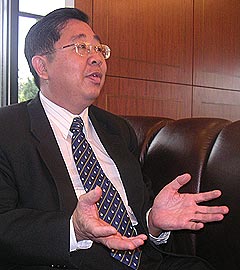 He urged Malays in Penang to go into the tourism industry at a time when the country is benefitting from an explosion in visitors from Arab countries.
"I think Malays are well-poised to enter this industry for the Arab market," said Chia during an one-hour exclusive interview with malaysiakini held at the Parliament House on Monday.
"I see the tourism trade, especially the Arab market, as a window of opportunity for them to come in and therefore we should develop that area, and not continue in the traditional thinking of agriculture because this is Penang - not Kedah, Perak or Johor, where they can go into oil palm or Felda," he stressed.
A tirade of criticisms have been made over the past one month at Umno Youth division meetings against the Gerakan-led state government.
The Youth wing alleged that he state government had ignored the Malays in their economic development.
Following that, they called for the rotation of the chief minister post, which is currently held by Gerakan deputy president Dr Koh Tsu Koon, but Prime Minister Abdullah Ahmad Badawi has ruled out that possibility.
Penang's 1.2 million population is made up of about 60 percent Chinese Malaysians, 32 percent Malay Malaysians and seven percent Indian Malaysians.
Rotation a 'usual' call
At the interview, Chia dismissed the Umno Youth's call for the rotation of the chief minister post. "This is nothing new to us, we take it as one of the 'usual' calls," he said.
Chia is regarded as a serious contender for the chief minister post as Koh is set to take over the Gerakan No 1 post next year when its long-serving president Dr Lim Keng Yaik steps down.
Koh, who has been Penang chief minister for 15 years, is expected to leave the state to take up a federal-level post.
On whether he is interested to take the job, Chia said: "The usual and proper way of answering that is to say that you cross the bridge when there is a bridge there. As there is no bridge now, you don't try to cross it ... otherwise, it makes you look like crossing an imaginary bridge, it doesn't look good."
Chia began his political career as a part-time assistant to Koh, who was then member of parliament for Penang's Tanjong constituency. The Johor-born Chia has made Penang his home after he moved to the island in 1972 to pursue his first degree at a local university there.
Apart from the soft-spoken 54-year-old politician, two other leaders are consider potential contenders - Gerakan vice-president Dr Teng Hock Nan, 60, and party's top central committee member Lee Kah Choon, 46.
A media owner too?
Meanwhile, Chia, who is also the deputy information minister, denied his ministry has encroached into areas under other ministries, especially internal security and water, energy and communications ministries.
"Previously we were the regulators of television and radio but because of the new administration and new approach - previously there is no private radio and television stations - so we can't be the competitor and regulator (at the same time). By moving the regulation and regulatory framework into a new ministry called Water, Energy and Communications Ministry is correct. I don't see the clash."
He argued that the Information Ministry, whose task is to disseminate government's information, has to use various mediums such as television, radio, newspaper and Internet to "get its message across" to Malaysians.
"We will tell the newspapers to help the government and the society to make sure it (the situation) doesn't get worse, whether it is on security, ethnic relations, economy or politics."
Chia also said that Gerakan did not intend to follow its coalition partners' example in owning media organistions as this can be a very costly affair.
"When a media is too closely identified with a political party ... no matter how independent, objective the report is, you can't get away from the fact that it is owned by a political party," he said.
"We rather have friends all over the places."
Part 1
Chia: Stop fighting like in pre-Merdeka days


Are you sure you want to delete this comment?
This action cannot be undone.