




The black spots in campus polls
special report Only a few years ago, the country's top universities were the bastion of anti-establishment student activism. Not anymore.
As students gear up to do battle in the campus polls, malaysiakini picks the top five factors why the government-backed 'pro-establishment' camp is going to rout their rivals.
special report Only a few years ago, the country's top universities were the bastion of anti-establishment student activism. Not anymore.
As students gear up to do battle in the campus polls, malaysiakini picks the top five factors why the government-backed 'pro-establishment' camp is going to rout their rivals.
Polling stations in hostel
This requirement is arguably as the most undemocratic and unfair. During the campus polls, two types of seats are contested - general and faculty.
Not all students from the same faculty are located in the same hostel. It is not uncommon that there will be a handful of students from a particular faculty.
 Thus, it is possible to identify, or at least suspect, the inclination of small group of voters from the same faculty. Those in a hostel who make up a small number from a particular faculty, risk intimidation from the hostel management to vote a particular candidate.
In the past, there have been cases of students being forced to vote before allowed out of the hostel. Some students even alleged that they were kicked out of the hostel because a vote for the 'anti-establishment' camp was traced back to them.
Deputy vice-chancellors (VC) chairs election committee
Over the years, the government and campus authorities have overtly backed the 'pro-establishment' faction to stamp out anti-government sentiments in campuses nationwide.
Hence, the appointment of the deputy VC as the election committee chairperson cannot ensure a free and fair election.
The election complaint and investigation committee is also led by university officials who hardly, if ever, entertain complaints filed by those perceived to be 'anti-establishment' students.
Tight rules and bureaucracy
Strict rules are imposed to discourage aspiring candidates who do not have the blessings of the university authorities.
In Universiti Malaya (UM) potential candidates must possess a grade-point average of 3.0 and above to be eligible, while International Islamic University (UIA) requires candidates to pass an "English Proficiency Assessment".
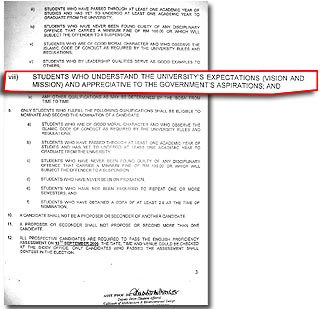 UIA, once stronghold of anti-establishment camp, also lists "students who understand the university's expectation (vision and mission) and appreciative of the government's aspirations" as one of the requirements to be candidates.
In all universities, candidates are required to obtain acknowledgement and signatures from the VC, the deputy VC, dean, hostel chief and student affairs officers - all in less than one working day.
At Universiti Teknologi Malaysia (UTM), candidates need to fork out RM30 for a nomination form, a RM100 (faculty seat) or RM150 (general seat) deposit and RM300 if they wish to file a protest after the polls.
Several students who spoke to the media on election irregularities last year were barred by their respective universities from contesting as their disciplinary hearing was ongoing.
Coalitions disallowed
 Candidates could only contest as individuals. No coalition or joint manifesto is allowed.
'Pro-establishment' candidates however are allowed to contest under the Aspirasi (Aspiration) umbrella and sanctioned by the university authorities.
Limited means of campaigning
Campaign materials used must be approved by the election committee. Furthermore, candidates who wish to engage in campaigning activities must first obtain permission from the election committee at least six hours beforehand.
No independent poll monitoring
Most of these controversial rules were introduced in 2003. Since then, traditional 'anti-establishment' strongholds of UIA, UM, UTM and Universiti Sains Malaysia (USM) were lost to Aspirasi.
This year, seven universities will be using the electronic voting system. This has been argued as the most non-transparent system as it is not possible to monitor the procedure.
Two years ago, when it was first implemented, a candidate at Universiti Putra Malaysia (UPM) obtained only one vote, which detractors say was a clear sign the system was flawed.
The Higher Education Ministry had also rejected pleas by various groups to monitor the polls, such as the Human Rights Commission (Suhakam).
With all these systems in place, 'pro-establishment' forces swept into power in every campus nationwide after their rivals boycotted the polls in five universities.
Despite having a new minister and three new VCs, investigations into complaints against campus polls irregularities have never been investigated.
Instead, students who exposed and raised the issue to the media were charged.
Campus elections nationwide are slated for next Thursday while nomination is on Monday.


Are you sure you want to delete this comment?
This action cannot be undone.