




Nation in hands of 'school kids'
Former Guthrie chairperson Khalid Ibrahim elaborates on the poor grasp of economics among political leaders, a budget that has a ballooning operations expenditure and whether it was necessary to build Putrajaya in concluding his interview with malaysiakini .
Khalid, who served under then premier Dr Mahathir Mohamad, also describes the contradictory nature of his former boss, who launched a scathing attack against Prime Minister Abdullah Ahmad Badawi's administration in May.
Malaysiakini: The government is lauding the new performance index that is being adopted for local industries. What do you think of the benchmark ?
 Khalid:
The level of understanding in using benchmarking and the way it is being implemented here is still very basic. I must say the government in still at a primary stage. They haven't even gone to the senior class.
Dia baru budak sekolah
(They are still schoolchildren). I think none of them (politicians) have earn PhDs in that area. It is just a matter of reciting the book without understanding the way the figures are being calculated and it is actually worsening the philosophy of the tools.
So, although you enjoy singing out loud about KPI (key performance indicators), you don't know the nature of it at all. I'm a bit cynical. It's like how my mother, who taught me to read the Quran, used to describe me. I could read in the loudest manner without truly understanding what I'm saying and I felt truly proud of myself. That was my level at that time. That's Islam Hadhari for you (laughs).
'Oh, the KPI benchmarking! Earnings per share! Productivity!' So they say. If you get a PhD on earnings per share, you have a different way of looking at it. But even the politicians can talk about earnings per share. So we ask them 'before profit or after profit?' or 'before depreciation or after depreciation?' or 'have you taken into account the interest?' or 'how about present value?'
That's secondary school level. We are still in primary school. This is our level at this time. The way I look at it, I say (to myself), hey, these people talk but they don't even understand what they're saying. They use terminology, just like you use terminology to impress your driver. But do they understand what they're saying?
 Of course, sometimes, you don't need to understand the true nature of (economics). But being a leader, being the person who proposes or plays a part as a proponent of any recommendation, that's dangerous. If you didn't know, you could just read the speech. You don't know whether what's in the speech is accurate or not.
Kita mesti memperkenalkan KPI (we must introduce KPI), so Dollah (Abdullah Ahmad Badawi) says. Let's take a few minutes to see the true meaning of KPI. Ask him to explain. But he doesn't even know what KPI is... not even the mechanics of calculation. In fact, it is a con job by the staff (speech writers). They know the boss doesn't know what they're writing about. We can make a joke out of this. And after 15 minutes of listening to the jargon, it's oh udahlah, baguslah! (a job well done!).
I understand the nature of bureaucracy. There needs to be some credited identification in order to show you are doing something. But whether it is for good or not, it gets lost somewhere.
 Do you know that Singapore doesn't use KPI regularly? It explains its own performance. It just presents what it thinks of its performance. Can my performance compare with other people's performance? KPI standards differs in each industry, it is not analogous.
Have you ever heard (Singapore mentor minister) Lee Kuan Yew say, 'We are proud of Singapore! We have achieved KPI'? Pak Lah (Abdullah) says every time that we are proud of KPI.
What do you think of the 2007 Budget?
The lower-income group has not benefited so much this time round. It will continue to be so, if the economy does not pick up. I think the government is trying to give more pay to staff. But I always think it's a better idea for the private sector to create more pay for the staff.
You see, you have a budget of roughly RM160 billion. Of this, RM112 billion relates to operation costs. Only RM50 billion or so relates to development. What does it mean?
If instead, say RM100 billion, is to be spent on development purposes and RM50 billion for operational issues, the development side creates the so-called capital investment to the economy. But now, in reality, you are spending less and less by ratio on developmental as opposed to spending more, and you are throwing a lot of money on expenditure. What does it mean?
 If you continue to give your workers additional salary without taking care of productivity, your operating expenditure will skyrocket and the development expenditure will keep going down until you reach the level of some African countries where operating expenditure is the only expenditure they can spend on because they have no money left for development. And even then, their operating expenditure results in a deficit.
So you see that pattern potentially emerging. Has the budget managed to attract foreign investors? But if the development budget is only RM50 billion, you need Malaysia to grow at least RM150 billion in terms of capital expenditure. The remaining two-thirds will have to come from foreign investment. So the question is, after the reading the budget, does it show that the government places emphasis on foreign investors and would they come anyway?
If the answer is that there is nothing in it for us, or that we are indifferent, then the budget has not solved the fundamental problems. What Malaysia needs for growth is continuous direct investment, not expenditure.
How about the lowering of corporate taxes? Doesn't that help?
Corporate taxes would not solve your problems immediately, you have to come up with a budget that give the rebates to the specific operations (foreign investors) that you want to come to Malaysia. But you have to do a lot of homework...
It's not an exercise to say 'come to Malaysia, there are a lot of dancing girls and beaches and all that sort of thing... nothing like that. Of course they might come but for a holiday.
Have the EPU (Economic Planning Unit) and the minister of finance and prime minster worked (hard) to select the industry that gives better returns and which requires capital investment expertise to harness resources?
What is our niche?
We have thought this through, but not as much as other people. Vietnam has shown that it is smarter in selecting industries that are more conducive to their needs. Taiwan has done it.
Of course, this is not coffee-shop talk. My conclusion to that budget speech is only this. This budget speech does not tickle the foreign investor. I need at least a year of so to plan one. It requires a team. We don't have very good economists and industry analysts to plan for specific targets.
How much time can the minister of finance, prime minister and economists spend to develop the budget? Who are the economists or consultants they employ to do this?
 The reason why we need to change the NEP (New Economic Policy) and all that is because of globalisation. To compete. To become a first division player.
That's why we never win in things like golf.. These golfers, like Vijay Singh, you know how many balls he hits? He hits balls for six hours. Our golfers, after half an hour, go and minum kopi (drink coffee) and duduk (sit) and rehat aja (relax). So you want to become world class? You will never become world class. You become water-carrier class. That's all.
So we need to change because we are quite complacent, politically, administratively. Our countries is blessed. Among the reasons why I enjoy staying in this country is that I have no problems with the weather. I enjoy it. In Oxford, every few hours, I have to get my clothing and equipment ready because ada sejuk, ada panas (it can be cold or warm). We are blessed here. We have all the good things many other countries don't have, but we are complacent.
The government is placing emphasis on real estate development. How do you think it is faring ?
I think it has become more sophisticated. I think Malaysia has also invested to create the first Islamic real estate investment trust. I think this action is laudable, but we are lacking professionalism in real estate marketing, though. You've got to be able to get a number of these marketeers who have reasonable experience in terms of evaluation, financial assessments and all that... We don't have that.
In countries like Australia, they (marketeers) are in a very useful occupation, very well paid jobs. They become tenderers, they can auction the place where they can get good value. They become building managers. We need that. But I'm not saying we don't have agents, but the level of quality isn't there.
So they need to upgrade the real estate sector. The government is trying to promote regional (development through growth corridors). But my argument is that if an area requires real estate development, just on the basis market demand and all that, that area has already been developed. I think the private sector is very quick and sensitive where demand is required.
So, if you are not careful, government-initiated property development will end up with thousands of units unsold. If they know that a place requires demand, they will have it. If they (private sector) hold their head up, things usually get done.
We need to be very careful about government -nitiated development because it always artificial and more importantly, it always the government that has to bail it (a project) out if it fails.
You spoke of cutting operational costs. Do you mean Putrajaya?
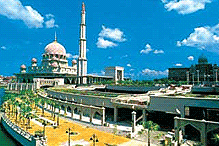 Yes. Sometimes they (government) say they use Petronas money, but actually it is our money. You see Putrajaya is not maintained all that well. In another five or six years, the cost of rehabilitation will be tremendous.
(The layout of) Putrajaya is so complex. If you don't know where the sections are, you get lost. There are no public facilities. I sometimes go, because I go to speak for the National Economic Action Council. It's unnecessarily big.
It is planned for the next 100 years...
If you are talking about cyber and information technology, networking with the so-called PR (public relations) government - where are your customers? Your customers are in Jalan Chow Kit ... (or) Kampung Pasir Penambang in Kuala Lumpur. With technology, can't you bring your government office to Pasir Penambang?
If the answer is yes, you don't need Putrajaya. Because your office is at your laptop, through wire connections. Technology will catch up one day that we won't need a centralised area for administration.
Look at me. I am now advising international investors. Where am I operating from? Here. Upstairs I have a PC (personal computer) and all that. I will only scratch my head if the email doesn't work or if there is petir (lightning).
Putrajaya was built because of (someone's) ego. Always it is ego. Every leader, I don't know how many leaders... but always it is ego.
Why did you join Parti Keadilan Rakyat (PKR)?
Ah, two reasons. The first reason is a personal reason. I don't run away from it. I've known Anwar (former deputy premier Anwar Ibrahim) for 30 years, from university days, not as professionals, but as friends. Even when he was in jail, we met. Maybe as a friend, who you feel your friend is in need, not of your resources or your money, but in need of your presence. I think I was doing a service to a friend. As a friend, you feel his pain. So I have done that. I'm quite happy with that.
 But, I also appreciate that he was victimised. The unfairness is real. It is not superficial. Now the nation understands. To be told that he boxed his own eye in order to gain sympathy (laughs) ... of course I didn't believe it. But, after many years, I did ask him again. 'I don't believe that you boxed your eye, but is there some truth to it?' He nearly wanted to
cekik
(strangle) me. (laughs)
But you can see I feel he was being victimised. And the truth has prevailed. Of course, there is a price. I think for some people, for me, I would cekik other people (if I had to spend six years in jail while waiting for the truth to come out).
But that's what it's all about. So then he asked me, 'Khalid I want to still pursue my ambition. I want to do the right thing for the country. Will you help me by joining this party?'
Actually I was very reluctant. But he said, 'Give me chance.' So I did it (firstly) as a friend and secondly, he said, 'You could also help me to bring change to the country because you have some experience with people'. Anwar's experience is political. My experience is corporate. So we could work together with other people and bring about change.
And so I accepted his offer. But I did tell Anwar I have done my national service. In fact, in my arithmetic, I am above average in giving national service. So with my experience, I could help to make a change and help a friend achieve his national objective. What I have got to lose?
Worse case is that it doesn't happen. Just for trying, I'm much happier. So I'm not very ambitious. But, of course, Anwar is ambitious. He wants to bring total change. I'm a player and part of the Anwar team.That's all there is to it.
Some have said you joined PKR because of your frustration with Guthrie...
That doesn't matter - my frustration ... I should have joined the government. It's much easier. But the truth is always the same. I could have. The logic is totally different. I join (PKR) I am much better off. I can maintain my independence (as I have since my PNB days). I work hard and I am very professional about it.
 But I don't 'kowtow' - when I was in PNB, a lot of politicians wanted shares. Some of them, free shares. Some wanted to pay. Both didn't get...I told them you're not going to get it. You're part of it, but your percentage is going to be one out of four billion, and that's the percentage you're going to get.
Do you think the verbal exchanges between Mahathir and the prime minister are scaring away investors?
Investors are much more sophisticated than that - that I must say. I give you the example of Thailand where they have changed governments regularly (laughs). But the fundamentals must be there. It will hurt investors who are under Mahathir's patronage. Internationally, Mahathir has friends, but overall it's not a total effect. I think the total effect is on the local community.
Mahathir is a very adored leader. And some respect him very highly. Unfortunately, because of his antics, he has reduced himself to an ordinary person.
Of course, he has a valid argument against Pak Lah. But the way he has done it is not the style of the leader among leaders. The supremo. In the Chelsea (football club), they call (the manager) 'the chosen one'.
God wants to show that he (Mahathir) is not immortal. God wants to show this, no matter how high up you go. You've have created a scene. Somehow or other, this 'crooked bridge' for whatever reason, will also bring you down to a level where you weren't before. That was a most irrational argument, but for me, it was in the Islamic tradition of fate ( qadar ). That's how the Islamic tradition is, that is true in some cases.
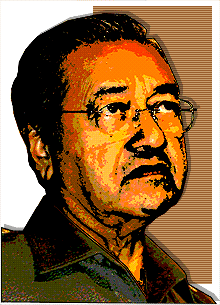 He (Mahathir) has punished quite a lot of people. Now, he's starting to get some of the effects, even though it is not in the same manner. He has a black eye, even if it is within a different connotation. But it is something to show that if you do wrong, then somehow or other, it will come back to you.
Could you imagine that the 'crooked bridge' got him? He could have kept silent, and stayed in Argentina and come back to Malaysia, people would be waiting in rows for him.
If he ever sat in a coffee shop, people would give him drinks, for free. But after this - (gestures, indicating nothing).
Why? Was he not a smart man? I worked under him. He is bloody smart. He knows facts faster than anyone else... no way you can bullshit him. You get thrown away. He's very capable, both in mental capacity, in his writing and his leadership capacity.
I think Dollah is a third or fourth division player. He (Mahathir) is in the first division. (Abdullah) would not even get a chance to play in the second division. If you ask me to evaluate candidly, this man is good. But God is great... he (Mahathir) is not good at everything. (laughs)
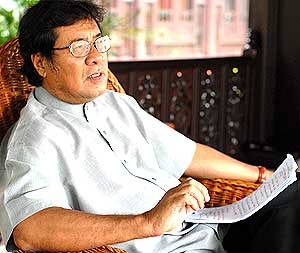 I worked with him, I was a secretary with Yayasan Pelaburan Bumiputera. So back then, I would give him my report. And he read it like this (imitates Mahathir fast reading documents). He would just read it like that (and ask) 'Why did you mention this way, Khalid, and not as recommended?'.
His analysis was that fast, you know. But I would already have answers. Then he would say, 'I think you should change your draft this way'. It was technical. And he has a very good memory. Sometimes he would get very angry about some subjects. Kawan you tak betul lah, Anwar (Your friend is not right, Anwar). That's different. I didn't answer him out of respect. He's good but of course he can be nasty. You should never belittle him in public. He'll cut you down straight.
My reading (of the on-going public spat) is that he's angry with Pak Lah, because Pak Lah released Anwar. And a combination of other things has added to his anger.
You must know, this man (Mahathir) has an ego bigger than Putrajaya. You talk about people's ego - this is huge. He knows his capabilities and he's proud of it. Some other people know their capabilities, but they're humble about it. But this chap... I know I worked for his brother-in-law, another independent minded and egoistical gentleman. (laughs)
When the two met, Mahathir would say, Khalid, Tun (former PNB chairperson Tun Ismail Ali) datang tak? Okay, buka mulut (Khalid, has Tun arrived? All right, speak). Tun was the vice-chairman, he would not talk to the chairman. He would talk through me and I became the messenger boy to get the job done.
What's the end game?
If Mahathir has his way, I would come to this conclusion, and this is simplistic. The pattern of Mahathir is similar to that of a samurai warrior. If a samurai warrior unsheaths his sword, it's either him or the others. There's no turning back. The history of Mahathir has shown that. And he has taken out his sword.
Part 1: NEP will destroy the Malays


Report this comment
Are you sure you want to delete this comment?
This action cannot be undone.