




Verbal war taken to global media
Ex-premier Dr Mahathir Mohamad, who has complained that local media have blacked out his criticism of Prime Minister Abdullah Ahmad Badawi over last six months, has taken his battle to the world media.
Ex-premier Dr Mahathir Mohamad, who has complained that local media have blacked out his criticism of Prime Minister Abdullah Ahmad Badawi over last six months, has taken his battle to the world media.
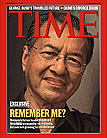 He smiles for the front cover of the Nov 6 Asian edition of
Time
magazine, in a photograph captioned 'Remember Me?'.
He smiles for the front cover of the Nov 6 Asian edition of
Time
magazine, in a photograph captioned 'Remember Me?'.
In an extensive interview, Mahathir picks up on his tirade against Abdullah, claiming he has been muzzled at home and told by Umno not to criticise the premier for reversing many of the policies he had put into place before stepping down on Oct 31, 2003.
"In many ways, he has frankly discarded the policies and strategies we used during my time, claiming that they were not good for the country, particularly what were termed as mega-projects," Mahathir was quoted as saying.
"I expected a little bit of a slow down but not a reversal. Maybe the direction would be slightly altered, but having been an agricultural country and converting the agricultural country into an industrialised country, to find that the new government wishes to revert to being an agricultural country is very unsettling. We rejected agriculture simply because it was not generating enough wealth, it was not generating enough jobs for our people."
Mahathir defended the need for Putrajaya, Petronas twin towers and other large-scale projects.
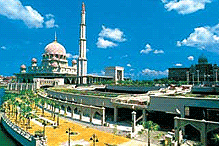 "They keep on mentioning these pet projects of mine. Everything in the last 20 years has been my pet project, so if you touch anything, it's going to be touching my pet project. It is not because it was a pet project. All these things that I caused to be built are actually essential to this country. We need the infrastructure, we need Putrajaya. I mean, imagine what Kuala Lumpur would be like now ... if the government administration was still in Kuala Lumpur," he said.
"I thought that I have done most of the things that will serve us for the next 100 years. All that remains is for people to just continue. Don't reverse what has already been done. I think very far ahead, not 10 years, 20 years, (but) 100 years ahead....."
Mahathir pointed at his failure in reading the calibre of those he has appointed as leaders.
"I think I'm not very good at that. I assume that people would react to things the way I would react ... But I find that the people I helped to reach certain heights are not really grateful. They have actually turned against me."
'Part of process'
The same issue of the magazine featured an interview with Abdullah.
 Asked if he thought Mahathir's comments were bad for the country, Abdullah replied: "He is free to say what he wants. We are a democracy and it is his right to speak. When I became prime minister, I encouraged more openness and did not want to muzzle different views, so I suppose this is part of that process.
"But it is unfortunate that he is making wild allegations and that he does not acknowledge that answers have been given. At the end of the day, Malaysia is still well regarded internationally as an advanced Muslim country and as a good investment destination, despite what he says."
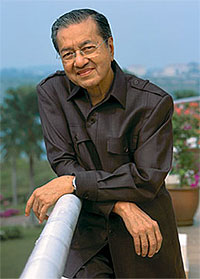 The cover story, entitled 'Not the Retiring Type', features a photo of a smiling, vigorous looking Mahathir casually leaning on a rail.
It begins with a description of the Perdana Leadership Foundation, which Mahathir recently claimed was being blackballed by Abdullah's administration:
"The golden spires of Putrajaya, Malaysia's new administrative capital, shimmer in the tropical heat ... But there is one road in Putrajaya that is different ... this strip of asphalt is mysteriously overgrown with weeds and scrub. No gleaming skyscrapers have taken root here. Only one building stands forlornly at the road's dead end: the office of former prime minister Mahathir Mohamad.
"The irony for the 81-year-old Mahathir must be overwhelming: Is this really how the story of one of Asia's modernising forces is to conclude, at the dead end of an unkempt road in the futurist metropolis he created?"
Sense of weakness
The report goes into the current political climate, and personality and administrative differences between Abdullah and Mahathir.
"The man Mahathir finally chose to succeed him could not be more different. Abdullah, 66, made his name in Umno as the quiet, harmony-seeking underdog. Where Mahathir was blunt and uncompromising, Abdullah was soft-spoken and amiable," it says.
It speculates that Mahathir's comments are not likely to quieten down and have contributed to a sense of weakness within Abdullah's administration.
Political personalities interviewed include de facto law minister Mohd Nazri Abdul Aziz who claimed Mahathir wants to bring Abdullah down.
"He wants to force him to quit. He needs to be told he is no longer prime minister. His campaign is not for the sake of the country but for himself," claimed the minister.
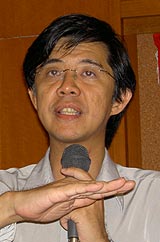 Parti Keadilan Rakyat information chief Tian Chua said: "We used to believe we were a model for the rest of Asia, because the other countries were unstable or undemocratic or run by the military. But the rest of Asia has caught up and, in some cases, even surpassed us, so we must start looking at all the things we swept under the carpet for so long."
On Mahathir's focus on mega-projects and his legacy, Umno supreme council member Shahrir Abdul Samad commented. "The good human-capital policies Mahathir put into place were what made a civil society that could think and speak out. But Mahathir couldn't handle what he had created. He understood buildings but not people."
Abdullah's son-in-law and Umno Youth deputy chief Khairy Jamaluddin responded to allegations about his overt influence on the administration: "I am a pretty easy scapegoat. [But] the decisions Dr Mahathir is unhappy with are entirely made by the prime minister and the cabinet."


