




Watchdogs back review of election laws
Watchdog bodies have applauded the Election Commission (EC) proposal for legislative review to promote transparency in the holding of general elections.
Watchdog bodies have applauded the Election Commission (EC) proposal for legislative review to promote transparency in the holding of general elections.
EC chief Abdul Rashid Abdul Rahman had said yesterday that independent review of outdated election laws would improve public confidence in the electoral process.
Anti-corruption group Transparency International Malaysia described this as a long overdue move.

"The integrity of the EC should always be given the highest priority. The quality of democracy would be enhanced if voters are absolutely confident that the voting system is free and fair in every aspect," said its president Ramon Navaratnam.
If the government carries out the review, the number of unregistered voters - now standing at 4.5 million - could be considerably reduced, he said.
Malaysians for Free and Fair Elections (Mafrel) deputy president Syed Ibrahim Syed Noh hoped that the review would take into consideration its previous recommendations, especially in relation to campaign practices and fair media coverage.
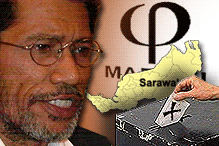 Mafrel had sent observer teams to the
Sarawak election
last May and the Pengkalan Pasir by-election in Kelantan in 2005.
Mafrel had sent observer teams to the
Sarawak election
last May and the Pengkalan Pasir by-election in Kelantan in 2005.
Syed Ibrahim, however, expressed sceptism about the review, saying: "We wonder whether this can be really done, whether changes will be made."
The Coalition for Clean and Fair Elections (Bersih) felt it is not necessary to set up an independent commission to undertake the proposed review
In a statement today, it suggested steps that the EC could introduce, including the use of indelible ink to prevent duplicate voting at different polling stations.
Bersih said the electoral rolls could be cleaned up by making house-to-house inquiries to iron out flawed registration and by releasing the list of deceased voters for public inspection.
"Postal voting should be abolished for police and military personnel. The process is neither transparent nor free - Abdul Rashid himself has blamed postal voting for the missing 5,486 ballots in Lumut in 2004," it said.
Public support necessary
Political commentator Liew Chin Tong was of the opinion that the timing of the call is linked to the impending retirement of Abdul Rashid, who has helmed the EC since the late 1970s.
 "It's probably Rashid trying to preserve his legacy as he is the longest-serving official in the commission. He's thinking of his place in history. He doesn't want to be remembered as the chairperson who oversaw one of the most problematic election exercises (in 2004)," Liew said.
During the 2004 general election, major glitches were recorded, with registered voters being unable to vote in some locations because their names were missing from the electoral roll.
Liew further said any such review should not be confined to election laws, but extended to amendment of Federal Constitution clauses that limit the EC's independence.
Prior to constitutional amendments in 1963, the EC was solely responsible for drawing up constituency boundaries.
"But the constitution was amended in such a way that the commission's independence was crippled," he said.
He also noted that, unless there is active public support for the review, there will be no change.
"I can't see why the government would change the election laws if they have a choice. The laws currently favour the government. Unless there is intense public pressure, the government will brush the issue aside," he said.
 This is not the first time the EC chief has pointed out defects in the electoral system. In 2003, he had conceded that the EC is not independent.
In 2004, he had called for a probe after the commission encountered problems with the electoral rolls in parts of Selangor on polling day.
Abdul Rashid is credited with abandoning ballots with serial numbers during the Sarawak election, a feature long criticised as compromising the secrecy of the ballot.


