




Machap an eye-opener for the opposition
So who dare say that by-elections do not benefit the people?
Go to Machap today - which has no more than 10,000 voters -and one would probably see many of its residents grinning from ear to ear.
So who dare say that by-elections do not benefit the people?
Go to Machap today - which has no more than 10,000 voters -and one would probably see many of its residents grinning from ear to ear.
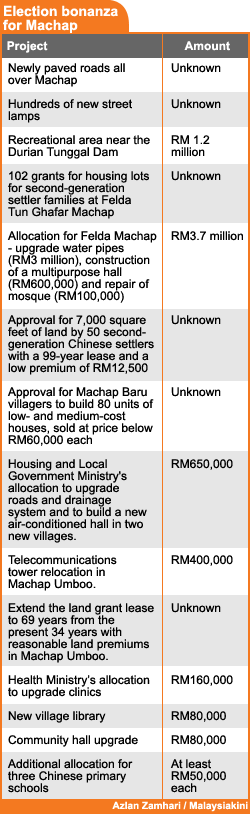 Why not, when they had just received a windfall. Election goodies amounting to at least RM6 million were poured into the sleepy hollow of Machap in Malacca over a fortnight - all under the name of development.
And the constitutency, simple minded as they are, showed their gratitude to the ruling BN - Deputy Premier Najib Razak's pleas to the voters to return the 'favour' were probably unnecessary - by giving the coalition's candidate a resounding victory on Thursday night.
In fact, there was little doubt who would win from Day One. It was only the question of 'by how much?'.
Although BN won with a comfortable 4,081-vote majority, its winning margin was slashed by 481 votes compared to when the two contesting parties last met in the 2004 general election.
Obviously this fell below the BN's target, given that it had widely publicised that it wanted the opposing candidate to lose his deposit, if not to win by a bigger majority.
Although there were no major issues which could be capitalised by the DAP, the Chinese-based opposition party still managed to swing some Chinese voters away from BN.
Surprisingly, the DAP made more gains compared to the last election among the Chinese voters in Machap Baru - a 92 percent Chinese-majority polling district where BN candidate Lai Meng Chong hails from.
Swing or no swing?
Party secretary-general Lim Guan Eng was quick to concede that his party failed to wrest the Machap state seat because of poor support from the Malay and Indian voters.
He said that the party had failed to penetrate the Malay and Indian areas in the constituency.
However, despite the election goodies, some Chinese voters did respond to the DAP's call for democracy, equal economic opportunities and political equality, argued Lim.
But Najib was just as quick to brush off the suggestion that there will be a swing of Chinese support from the BN in the next general election - he attributed the lower majority in Machap to 'local factors'.
Think-tanker Ibrahim Suffian begs to differ.
"In some ways, the results indicate there is a swing (of Chinese votes) even in a place like Machap, which has never been the stronghold of the DAP," the director of independent opinion research firm Merdeka Centre opined.
 "To a certain extent, it also showed that national issues do have a strong impact and it is a trend that we see moving from the Sarawak state election into Machap this time," Ibrahim said in reference to the state election last year which the DAP successfully made inroads.
The Merdeka Centre in a quarterly national survey done last December that two out of three Chinese Malaysian voters are likely to vote for opposition parties in the next general election, which political pundits expect to be called between late this year and early next year.
DAP election strategist Liew Chin Tong was more cautious though.
"There won't be any 'tsunami' in the next general election, neither will there be a repeat of the Sarawak state election (for us)," said Liew, who was appointed as the election strategy adviser to party secretary-general Lim Guan Eng in early March.
"We can prepare perhaps for a swing between five to 10 percent of votes (to the DAP in the next national poll), but this may not translate into seats. The Machap by-election indeed is a wake-up call for both DAP and MCA."
Unlike Najib who had rejected the suggestion of a swing of Chinese votes to the opposition, MCA president Ong Ka Ting appeared cautious and chose his words carefully when asked on the matter.
 "We will not be complacent. We will continue to work hard. We still want to look into ways for improvement," said Ong when met in Machap after the election results were announced.
On the drop in the BN's majority, he said it was hard for a newcomer to match the performance of its long-time serving state assemblyperson Poh Ah Tiam.
Questions for PKR too
The Machap by-election proved the challenge to win Chinese votes in the next general election is not only meant for DAP and MCA - it was one for Parti Keadilan Rakyat (PKR) too.
PKR, campaigning for the DAP in Malay-majority areas, managed to pull big crowds on the eve of polling with the presence of its advisor Anwar Ibrahim.
In fact, the numbers who attended Anwar's ceramah doubled that of the BN's that night, but this did not turned into votes for the opposition.
Take, for example, the case of Kemuning - one of the eight polling stations Machap. With Malay voters representing 62 percent of the voters, the DAP candidate only obtained four votes as opposed to 374 received by the BN candidate.
 Merdeka Centre's Ibrahim said: "You can pull big crowds at ceramah but that does not necessary translate into votes. Many people go there because of the 'pasar malam' (night bazaar) selling fried
bihun
or
mi sup
."
Merdeka Centre's Ibrahim said: "You can pull big crowds at ceramah but that does not necessary translate into votes. Many people go there because of the 'pasar malam' (night bazaar) selling fried
bihun
or
mi sup
."
He said there is a need for PKR to re-assess the situation and to inject its election campaigns with a "human touch" so that voters can feel more involved especially in the conservative rural areas.
Machap, apart from raising question on PKR's ability to gain the support of rural Malays even with the charismatic Anwar at its helm, could also possibly reduce PKR's bargaining power in the impending seats allocation talks with DAP in the coming general election.
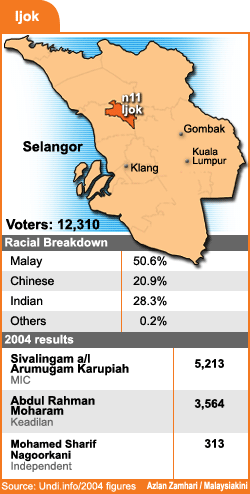
Both parties had earlier slated to start the seat negotiation in April but it is believed to have been put on hold due to the Machap by-election and the April 28 Ijok by-election.
However, Ibrahim said that Machap - a rural racially mixed seat - is not fully reflective of the opposition performance in the next general election.
"How they perform in the upcoming Ijok by-election (which is a semi-urban mixed seat) will be more of an indication," he said.


Are you sure you want to delete this comment?
This action cannot be undone.