




Civil service getting too fat
The substantial pay hike for government servants, the first of such increases since 1992, has underscored another major problem - our bloated civil service.
The substantial pay hike for government servants, the first of such increases since 1992, has underscored another major problem - our bloated civil service.
 "The civil service has been expanding rapidly since the 1990s and the growth accelerated under the current prime minister," said opposition politician Tony Pua, who welcomed the long-overdue pay rise which was announced yesterday.
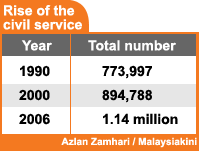 "In 1990, the federal government had 773,997 employees; by the year 2000, there were 894,788 on the payroll, a significant increase of 15.6%.
"However, since then, the civil service employment has accelerated by another 210,000 personnel, marking a 23.5% increase over the past six years alone," said Pua, who is DAP economic advisor.
According to Pua, one of the key objectives under the privatisation programmes launched by the then prime minister Dr Mahathir Mohamad was to reduce the civil service numbers to just above 500,000.
"Hence, it could be verily argued that the privatisation exercise by the government was a failure in maintaining a lean and efficient government for the civil service is today more than double its intended size."
Prime Minister Abdullah Ahmad Badawi announced yesterday that all civil servants and security forces will get a pay rise of between 7.5% and 42%. Meanwhile, the cost of living allowance has been increased by 100%.
As a result of the pay hike, which will take effect on July 1, the government will have to allocate an additional RM8 billion in its budget beginning next year.
Pua said the government will also have to find RM4 billion for the pay increase for the second half of this year as this was not previously budgeted.
This raises questions if the targeted deficit of 3.4% of GDP for 2007 can be achieved, said Pua.
"The RM8 billion increase also marks a permanent 7.1% increase on the government's annual operating expenditure."
Trim the service
Pua blamed the government's failure to trim the civil service on the policy of making the "civil service the dumping ground for the politically sensitive constituency of unemployed Malay graduates".
Last year, Deputy Prime Minister Najib Abdul Razak has urged government agencies to speed up the recruitment of graduates to fill some 30,000 vacancies in the civil service.
Pua called on the government to take the "painful but very important step" of slashing the civil service sector into a leaner and more efficient "machine".
"The increase in pay will be a waste of public funds, if the move is not accompanied by a corresponding increase in civil service productivity."
Meanwhile, DAP secretary-general Lim Guan Eng lamented that despite the hefty 35% increase, the lowest basic salary in the civil service is RM649, which is still below the poverty line of RM691 per month.
Lim suggested that the minimal basic wage for civil servants and pensions be fixed at above RM700 instead.
"The salary of the highest-ranked civil servant in Malaysia is 19.5 times more than his or her lowest-ranked colleague - amongst the worst in the world.
"Salaries of the lower levels must be increased dramatically if the government wants to bridge the salary differential to make it fairer and more equal to civil servants."


Report this comment
Are you sure you want to delete this comment?
This action cannot be undone.