




No nation wants to keep wages low but...
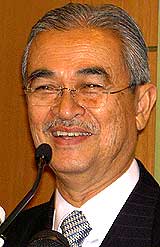
No nation wants to suppress wages or keep them artificially low to attract investment, said Prime Minister Abdullah Ahmad Badawi today.
No nation wants to suppress wages or keep them artificially low to attract investment, said Prime Minister Abdullah Ahmad Badawi today.
In fact, the premier stressed, all workers should be paid wages that are commensurate with their productivity and value added.
 "Nonetheless, what is fair and appropriate to employers and employees must be dictated by prevailing market conditions and relevant commercial considerations.
"After all, companies and nations must be bound by the rules of the market economy. Nations can and must establish sufficient protection against an unfettered market such as adequate safety laws and fair workplace condition," he was quoted as saying by Bernama .
Abdullah said this when opening the 2nd Union Network International Conference for the Asia Pacific Region in Kuala Lumpur.
About 1,000 delegates from 200 trade union representatives in the Asia Pacific region are attending the two-day conference.
Supply and demand
Abdullah said nations must also understand the law of supply and demand, which means that nations and their workers must ensure that they can offer value to the world's market wages, welfare and well-being.
He said that to ensure decent work conditions and fair labour laws, the nation and workers must find ways to offer greater value added by upgrading and improving incentives for their performances.
"This is not only done by the government but also by business owners and their workers, as all of them have a shared responsibility to improve themselves," he said.
The premier also commended the Union Network International (UNI) for its constructive engagement with government organisations and hoped that the newly formed UNI Asean Service Employees Trade Union Council would have a fruitful dialogue with the relevant organisations on issues related to the liberalisation of the services within Asean by 2010.
The liberalisation of the services would involve sectors such as information communication technology (ICT), aviation, tourism and health care industries.
Abdullah congratulated UNI for working towards establishing a framework for the protection and promotion of the rights of migrant workers in the Asia Pacific region.
Market liberalisation
He said with the market liberalisation, they could expect more cross border movement of labour and labour-related issues.
Abdullah said governments and workers alike had to adapt to a rapidly changing world as the liberalisation of markets and sectors, as agreed under the World Trade Organisation (WTO) and Asean, had had great implications on how work and skills were valued.
"Due to the free movement of investment, work that involves skills will be under the greatest of pressure, whereas work that requires specialised skills will be prized and rewarded," he said.
He said minimal skilled work would continue to move to countries that had the lowest cost of labour. "This is the reality faced by many developing countries and their people today."


Report this comment
Are you sure you want to delete this comment?
This action cannot be undone.