




Umno still strong in Malay heartland
analysis The 2008 general elections results suggest that as Malaysia developed economically and its society underwent some fundamental transformations, its political parties have not kept pace.
The outcome has been a yawning gap between what Malaysians expect of their political parties and what they actually receive. These transitions in society indicate the need for political parties to critically review their pattern of organisation and mobilisation.
analysis The 2008 general elections results suggest that as Malaysia developed economically and its society underwent some fundamental transformations, its political parties have not kept pace. The outcome has been a yawning gap between what Malaysians expect of their political parties and what they actually receive. These transitions in society indicate the need for political parties to critically review their pattern of organisation and mobilisation.
These socio-economic transitions were a consequence of key government policies, such as affirmative action, and those introduced by Dr Mahathir Mohamad during his long tenure as prime minister. Mahathir’s primary goals included industrialising Malaysia with the support of internationally-recognised Malay conglomerates he would help nurture. The implementation of these controversial policies was aided by Mahathir’s extreme concentration of power in the office of the executive.
One major outcome of these redistributive and developmental plans was an acute spatial and intra-Malay class divide. On one hand, a new urban middle-class had emerged, comprising independent, dynamic, professional Malays at ease in inter-ethnic economic and social relationships.
By the late 1990s, this group had become disgruntled with BN, viewing selective patronage through affirmative action as corrupt and wasteful, undermining resourceful use of government-created concessions to promote entrepreneurship. They supported the opposition in the 1999 election, following the economic and political crises that led to the rise of the reformasi movement, before returning in fairly large numbers to BN in 2004.
On the other hand, poverty persisted among rural Malays even though affirmative action was explicitly targeted at uplifting their status. The relatively homogeneous Malay heartland was Umno’s traditional bedrock, but its support for the party steadily eroded in the 1990s with growing disillusionment over its constituents’ scant economic progress, before they returned, though not in large numbers, to BN in 2004.
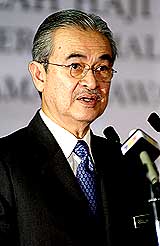 When Abdullah Ahmad Badawi assumed the premiership, he publicly announced he would govern differently by devolving power, curbing corruption and implementing policies to aid the rural poor who had been abandoning Umno. His key economic pledges to alleviate poverty included increasing income through self-employment, by promoting agriculture, a sector rural Malays were heavily involved in, and by supporting small- and medium-sized firms, where the Chinese had a huge presence.
Abdullah’s pledges deftly undermined the reformasi agenda and helped BN secure substantial electoral support in 2004. Four years later, however, BN would go on to record its worst-ever performance.
While BN had secured 90% of the seats in parliament in 2004, its presence there was reduced to 63% in 2008. BN obtained only 51.2% of the popular vote, compared to the 64.4% it won in 2004. Umno’s presence in parliament fell from 109 to a meagre 79 seats, a shock for a party accustomed to regularly holding more than half these seats.
Umno’s similarly ethnic-based BN partners, the MCA and MIC, fared worse. MCA won just 15 seats, a massive drop from 31, and MIC was down to three parliamentarians when before it had nine. BN had a majority in parliament only because it won 55 of the 57 parliamentary seats in Sabah and Sarawak. In the peninsula, BN obtained a mere 49.8% of the total votes cast, meaning that the opposition had more popular support in this part of the country.
Inconsistencies in voting patterns
The party that benefitted most from BN’s decline was PKR, whose de facto leader Anwar Ibrahim had been ousted as deputy prime minister by Mahathir in 1998 on grounds so widely seen as unfounded that it precipitated the reformasi. While PKR held only one parliamentary seat going into this election, it emerged unexpectedly victorious in 31 constituencies.
 Islamic party PAS secured 23 seats, compared to its seven in 2004, while socialist-based DAP won 28 seats, 16 more than before.
A review of electoral trends from 1990 will put in perspective BN’s shocking electoral loss.
Between 1990 and 1995, when BN secured its best electoral victory with 65% of the popular vote, Malay support for it had already begun to fall ( Table 1 ). This was in spite of the fact that the economy had grown phenomenally over that five year period, a factor in the unprecedented non-Malay swing to the coalition in 1995 ( Table 2 ).
The BN continued to lose Malay support after the reformasi, but following Mahathir’s departure the coalition registered in 2004 increased support in all Malay-majority seats, only narrowly failing to regain control of Kelantan, and recouped non-Malay support it had lost in the previous election. In 2008, BN’s support in most Malay-majority seats declined, while a large segment of non-Malays swung to the opposition.
The percentage point difference in times of electoral victory and loss in numerous Malay-majority areas has, however, consistently been below 10, suggesting swings in support between Umno and PAS. The swings against Umno were registered when it was seen to have failed to deliver economically. The voting trend suggests important anomalies.
Although BN lost Malay support in 2008, Terengganu did not fall to the opposition as it had in 1999, though Kedah did for first time in its history. The results suggest Umno could well regain control of Malay heartland states in the next election if it addresses the economic needs of rural Malays.
There were similar inconsistencies in voting patterns in non-Malay majority seats. Between 1995 and 1999, although BN lost much support in two-thirds of these seats, then opposition leader Lim Kit Siang of the DAP and prominent allies registered defeats. Even though the opposition retained its Chinese-stronghold seats in Kuala Lumpur, BN increased its support there.
In 2004, BN secured greater support in 22 non-Malay majority constituencies, with a decline in only 10. However, DAP secured two more parliamentary seats and Lim was returned as opposition leader. In 2008, BN recorded a phenomenal double-digit percentage point fall in support in most non-Malay constituencies. There was a reason for these unusual electoral patterns in both non-Malay and Malay-majority constituencies.
Ambivalent electoral results
The results of the epochal 1999 elections following the reformasi reflected an ambivalence among the electorate. Although the urban, particularly non-Malay, electorate supported the demands for political reform made by the reformasi, it was also uneasy over the awkward constitution of the opposition coalition.
The major opposition parties had then coalesced to form Barisan Alternatif (BA). Lim would later admit his decision to take DAP into the BA had been repudiated by the electorate. BA subsequently fragmented when DAP left, citing irrevocable differences with PAS over the latter’s insistence on propagating an Islamic state.
The subsequent 2004 electoral results reflected a number of pertinent issues.
First, the results confirmed that BA was not seen as a viable alternative to many Malaysians. Second, they supported the argument that Mahathir’s focus on heavy industries and corporate accumulation had steadily alienated rural Malays and contributed to PAS’s growing influence in the Malay heartland. Third, they suggested that BN’s phenomenal victory was due to problems within the opposition, specifically its inability to articulate a common stand to unify Malaysians.
DAP’s departure from BA and PAS’s Islamic state ideology had alienated non-Muslims and hindered PKR’s capacity to secure victories in non-Malay majority constituencies. Prominent PKR leaders would later publicly acknowledge that it was PAS’s brand of theocratic politics that had stymied BA.
While PAS remained Umno’s primary opposition, electoral trends between 1990 and 2004 suggest that it was not the Islamic party’s religious stance that posed a threat to BN. PAS has little national influence, with limited capacity to win seats outside the Malay heartland. After its victories in 1990 and 1999, PAS had become aware that it fared well only when it contested elections in a coalition.
Although PAS has a strong core base comprising about 40% of the Malay heartland electorate, it recognised the need to modify its discourse if it was not to be viewed merely as a party to support in protest of BN. PAS subsequently began emphasising the need for a welfare state.
Opposition fares well
Among politicians, it was Anwar who best responded to the electorate’s clamour for a repeal of repressive legislation and fair implementation of economic policies for all Malaysians. Interestingly, it was Abdullah’s endorsement of these same issues that had drawn him enormous support in 2004.
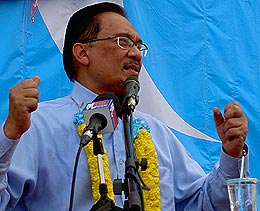 Anwar had two key rallying points in his campaign. BA would institute a genuine form of multi-ethnic governance, without Malay hegemony, and it would dispense with affirmative action along racial lines. Although affirmative action had reduced inter-ethnic income and wealth disparities, Anwar was aware that its long-term implementation had dissatisfied many Malaysians.
Poor Indians had manifested their anger over their continued marginalisation in a mass demonstration, while the Chinese had been particularly critical of affirmative action after 1990 when the policy was sustained indefinitely even though BN had promised in 1970 that it would practice positive discrimination for only the next 20 years. Rural Malays were upset that the policy had contributed to huge intra-ethnic income and wealth disparities.
Abdullah had introduced economic policies to advance the rural Malays, but there was little evidence of adequate support for their cottage and agricultural industries. This was attributable to the bureaucracy’s poor delivery mechanism, a problem significant enough to warrant discussion in Abdullah’s major economic plan, the 9th Malaysia Plan, 2006-2010. Abdullah was well aware of institutional reforms urgently required within the civil service but had yet to tackle them.
Although Abdullah had advocated an open and inclusive form of governance that would promote the well-being of all Malaysians, Umno had shown that it cared little to change its brand of highly racialised politics. Corruption continued to fester because Abdullah was patently reluctant to act decisively against errant but influential politicians. Inevitably, the huge swing against BN was seen as Malaysians standing cohesively in opposition to Abdullah for failing to deliver on his pledges.
New politics now?
The results of the recent elections suggest the emergence of an electorate ready to hold politicians accountable, even forcing the BN to institute a genuine form of democracy. This shift was already discernible during the reformasi, a movement heavily represented by the young, which had made unambiguous calls for real change in the political system.
Another issue important to them was the need for all parties to seriously consider the concept of Bangsa Malaysia, a Malaysian nation that transcended ethnic identity, a concept conceived by Mahathir in 1990, probably as mere rhetoric but which captured the imagination of Malaysians, suggesting news forms of identification.
National identity appears important as a recent poll indicates, although experiences of exclusion, discrimination and marginality shape how it is understood by Malaysians. And in spite of their public endorsement of Bangsa Malaysia, past and present Umno presidents have had to contend with repeated calls from within the party for ‘ketuanan Melayu’ (Malay supremacy).
What further complicates the idea of a Bangsa Malaysia for Umno is that it recognises the serious need to redress its own policies that have exacerbated spatial imbalances. The factors contributing to such inequities in the Malay heartland include the people’s weak asset base, low income and employment security and the region’s poor infrastructure as well as limited access to the national and global economy.
Since politics in the Malay heartland has persistently been ethnically-based, and as the region remains one of Malaysia’s poorest, Umno will continue to insist on a targeted form of affirmative action, rather than on understanding the structural basis of spatial inequality in order to introduce the appropriate policies.
It is plausible Umno believes that the propagation of race-based politics or policies to resolve these spatial and class cleavages remains the best strategy to mobilise rural Malay support and reinforce its legitimacy as a Malay-based party. Racialising Malay poverty would, moreover, allow influential Umno members continued access to government concessions. This will only serve to foreclose other forms of political identification, such as ‘ketuanan rakyat’ (people supremacy) that the opposition is trying to promote.
But BN has also to contend with explicit calls for non-ethnic and non-religious-based politics from an increasingly vocal urban middle-class. And the non-Malay poor, notably the well-dispersed Indians, face the same problems that bedevil under-privileged rural Malays while income and wealth inequalities in urban areas have evolved differently. All this suggests the need for universal-type policies rather than those that target specific communities.
Opposition governance under scrutiny
Members of the BN-led national government and the state governments under the opposition are aware that how their form of governance unfolds is under scrutiny, and that the coalition that appears less racially-oriented would probably secure ascendancy in the next election. Opposition parties have addressed this by proposing Pakatan Rakyat (Peoples’ Alliance), a tripartite coalition with all parties standing equal.
But a crucial fact haunts Pakatan. DAP, which contested as a single party, performed extremely well in non-Malay majority constituencies, a result it had expected but not secured in 1999 when in BA. DAP’s participation in Pakatan has yet to be endorsed by the electorate, and unless the coalition members transcend their ideological differences, they could well lose the electoral gains that have unexpectedly led them to power.
The dual-type society that has now emerged in the peninsula, in multi-racial urban areas and in the rural Malay heartland, though numerous class and other cleavages exist within both spatial areas, poses a complex challenge to Pakatan, which has to navigate the difficult terrain of understanding cultural and national identity before articulating a discourse of politics and promulgating policies that all groups would welcome.
As for BN, in spite of its poor showing, Umno has shown no move towards reforming this coalition to allow its partners meaningful participation in policy planning and decision-making. The MCA and MIC, realising their growing irrelevance following their dismal electoral showing, have become overtly, and unconventionally, critical of government plans.
There appears, however, to be more willingness on Umno’s part to accommodate the demands by BN component parties from Sabah for greater autonomy over royalties from its mineral resources, particularly oil and gas, which are desperately required to alleviate poverty in this state. Umno may not be as willing to respond to demands from Sabah- and Sarawak-based BN parties for larger representation in the executive, given Abdullah’s need to indulge influential Umno leaders in the peninsula.
These calls from Sabah and Sarawak for greater inclusion and funds have to be considered by Umno as Anwar now claims that at least 30 BN parliamentarians are ready to join his coalition, a move which would lead to the fall of Abdullah’s government. A majority of these parliamentarians are reputedly Sabah-based BN members.
Anwar has, however, come under some public criticism over the ethics of encouraging party-hopping. It is unclear how Malaysians would view Anwar’s ascension to the premiership under these circumstances. And if BN politicians who join him are those with a tainted track record, this could jeopardise the goodwill the opposition now has from much of the electorate.
Umno cannot easily dismissed
Umno’s principal preoccupation is whether Abdullah should remain its president. It is difficult to gauge whether Abdullah’s party position is as extremely tenuous as widely suggested and in spite of strident criticisms by Umno members and elders, especially Mahathir.
 Mahathir’s discontent with his chosen successor is probably over Abdullah’s obvious reluctance to continue with his key economic policies. It is unlikely that even an influential Umno leader such as former finance minister Tengku Razaleigh Hamzah would succeed if he were to attempt to challenge Abdullah for the party presidency.
Since Umno’s constitution stipulates that presidential nominees by each party division would obtain ‘bonus votes’, a potential candidate would need to secure enormous grassroots support if he hopes to unseat the incumbent during elections at the general assembly. This rule heavily favours the incumbent as divisional heads come under the purview of state leaders appointed by the president.
Mahathir had introduced this regulation in the late 1980s to consolidate his then tenuous position in Umno, but he now contends that it deeply undermines party democracy. Umno history indicates that an attempt to topple a senior party leader would only succeed if the challenger can raise sufficient funds to buy grassroots support, an unwise move in a climate where there is bound to be public outcry over money politics. For this reason, an attempt is being made, with the support of some senior Umno leaders, to amend this rule before the party elections this December.
The electoral trends, particularly in the Malay heartland, suggest that Umno cannot be so easily dismissed, though the way Abdullah’s critics, specifically Mahathir, have intensely racialised their campaign to oust him is probably doing little to improve the party’s prospects. Mahathir has argued that Umno is doing little to protect Malay rights and hegemony that are ostensibly under threat.
The tenor of this highly racialised campaign, if it is adopted by Abdullah’s rivals, suggests that Umno is persisting with an outmoded political discourse that reinforces ethnic differences. This form of campaign against Abdullah has already drawn much public criticism for this reason, and the party’s festering factionalism will only serve to distract the government from conceiving universally-based pro-poor policies to overcome serious spatial and class divides, problems which the electorate now clearly expects its politicians to resolve.
TERENCE GOMEZ is research coordinator at the United Nations Research Institute for Social Development (UNRISD). His edited volume, ‘Politics in Malaysia: The Malay Dimension’, was published in 2007.


Are you sure you want to delete this comment?
This action cannot be undone.