




All eyes on the Chinese 'taiko' of Sabah politics
The guessing game has begun in earnest on exactly when and the manner in which the no confidence motion against embattled Prime Minister Abdullah Badawi will be carried out. Will it come through a motion in Parliament or will a substantial number of MPs sign a petition with sworn affidavits to be presented to His Majesty the King, whom some see as a true reformer at heart.
The guessing game has begun in earnest on exactly when and the manner in which the no confidence motion against embattled Prime Minister Abdullah Badawi will be carried out. Will it come through a motion in Parliament or will a substantial number of MPs sign a petition with sworn affidavits to be presented to His Majesty the King, whom some see as a true reformer at heart.
The dice was thrown when 50-year old Sabah Progressive Party(Sapp) president Yong Teck Lee remained true to his colours as the Chinese taiko of Sabah politics and struck on June 18 with a press conference expressing his party’s no confidence in Abdullah’s leadership. He stressed that Sapp had no quarrel with the state government led by Musa Aman but only “with the policies of the federal government which were burdening the people”.
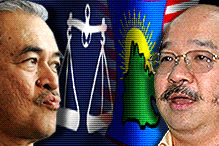 Yong believes the Sapp would come out stronger from this episode and that “although the road is bad, the destination is luxurious”. Sapp has only two MPs, Eric Enchin Majimbun (Sepanggar) and Dr Chua Soon Bui (Tawau).
Has Yong an axe of sorts to grind with the federal leadership, immediate past and present? He has been previously disqualified by an Election Court and left in the political wilderness for five years, and more recently, he was denied a seat for the March 8 general Election.
Apparently, Yong was later promised as a form of compensation, a seat in the senate and appointment as special envoy to the BIMP-Eaga region. There appears to have been much foot-dragging on these appointments which now Yong publicly dismisses as a bid to bribe him and this was swiftly denied by Musa Aman. Abdullah has since explained that the appointments, which Yong himself had apparently accepted, had to go through proper procedures and dropped a bombshell of his own when he charged in public that he “could not satisfy Yong’s personal greed”.
Mystery surrounds the apparent lack of urgency by Abdullah on these appointments. The mystery deepened further when Yong himself revealed in the local media that he received an urgent and confidential letter from the Prime Minister’s department on the eve of his June 18 press conference. He declined to go into details but speculation is rife that the letter was in a positive and re-assuring tone about the two appointments offered him. Yong, in any case, apparently decided it was too little, too late. He was not one to be kept stringing along forever.
 "I would like to tell them (KL) that what I want is not the Senator post but what is good for the rakyat in Sabah," Yong said at a public meeting in Likas three days after the no confidence pledge. "Had I accepted the post, I would have gained but what I am championing are the interests of the Sabah people and state and not for (my) personal sake.”
Corruption investigated
The Anti Corruption Agency has begun investigations, after testimony in court by a witness in the long-running corruption trial of ex-federal minister Kasitah Gaddam, that he was asked by Yong as chief minister in 1996 to pay out RM5 million from the sale of shares belonging to a state-owned company to his selected agents. The ACA investigation may be an unfortunate coincidence, although it is certainly being played up by Sapp as an example of victimisation and the politics of revenge by the Abdullah Administration.
“ Biar putih tulang jangan putih mata. Apa guna ilmu dituntut kalau tidak berani mati (Better to be brave than to live in indignity)," he thundered at the Likas meet. "They want to slaughter the chicken and scare the monkeys. But mind you (pointing to himself) this is not an ordinary chicken, this is a fighting cock.”
Yong himself revealed in the media later that he told the Sapp supreme council meeting two days after the no confidence pledge that should he “be charged in court and jailed for whatever reason, they must continue the struggle”. It is evident that Yong is playing a high stakes game to which he is no stranger.
He has been previously credited with bringing about the downfall of the PBS Government in 1994 after the dissolution of the state assembly. He left with a substantial number of the party’s Chinese members and leadership despite having played kingmaker for a decade in the tussle of Bumiputera politics in the state. Ex-premier Dr Mahathir Mohamad ended the kingmaker role of Chinese state assemblymen in Sabah politics by rotating the chief minister’s post. The rotation was ended when PBS, which opposed the rotation, re-joined the coalition.
In the aftermath of the March 8 political tsunami when the opposition alliance surprisingly ended the ruling Barisan Nasional’s 50-year stranglehold on national politics, the situation in Sabah has come full circle and Yong senses a historical window of opportunity.
It was time to get into the balancing act again, one lost when the rotation system started and since then by the increasing marginalisation of the Chinese community in politics by the illegal immigrant influx allegedly entering the electoral rolls. Yong himself was stripped of the Likas seat because of illegals on the rolls. The Chinese, at the moment, have a tenuous hold on seven to nine state seats and four seats in Parliament.
Window of opportunity
In Yong’s own words, the historical window of opportunity was opened up by the March 8 political tsunami which swept Peninsular Malaysia and was fast closing.
 “If not for Sabah and Sarawak, the BN would not form the federal government. The window of opportunity closes by August after which Sabah would be forgotten again,” says Yong. “The nation’s attention would switch to the MCA and Umno elections, people will be pre-occupied with the fasting month, Hari Raya, school exams and year-end events. Political fatigue in the national mainstream over Sabah issues would set in. We don’t want to wait another 50 years.”
Yong sees a loss of momentum after August in resolving several serious issues viz.
1) 20 per cent oil royalty against 5 per cent now. (Under the Production Sharing Contract, the oil contractor retains 70 per cent as cost oil with the remainder 30 per cent shared equally with Malaysia. The country’s 15 per cent is shared according to a 2 : 1 ratio with the oil state concerned. Hence, 5 per cent.);
2) The return of the federal territory of Labuan to Sabah. The island would be administered as a special zone;
3) Unfair federal laws, excessive taxes and structural imbalances in the economy;
4) Sabah subservience to the federal leadership as the poorest state;
5) Labuan bridge, poverty eradication and rural development;
6) Racial politics and wasteful monopolies;
7) Continuing illegal immigration, street kids, illicit drugs and rampant crime; and
8) Under-staffed and under-resourced enforcement agencies.
Sapp’s stand is by no means unanimous. The supreme council remains divided on the no-confidence motion and related issues, according to insiders. Sapp deputy president and Deputy Chief Minister Raymond Tan, himself has publicly distanced himself from the party’s stand. Sepanggar MP Majimbun says that he has not decided whether to vote for a no confidence motion against the prime minister and needs to “think about it”.
Generally, the thinking in the business community is that the current food and energy crisis is worse than the 1997-98 financial crisis from which Malaysia took five years to recover. “High fuel prices have brought about stagnation in the business sector,” is a common lament in Kota Kinabalu. “Unemployment and social problems will rise. But the Federal Government’s responses seem ad hoc, flip flop, lacking in foresight, with a fire-fighting style.”
The consensus of views within the political mainstream of Sabah is that, “we can no longer tolerate the insensitive attitude of the BN federal government towards Sabah issues which are real and serious issues”.
 “BN MPs in Sabah will leave the coalition if the federal government is not fair to the people of the state,” warns MP Anifah Aman (Kimanis), a younger brother of Musa, who declined re-appointment as a deputy federal minister. Anifah adds that he has known Yong well since their student days in London and as members of the Sabah Students Association in that city. “Giving Yong a post (in government) will not solve anything. In fact, without a post, he can express himself better as a Sapp president.” Anifah didn’t say whether the two posts offered Yong was as alleged ‘a move to shut his mouth’.
Minister kills any hope
The 20 per cent oil royalty claim, in particular, may prove an intractable issue unless the federal government cuts its share to 5 per cent and the oil contractors pare their cost oil portion to less than 70 per cent. In short, it means a review of the current Production Sharing Contracts with Petronas, Shell, Exxon and others. Federal Minister Nazri Aziz, killed off any hope of a review of the petroleum royalty for the oil producing states of Sabah, Sarawak and Terengganu by declaring on May 13 that “the oil royalty shall remain at 5 per cent”. The thinking behind the 20 per cent oil royalty claim is that the extra billions will help the state insulate itself against external shocks, particularly the food and energy crisis, and provide enough resources to invest in agriculture, education, capacity-building and achieve self-sufficiency in many other areas.
 “There are times in the affairs of men, which if taken at the tide, will lead on to fortune,” says Sabah PKR deputy chief, Dr Jeffrey Kitingan, quoting Shakespeare. “Sabah and Sarawak, for the first time, hold the powerful key for the survival of the current so-called BN but Umno-controlled federal government. That same key can also open the door for a new PKR-led Pakatan Rakyat federal government.”
Jeffrey refers to the current political situation as a window of golden opportunity. “The good MPs cannot go against their deepest conscience and let the window of golden opportunity slip through their fingers and regret forever how we have missed the offer for change and gain,” warns Jeffrey. “If they do, history will definitely record them as traitors of Sabah, instead of being sung as unforgettable heroes.”
“Turning that fateful key will effectively reverse the whole political equation into the greatest political achievement since independence.”
Sarawak BN wrestles with a dilemma all its own and faces an opposition onslaught at the forthcoming state elections unless it steers a neutral stance at the federal level and makes common cause with Sabah BN. At press time, Sarawak Chief Minister Abdul Taib Mahmud reiterated his call to Sarawakians to reject outsiders who want to turn Sarawak into their political pawns which could be sacrificed for their political goals and aspirations.
“Sarawakians must not be sacrificed like fighting cocks which could die due to the poison in the spurs placed by others,” warned Taib in Limbang when officiating at the closing of Gawai Dayak with a ngiling tikai ceremony at the Civic Centre. Political observers read Taib’s statement both ways, favouring neither the BN nor Pakatan Rakyat.
MPs in Sabah and Sarawak are not caught between the devil and the deep blue sea, the known devil and the unknown angel but, in the words of a senior political analyst, between the frying pan (federal BN) and the fire (opposition alliance). “MPs in Malaysian Borneo should not go from the frying pan into the fire,” cautions the analyst.
“The opposition alliance, just like the federal BN, may not fulfill their electoral promises to us if they form the federal government. It’s better to steer between these two blocs in Parliament.”
JOE FERNANDEZ is an educationist, a former newspaper editor and ex-civil servant.


Report this comment
Are you sure you want to delete this comment?
This action cannot be undone.